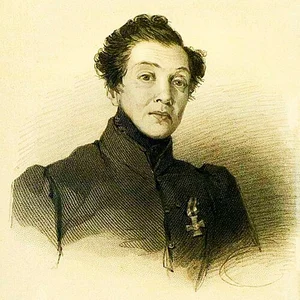

Nadezhda Durova was a Russian cavalrywoman who disguised herself as a man to enlist in the imperial army. She fought in the Napoleonic Wars, notably during the 1812 campaign, and became a decorated officer before publishing her memoirs.
Nadezhda Durova
Nadezhda Andreyevna Durova
5 min read
Frequently asked questions
Key Facts
- Born in 1783 in the Russian Empire, died in 1866
- Enlists in 1806 disguised as a man under a male identity in the cavalry
- Takes part in the campaigns against Napoleon, including the Battle of Borodino in 1812
- Receives the Cross of Saint George from the hands of Tsar Alexander I, who authorizes her to serve as an officer
- Publishes her memoirs, “The Cavalry Maiden”, in 1836, praised by Pushkin
Works & Achievements
An autobiographical account of her years in the army, praised by Pushkin. It is one of the first major works of military memoirs written by a woman in Russia.
Nearly ten years of service as a cavalryman and then officer in the Napoleonic Wars, an unprecedented feat for a woman in the Russian imperial army.
An act of bravery in combat that earned her the Cross of Saint George from the tsar's own hands, illustrating her officially recognized courage.
After leaving the army, Durova wrote several short stories and tales, pursuing a career as a writer in Russian literary magazines.
Engaged in the major battles against the Grande Armée, including Borodino, she took part in the defense of Russian territory.
Anecdotes
Around 1806, Nadezhda Durova cut her hair, put on a Cossack uniform, and left the family home on her name day to join the army. She introduced herself under a man's name, and at first no one suspected that a young woman was hiding behind the cavalryman.
Her secret was eventually discovered when her father, worried by her disappearance, wrote to the authorities. The affair reached Tsar Alexander I himself, who, impressed by her courage, exceptionally allowed her to remain in the army and gave her the name Alexandrov, inspired by his own.
To reward her for saving a wounded officer on the battlefield, the Tsar awarded her the Cross of Saint George, one of the highest Russian military distinctions. She thus became one of the very few women of her time decorated for feats of arms.
During the 1812 campaign against Napoleon's Grande Armée, she served as a cavalry officer and took part notably in the fighting around the Battle of Borodino (the Moskva), where she was wounded in the leg.
Having become a writer after her military career, she published her memoirs, which the writer Alexander Pushkin encouraged and brought to print. All her life, she continued to wear men's clothing and to sign her name as Alexandrov.
Primary Sources
Freedom, that treasure so precious to all — to me alone have you at last been given? I felt with delight this freedom that I had not dared to dream of before.
With indescribable wonder and interest I read these memoirs: the freshness of the style and the simplicity of the narrative make it a remarkable work.
In consideration of her exceptional courage, she is granted permission to remain in service under the name Alexandrov.
Key Places
Town in the Russian Empire where Durova spent part of her youth, her father being a civil servant there. She lived there before running away to enlist.
Village west of Moscow, scene of the great battle of 1812 between the Russians and the French. Durova fought there and was wounded.
Imperial capital where Durova was received by Tsar Alexander I, who allowed her to remain in the army. The center of Russian power at the time.
Town in present-day Tatarstan where Durova spent her final years and died in 1866. She is buried there and a museum is dedicated to her today.
Regions where the 1807 campaigns against Napoleon took place. Durova saw her first action there as a young cavalrywoman.