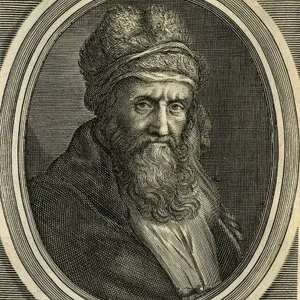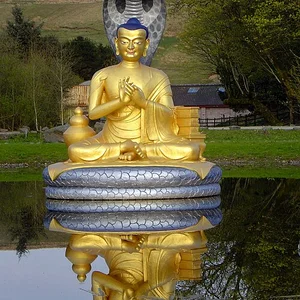

Indian Buddhist philosopher and monk of the 2nd–3rd century CE, founder of the Madhyamaka school. He developed the concept of śūnyatā (emptiness) and had a major influence on Mahāyāna Buddhism.
Nāgārjuna(150 — 250)
Nāgārjuna
7 min read
Frequently asked questions
Key Facts
- c. 150–250 CE: life and activity of Nāgārjuna in southern India
- Founding of the Madhyamaka philosophical school (the "Middle Way")
- Composition of the Mūlamadhyamakakārikā, his central philosophical work
- Development of the concept of śūnyatā (the emptiness of all phenomena)
- Lasting influence on Tibetan, Chinese, and Japanese Buddhism
Works & Achievements
Nāgārjuna's philosophical masterpiece in 448 verses, which establishes the Mādhyamika school. Through relentless dialectical reasoning, he demonstrates that all phenomena are empty of inherent existence (śūnyatā).
A text in verse and prose in which Nāgārjuna responds to critiques of his theory of emptiness. He clarifies that his own thesis is likewise empty, which makes it logically self-consistent.
A philosophical and political letter addressed to a Sātavāhana king, setting out the ethical principles of Mahāyāna Buddhism as applied to governance. It is one of the rare texts in which Nāgārjuna addresses a layperson.
A short verse treatise developing the doctrine of emptiness as applied to the fundamental categories of existence and time. It complements and deepens the arguments of the Mūlamadhyamakakārikā.
A treatise in 60 verses on the logic of emptiness and the nature of liberation (nirvāṇa). Nāgārjuna argues that the distinction between saṃsāra and nirvāṇa is itself empty of substance.
A vast multi-volume commentary on the Prajñāpāramitā sūtras, preserved in Chinese translation by Kumārajīva. Its attribution to Nāgārjuna remains a subject of debate among modern scholars.
Anecdotes
According to Buddhist tradition, Nāgārjuna discovered the Prajñāpāramitā sūtras ('Perfection of Wisdom') in the kingdom of the nāgas — divine serpents who had been guarding them since the time of the Buddha. This legend reflects how revolutionary his followers considered his teachings to be.
Nāgārjuna carried on a philosophical and political correspondence with a king of the Sātavāhana dynasty, most likely Gautamīputra or his successor. He addressed to him a letter known as the Ratnāvalī ('Garland of Jewels'), in which he advised the king to govern with compassion and wisdom rather than by force.
According to Tibetan and Chinese sources, Nāgārjuna was credited with mastery of metallurgical chemistry and alchemy (rasāyana). Some texts attribute to him the ability to transmute metals, illustrating the close relationship between philosophy, medicine, and natural science in ancient India.
His major work, the Mūlamadhyamakakārikā, contains 448 verses arranged in 27 chapters in which he systematically deconstructs every category of thought through rigorous dialectical reasoning. This method, known as prasaṅga (reduction to absurdity), confounded both his Brahmanical and Buddhist philosophical opponents.
Nāgārjuna is venerated as a 'second Buddha' in Tibetan, Chinese, and Japanese traditions. He is considered the spiritual forefather of several major schools — Mādhyamika, Zen (Ch'an), Tendai, and Shingon — making him one of the most influential figures in the entire history of Buddhism.
Primary Sources
Nothing exists by its own nature (svabhāva) — not here, not there, not in causes, not in conditions, not in their combination, nor in their absence.
As long as you have not attained enlightenment, the welfare of the world depends on you. Therefore, rule with righteousness, free from arrogance and with compassion for all beings.
If all things are empty, your own words are empty too, and they therefore cannot refute anything. — To this I reply: my proposition is itself empty, and that is precisely why it refutes without relying on any intrinsic nature.
Existence, non-existence, both existence and non-existence, neither one nor the other: these are the four positions that the Buddha declared false for all things.
Perfect wisdom sees that all dharmas are like dreams, like illusions, like reflections in a mirror: they have neither true arising nor true cessation.
Key Places
A major archaeological site in present-day Andhra Pradesh, associated with the Nāgārjuna tradition. This Buddhist monastic center, flourishing in the 2nd–3rd centuries CE, bears witness to the spread of his teachings across southern India.
A great Buddhist monastic university of which Nāgārjuna is considered one of the founding abbots according to Tibetan tradition. The site became the intellectual heart of Mahāyāna Buddhism for several centuries.
Capital of the Sātavāhana dynasty and a major Buddhist center of the Deccan, adorned with a celebrated richly carved stūpa. Nāgārjuna is said to have spent time in this region and maintained close ties with the royal court.
A sacred mountain identified with Śrīśailam in Andhra Pradesh, where Nāgārjuna is said to have lived for an extended period and composed several of his major works. Buddhist tradition regards it as his favored place of retreat.
Typical Objects

An essential object for Buddhist monks, the alms bowl symbolizes dependence on lay donors and detachment from material possessions. Nāgārjuna, as a monk, performed the daily alms round (piṇḍapāta) carrying this bowl.

An ochre or saffron-colored garment worn by Buddhist monks, made from several pieces of cloth stitched together. It represents renunciation of the world and membership in the monastic community (saṅgha).

The traditional writing medium of ancient India, used to record philosophical and religious texts. Nāgārjuna's works were inscribed on prepared palm leaves bound together into manuscripts.

A long wooden staff carried by wandering monks for travel and as a symbol of their renunciant status. It also served as support during long journeys between monasteries and during public debates.

A bell used during Buddhist ceremonies to mark key moments in meditative practice and recitations. In the Tantric Buddhism influenced by Nāgārjuna, it symbolizes wisdom (prajñā).

Scrolls or palm-leaf manuscripts containing the sūtras of the 'Perfection of Wisdom.' According to tradition, Nāgārjuna recovered and popularized these texts, establishing them as the doctrinal foundation of Mahāyāna Buddhism.
School Curriculum
Vocabulary & Tags
Key Vocabulary
Daily Life
Morning
Nāgārjuna rose before dawn to meditate in silence, then joined the other monks for collective recitations of sūtras. He would shave his head and put on his ochre robe before taking part in the alms round through nearby villages.
Afternoon
After the main meal taken before noon — the only substantial meal of the day — Nāgārjuna devoted his afternoons to teaching and philosophical debate with his disciples. He would dictate or compose his treatises on palm leaves, engaged in careful logical inquiry.
Evening
In the evening, Nāgārjuna led study sessions on canonical texts and answered his disciples' questions. After a brief period of meditation at sunset, he observed the monastic rule of silence and rested on a simple mat.
Food
Nāgārjuna followed the strict vegetarian diet of Buddhist monks: rice, legumes (lentils, peas), cooked vegetables, fruit, and curdled milk collected during the alms round. He ate only once a day, before noon, in keeping with the monastic rule of the Vinaya.
Clothing
He wore the kāṣāya, a three-piece set of cloth dyed ochre or saffron and assembled according to Vinaya rules: an undergarment (antaravāsaka), an upper robe (uttarāsaṅga), and an outer cloak (saṃghāṭī). He walked barefoot or in wooden sandals within the monastery.
Housing
Nāgārjuna lived in a monastic cell (vihāra) made of stone or brick, simply furnished with a mat, a small altar, and palm-leaf manuscripts. The monastery was organized around a central courtyard with a stūpa, assembly halls, and gardens.
Historical Timeline
Period Vocabulary
Visual Style
Style inspiré des reliefs sculptés d'Amarāvatī et Nāgārjunakoṇḍa : teintes ocre et safran, végétation tropicale, architecture monastique en pierre finement ornée.
Sound Ambience
Atmosphère d'un monastère bouddhiste du sud de l'Inde au IIe siècle : chants en sanskrit, clochettes rituelles, bruissement de feuilles de palme et pluie tropicale.
Liens externes & ressources
Références
Œuvres
Mūlamadhyamakakārikā (Stances fondamentales sur la Voie du milieu)
vers 150-200 apr. J.-C.
Vigrahavyāvartanī (Réfutation des objections)
vers 150-200 apr. J.-C.
Ratnāvalī (Guirlande de joyaux)
vers 150-200 apr. J.-C.
Sūnyatāsaptati (Soixante-dix stances sur la vacuité)
vers 150-200 apr. J.-C.
Yuktiṣaṣṭikā (Soixante stances sur le raisonnement)
vers 150-200 apr. J.-C.
Mahāprajñāpāramitāśāstra (Grand traité de la perfection de la sagesse)
vers 200 apr. J.-C.