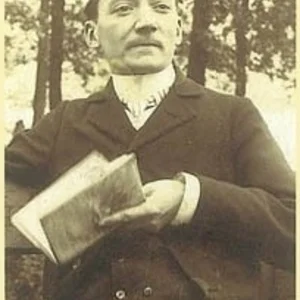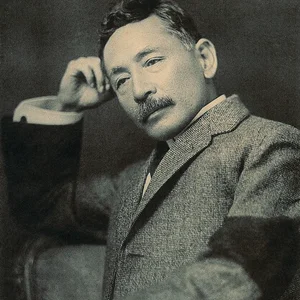

Natsume Sōseki is one of the greatest Japanese novelists of the Meiji era. A specialist in English literature, he portrays with irony and melancholy a Japanese society torn between tradition and Western modernization.
Natsume Soseki(1867 — 1916)
Natsume Sōseki
Japon
6 min read
Frequently asked questions
Famous Quotes
« I am a cat. As yet I have no name.»
Key Facts
- Born in 1867 in Edo (the future Tokyo), shortly before the Meiji Restoration
- Stays in London to study English literature (1900-1902)
- Publishes his first novel, I Am a Cat, in 1905
- Releases Botchan (1906) and then Kokoro (1914), among his major works
- Dies in 1916 in Tokyo, celebrated as a major figure of Japanese letters
Works & Achievements
A satirical novel narrated by a cat who observes Japanese intellectuals with irony. Sōseki's first work, an immediate success.
A funny, biting tale of a naive and impulsive young teacher in the provinces. One of the most widely read novels in Japan.
A poetic novel in which a painter seeks beauty far from society. A meditation on art and serenity.
A coming-of-age novel about a provincial student discovering Tokyo and the modern world.
The story of an idle man torn between desire and morality, a critical portrait of Meiji society.
A novel about a humble couple eaten away by remorse, in an atmosphere of introspection and restraint.
A masterpiece on guilt, loneliness, and the end of the Meiji era. Often regarded as his greatest novel.
A psychological novel left unfinished at his death, a meticulous exploration of selfishness within a marriage.
Anecdotes
The writer's real name was Natsume Kinnosuke. He chose the pen name “Sōseki,” drawn from a Chinese expression (“to rinse one's mouth with stones and use the current as a pillow”) that refers to a stubborn person who refuses to admit their mistakes. It was an ironic way of laying claim to his own obstinate character.
Born the youngest of a large family, little Kinnosuke was placed with an adoptive family right after his birth, then shuffled between several households throughout his childhood. This feeling of loneliness would deeply mark his novels.
In 1900, the Meiji government sent him to London to study English. Isolated, short of money, and depressed, he shut himself away in his room to read; a rumor even spread back in Japan that “Natsume has gone mad.” He returned two years later, profoundly changed.
At the Imperial University of Tokyo, Sōseki succeeded the famous writer Lafcadio Hearn as a professor of English literature. At first, his students missed their former teacher and gave him a cold welcome.
His first novel, “I Am a Cat,” came about almost by chance: a short piece written for a haiku magazine, told from the point of view of a mocking cat. Its success was so great that in 1907 Sōseki gave up his prestigious university chair to become a full-time writer for the Asahi newspaper.
From 1984 to 2004, Natsume Sōseki's face, recognizable by his moustache, appeared on the 1000-yen banknote, proof of his immense place in Japanese culture.
Primary Sources
I am a cat. As yet I have no name.
Ever since I was a child, the recklessness I inherited from my parents has brought me nothing but trouble.
We who were born into this modern age, so full of freedom, independence, and self-interest, must each, in return, taste this loneliness.
Key Places
Sōseki's birthplace, where he lived, wrote his great novels, and died. The capital embodies a Japan undergoing profound change during the Meiji era.
Sōseki stayed here from 1900 to 1902 to study English literature. This lonely and difficult experience shaped his reflections on modernity and the West.
Sōseki taught English literature here after succeeding Lafcadio Hearn, before leaving it all behind to devote himself to writing.
A small town on the island of Shikoku where Sōseki was a middle school teacher. His stay there inspired the setting of the novel “Botchan”.
A city in southern Japan where he taught at the higher school and where he married. It was from here that he departed for London.
A hot spring resort where, in 1910, Sōseki nearly died from a hemorrhage caused by his ulcer. This episode profoundly changed his view of life and death.
Typical Objects

Traditional instruments of Japanese writing, with which Sōseki composed his texts and practiced calligraphy and haiku.

Gridded sheets where each box holds a single character, used by Japanese writers to compose novels and articles for newspapers.

A major Japanese daily in which Sōseki published his novels as serialized installments, read every day by thousands of people.

Works by Shakespeare and British authors that Sōseki studied and taught, a symbol of Meiji Japan's opening to Western culture.

Traditional Japanese garment that Sōseki wore at home, while he donned Western dress for his university duties.

Along with his mustache, the small glasses are part of the familiar image of the writer, an intellectual and avid reader.
School Curriculum
Vocabulary & Tags
Key Vocabulary
Daily Life
Morning
Having become a writer for the Asahi newspaper, Sōseki worked to a steady rhythm: he devoted his mornings to writing his serial novels, in his study filled with books, in front of his sheets of squared paper.
Afternoon
In the afternoon, he read a great deal, especially English authors, composed haiku and practised calligraphy. He also received mail and visitors who came seeking advice.
Evening
On Thursday evenings, his house opened up to his young disciples during famous gatherings (the “Thursday Circle”), where literature was discussed; young writers such as Akutagawa Ryūnosuke made their debuts there.
Food
His cooking remained largely Japanese (rice, miso soup, fish), but Sōseki had a great weakness for sweets and jam, which he consumed in abundance. His stomach ulcer, however, forced him to watch what he ate.
Clothing
At home, he wore the traditional kimono; for his lectures and public outings, he donned Western-style European dress, mirroring Meiji Japan caught between two worlds.
Housing
He lived in Tokyo in a classic Japanese house, with tatami mats and sliding partitions, where his study held a central place. His home, nicknamed the “Sōseki Sanbō”, was a venue for literary gatherings.
Historical Timeline
Period Vocabulary
Liens externes & ressources
Références
Œuvres
Je suis un chat (Wagahai wa neko de aru)
1905
Oreiller d'herbes (Kusamakura)
1906
Sanshirō
1908
Et puis (Sorekara)
1909
La Porte (Mon)
1910
Le Pauvre cœur des hommes (Kokoro)
1914