 flip
flipUmphokoqo with amasi (crumbly maize, fermented milk)
Umphokoqo with amasi (crumbly maize, fermented milk)
Why this dish? This is the taste of Mandela's childhood, herding cattle in the hills of Qunu: crumbled maize porridge drowned in amasi, the thickened, sour milk from calabashes. He described it all his life as the flavor of home.
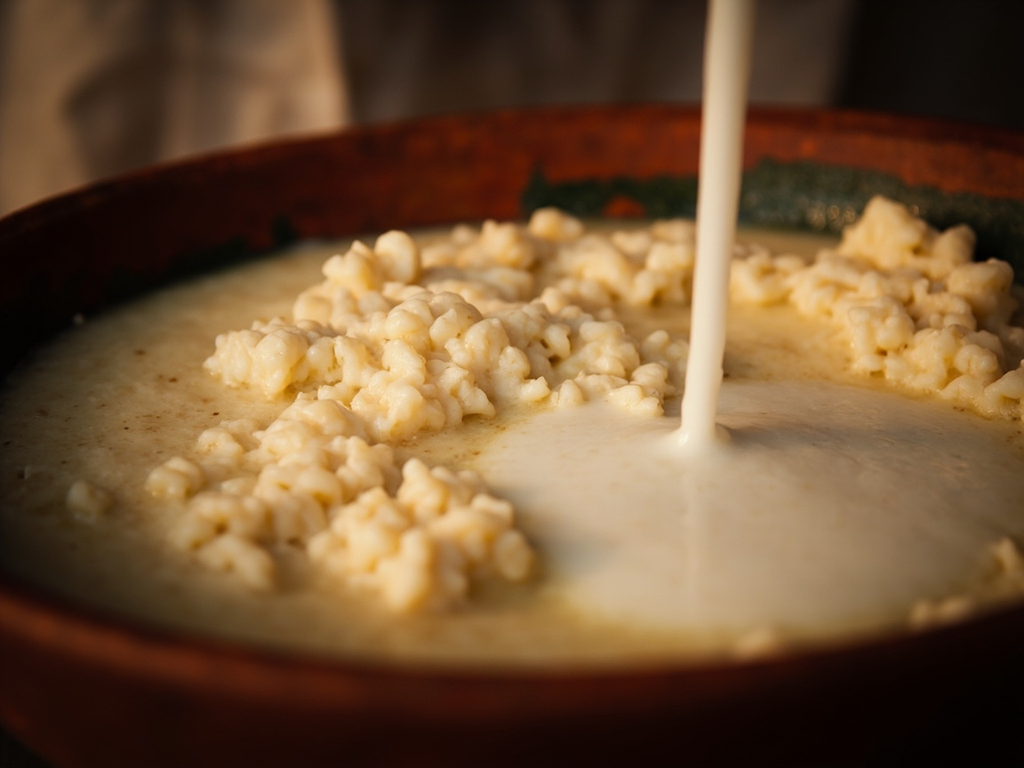
A maize porridge cooked quite dry then worked until granular and crumbly, drizzled with fresh, tangy fermented milk (amasi). Sweet and sour at once, it is the ultimate Xhosa comfort food, eaten by hand.
When I was small, in Qunu, I would lead the calves in the hills and already dream of evening: my mother would crumble the cooked maize with her fingertips until it was like sand, then pour the amasi from the calabash, that thick, slightly sour milk that nothing can replace. You eat it with your fingers, believe me, never with a spoon — otherwise it is no longer quite umphokoqo. Even today, that bittersweet taste brings me back home more surely than any speech.
- •White maize meal — two large cups (base)
- •Water — as needed for texture (cooking)
- •Amasi (curdled milk in calabash) — as much as you like (tangy sauce)
- •Pinch of salt — a little (seasoning)
Umphokoqo with amasi (crumbly maize, fermented milk)
A maize porridge cooked quite dry then worked until granular and crumbly, drizzled with fresh, tangy fermented milk (amasi). Sweet and sour at once, it is the ultimate Xhosa comfort food, eaten by hand.
Why this dish? This is the taste of Mandela's childhood, herding cattle in the hills of Qunu: crumbled maize porridge drowned in amasi, the thickened, sour milk from calabashes. He described it all his life as the flavor of home.
When I was small, in Qunu, I would lead the calves in the hills and already dream of evening: my mother would crumble the cooked maize with her fingertips until it was like sand, then pour the amasi from the calabash, that thick, slightly sour milk that nothing can replace. You eat it with your fingers, believe me, never with a spoon — otherwise it is no longer quite umphokoqo. Even today, that bittersweet taste brings me back home more surely than any speech.
Ingredients (period version)
- White maize meal — two large cups (base)
- Water — as needed for texture (cooking)
- Amasi (curdled milk in calabash) — as much as you like (tangy sauce)
- Pinch of salt — a little (seasoning)
Ingredients
- White maize meal — 250 g (base)
- Water — about 600 ml (cooking)
- Amasi (or substitute: buttermilk, kefir, or plain drinking yogurt) — 300 ml (tangy sauce)
- Salt — 1 pinch (seasoning)
Method
- Bring salted water to a boil in a heavy-bottomed pot.
- Sprinkle in the maize meal without stirring, cover, and let swell for 5 minutes.
- Stir vigorously with a wooden spoon, cover, and cook over very low heat for 20-25 minutes: the porridge should be firm.
- Using a fork (or clean fingers, in the traditional way), crumble the still-warm mass into dry, friable lumps.
- Divide into bowls and generously drench with well-chilled amasi just before eating.
How it was made : Amasi was made by letting raw milk thicken and sour in a calabash (iselwa), sometimes for several days: a natural preservation method long before refrigerators. Each family had its own calabash, whose ferments gave the milk a unique flavor.
The contemporary twist : Served in a bowl as a "grain bowl," with amasi poured at the table in front of the guest — the warm/cold and sweet/sour contrast always surprises palates used to sweet porridges.
Sources : Anna Trapido, Hunger for Freedom (2008) · Nelson Mandela, Long Walk to Freedom (1994)
Nelson Mandela · Charactorium