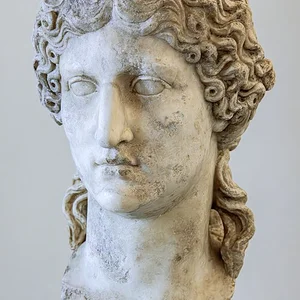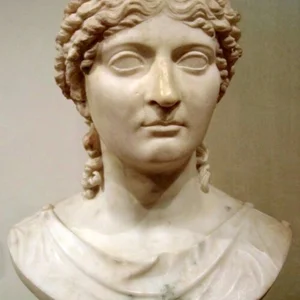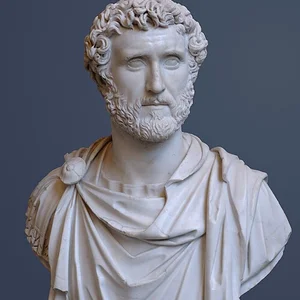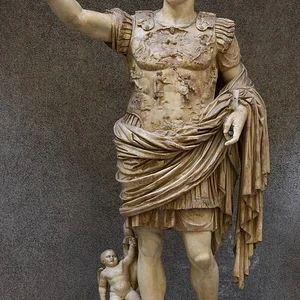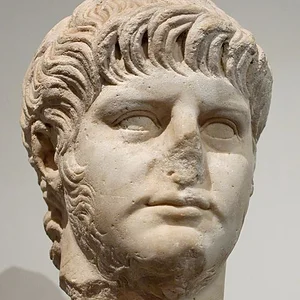

The fifth Roman emperor from 54 to 68, Nero is known for a reign marked by persecutions of Christians and the Great Fire of Rome in 64. The last representative of the Julio-Claudian dynasty, he consolidated imperial power against the Roman aristocracy.
Nero(37 — 68)
Nero
Rome antique
7 min read
Frequently asked questions
Key Facts
- Accession to the throne in 54 following the death of Claudius
- Great Fire of Rome in 64, from which Nero allegedly benefited to rebuild the city according to his own plans
- Systematic persecution of Christians from 64 onwards, holding them responsible for the fire
- Construction of the Domus Aurea (Golden House), a vast imperial palace
- Suicide in 68 in the face of a legionary revolt, bringing the Julio-Claudian dynasty to an end
Works & Achievements
Revolutionary palatial complex featuring major architectural innovations, including an octagonal domed hall. Rediscovered during the Renaissance, it inspired artists such as Raphael.
Epic poem on the Trojan War composed by Nero, of which a few fragments are quoted by ancient authors. It reflects his literary ambitions, which were mocked by his contemporaries.
Nero reduced the precious metal content of coins (the aureus and denarius), the first known Roman monetary devaluation, in order to finance his expenditures and the reconstruction of Rome.
Nero had Rome rebuilt with wider streets, porticoes, and fire-resistant materials. This modern urban planning scheme lastingly transformed the layout of the city.
Quinquennial competitions inspired by the Greek Games, encompassing music, poetry, and rhetoric. Nero participated himself and invariably won first prize.
Following the Great Fire of Rome, Nero accused the Christians of being responsible and organized their persecution. It was during this episode that, according to tradition, the apostles Peter and Paul were martyred.
Anecdotes
Nero was so passionate about music and poetry that he performed on stage before the Roman public, which scandalized the aristocracy. According to Suetonius, his dying words were: "What an artist dies with me!"
During the Great Fire of Rome in July 64, a popular legend — probably false — claimed that Nero played the lyre while watching the city burn. In reality, he was at Antium and quickly returned to organize relief efforts.
Nero had the Domus Aurea built, a gigantic palace covering 300 hectares in the heart of Rome following the fire of 64. At its entrance stood a colossal 30-meter statue depicting him as the Sun god, the Colossus of Nero, which later gave its name to the nearby Colosseum.
To eliminate his own mother Agrippina the Younger, Nero reportedly first attempted to drown her by sinking the boat she was travelling on. Agrippina survived by swimming, and Nero ultimately sent assassins to her home in 59 AD.
Nero organized the Neronia Games in 60 AD, a competition inspired by the Greek Games including poetry, singing, and rhetoric — disciplines he himself practised. These games, very popular in Greece, were perceived as a shocking eccentricity in Rome.
Primary Sources
He never ceased to practice singing and music, and he took as his teacher Terpnos, the most celebrated cithara player of the time. He would listen to him every day after dinner singing until late into the night.
Rome then fell prey to a disaster unmatched in violence by any other conflagration… Nero was at Antium at the time; he did not return to Rome until the fire was approaching the house he had built to connect the Palatine to the Esquiline Hill.
Nero always carried an emerald cut as a concave mirror, through which he watched gladiatorial combats.
I was delivered from the mouth of the lion — a passage traditionally interpreted as a reference to the tribunal of Nero before which Paul is said to have appeared.
Nero, abandoned by all, fled on foot disguised as a slave and made his way to the villa of a freedman named Phaon, where he put himself to death by stabbing himself in the throat.
Key Places
Colossal palace built after the fire of 64, stretching across the Palatine, Esquiline, and Caelian hills. A symbol of Nero's excess, it was buried under the constructions of his successors.
Great circus where chariot races were held. Nero had himself competed there, outraging Romans who considered such activities unworthy of an emperor.
Nero's birthplace on the Tyrrhenian coast, where he owned a villa and where he was staying during the great fire of Rome in 64.
In 67, Nero personally inaugurated the construction of a canal across the isthmus — a project abandoned at his death and only completed in 1893. It symbolizes his admiration for Greek culture.
Traditional residence of the Roman emperors. Nero had his apartments there before the construction of the Domus Aurea, and it was from the Palatine that he governed the empire.
Typical Objects

A stringed instrument from ancient Greece that Nero learned to play with passion. He performed publicly with this instrument, which was considered unworthy of a Roman emperor.

Nero used a polished emerald as a monocle to watch gladiatorial combat, the earliest known example of a corrective optical instrument in Antiquity.

A ceremonial garment embroidered with gold, reserved for triumphant generals and later emperors. Nero wore it during major public ceremonies to assert his power.

Nero performed in the theatre wearing masks representing mythological heroes. He is reported to have played female roles, which horrified traditional Romans.

Common writing tools of the 1st century, which Nero used to compose his poems. According to Tacitus, he recited his verses in public and had them compiled by his scribes.

Imperial tableware was made of solid gold, a symbol of the empire's wealth. Nero's banquets were famous for their extravagant opulence and length, sometimes lasting all night.
School Curriculum
Vocabulary & Tags
Key Vocabulary
Daily Life
Morning
Nero rose late, after nights often prolonged by banquets or musical performances. He would first receive his closest advisors and freedmen in his private apartments, then grant a formal audience to senators and ambassadors.
Afternoon
The afternoon was devoted to physical exercise (horse riding, wrestling), musical rehearsals with his cithara masters, or presiding over the games at the Circus Maximus and the amphitheater. He was also interested in chariot racing and practiced it privately.
Evening
Nero's evenings were famous for their extravagance: endless banquets on barges floating across the ponds of the Domus Aurea, with music, dancing, and poetry recitals. He would perform his own singing before his guests, who were not permitted to leave.
Food
The imperial table offered the most refined dishes from across the empire: fish from Spain, oysters from Britannia, spices from the Orient, wines from Greece and Campania. Nero was known for his dietary excesses but also for periods of relative asceticism under the Stoic influence of Seneca.
Clothing
Nero wore the white toga edged with purple (toga praetexta) for official ceremonies, and the purple and gold toga picta during triumphs. In private, he favored wearing loose Greek tunics (chiton) without a belt, which conservative Romans considered indecent.
Housing
Before the fire, Nero resided in the imperial palaces on the Palatine Hill. After 64 AD, he had the Domus Aurea built, featuring a rotating domed banquet hall mimicking the celestial vault, baths fed by seawater and sulfurous water, and vast gardens at the very heart of Rome.
Historical Timeline
Period Vocabulary
Visual Style
Le style visuel évoque la splendeur et la démesure de la cour impériale romaine du Ier siècle, avec ses décors dorés, ses mosaïques somptueuses et son clair-obscur dramatique aux reflets de torches.
Sound Ambience
L'ambiance sonore de la cour impériale de Néron mêle la musique de cithare, les bruits de foule du Circus Maximus et le crépitement des torches dans les couloirs en marbre de la Domus Aurea.
Liens externes & ressources
Références
Œuvres
Domus Aurea (Maison Dorée)
64-68 apr. J.-C.
Troica (poème épique)
vers 64 apr. J.-C.
Réforme monétaire
64 apr. J.-C.
Reconstruction de Rome après l'incendie
64-68 apr. J.-C.
Jeux Néroniens (Neronia)
60 et 65 apr. J.-C.
Persécution des chrétiens de Rome
64 apr. J.-C.