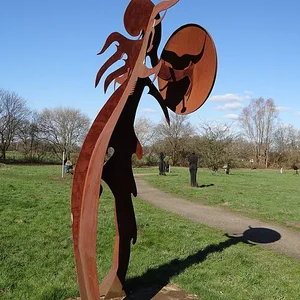

Nestis is a deity from Greek mythology associated with water, mentioned by the philosopher Empedocles (5th century BCE) as one of the four fundamental roots of the universe. Sometimes identified with Persephone, she personifies the element of water in Empedoclean cosmology.
Nestis
Nestis
7 min read
Frequently asked questions
Key Facts
- Mentioned by Empedocles in his philosophical poem “On Nature” (c. 450 BCE) as the personification of water
- One of the four “roots” (rhizomata) of the world according to Empedocles, alongside fire (Zeus), air (Hera), and earth (Hades)
- Associated with Sicily, Empedocles’ home region, where local water cults existed
- Sometimes identified with Persephone in the allegorical interpretation of gods as natural forces
Works & Achievements
The only ancient text to mention Nestis by name. This poetic fragment presents the four divine roots of the universe, making Nestis the sacred personification of water.
Empedocles' second major poem, religious and Orphic in character, in which deities intervene in the fate of souls and cycles of reincarnation — extending the cosmological universe in which Nestis takes her place.
A critical discussion of Empedocles' theory of the four elements. Aristotle analyzes the cosmological system in which Nestis is one of the four fundamental roots of all reality.
The primary source for the transmission of Empedocles' Fragment B6 mentioning Nestis. Without this Byzantine commentary, Empedocles' water deity might have been entirely lost.
The modern critical edition cataloguing all pre-Socratic fragments. Empedocles' Fragment B6, mentioning Nestis, is recorded and discussed here, making it accessible to all contemporary scholars.
Anecdotes
Empedocles of Akragas, a Sicilian philosopher of the 5th century BC, was the only ancient author to mention Nestis by name. In his cosmological poem, he places her alongside Zeus (fire), Hera (earth), and Hades (air) as one of the four “roots” of all things. It is thanks to this single poetic fragment that Nestis is known to us.
Nestis is often identified with Persephone, goddess of the Underworld and vegetation. This identification rests on the mention of her “tears” that “moisten the mortal springs” in Empedocles’ text, echoing the myth of Persephone weeping during her abduction by Hades into the depths of the earth.
The name “Nestis” is thought to be of Sicilian or Punic origin according to some ancient commentators, a reminder that Empedocles lived in Magna Graecia. He may thus have drawn on local religious traditions to name the elemental forces that, in his view, make up the entire universe.
In Empedocles’ system, the four roots — including Nestis — are neither created nor destroyed: they combine and separate under the influence of two opposing cosmic forces, Love (Philia) and Strife (Neikos). Nestis, as water, is present in every living being, invisible yet absolutely essential to life.
The philosopher Simplicius, in the 6th century AD, quoted in full the fragment of Empedocles mentioning Nestis in his commentary on Aristotle’s Physics, thereby preserving for posterity one of the rare surviving original texts of Empedocles. Without this late Byzantine commentator, the very name of Nestis might have vanished forever from human memory.
Primary Sources
“Hear first the four roots of all things: shining Zeus, life-bringing Hera, Hades, and Nestis who with her tears moistens the mortal springs.”
Simplicius quotes and transmits Empedocles' Fragment B6, clarifying that Nestis represents the element of water among the four fundamental roots of the cosmos.
Aristotle analyzes Empedocles' theory of the four elements and their divine names, describing the cosmological system within which the figure of Nestis belongs.
Diogenes Laërtius records biographical details about Empedocles and mentions his cosmological work, in which divine figures are used to designate the primordial elements of the universe.
Key Places
Birthplace of Empedocles, founded by Greek settlers in the 6th century BCE. It was here that Empedocles developed his cosmology and named Nestis as the watery root of the universe in his philosophical poems.
If Nestis is identified with Persephone, the Underworld is the domain she shares with Hades. Its infernal rivers — the Styx, Lethe, and Acheron — make the underworld a watery space laden with cosmological meaning.
Sanctuary of the Eleusinian Mysteries, sacred to Demeter and Persephone. If Nestis is a form of Persephone, Eleusis is the central holy site of her cult, where initiates gathered each year to celebrate the cycle of death and rebirth.
The mythical springs and rivers of Sicily, associated with local nymphs and water deities, form the cultural backdrop against which the figure of Nestis takes shape. The Acis illustrates the deep connection between water and the divine that was characteristic of Magna Graecia.
Typical Objects

Nestis is directly associated with freshwater springs. Empedocles describes her tears as feeding the "mortal springs," making her the guardian of all gushing waters and sacred fountains.

In Empedocles' fragment, Nestis "moistens mortal springs with her tears." These tears symbolize the generation and sustenance of life through water — a force at once gentle, fertile, and melancholic.

The *hydria*, a large Greek three-handled jar used to carry and store water, is the ritual object par excellence associated with water deities. As a personification of water, Nestis is naturally linked to it in cultic practice.

If Nestis is identified with Persephone, the pomegranate — symbol of passage between the world of the living and the dead — becomes a possible attribute, evoking the dual nature of water as both a source of life and a boundary between worlds.

Greek water deities are frequently associated with reeds growing along riverbanks. These plants symbolize the boundary between the terrestrial world and Nestis's watery domain.

Still or reflective water evokes the boundary between the visible and the invisible, a recurring motif in Mediterranean mythologies. For Nestis, this liquid mirror connects the world of mortals to that of the gods and the dead.
School Curriculum
Vocabulary & Tags
Key Vocabulary
Daily Life
Morning
In Empedocles' cosmological imagination, Nestis is present from dawn in every dewdrop and every spring that bubbles forth. She is the deity who moistens the world at daybreak, nourishing plants, humans, and animals with her vital and indispensable element.
Afternoon
Nestis animates waterways and public fountains (krenai) at the heart of the day. In Greek cities, these fountains were places of worship for nymphs and water deities. Nestis is symbolically present each time a woman comes to draw water for her family.
Evening
In the evening, water becomes a mirror: it reflects the moon and the stars, linking the human world to the cosmos. Nestis, much like Persephone, is a figure of passage — between day and night, between the visible and invisible world, between life and death.
Food
As a water deity, Nestis is honored through libations: wine mixed with water, oil, or honey poured in her name. Fish and seafood are symbolically linked to her in Sicilian cultic traditions, where fresh water and the sea come together.
Clothing
In Greek art, female aquatic deities are depicted wearing light robes in blue or transparent hues, evoking the movement and fluidity of water. If Nestis is identified with Persephone, she sometimes wears a crown of spring flowers, a symbol of the rebirth made possible by water.
Housing
The domain of Nestis is water itself: springs, rivers, lakes, and seas. If she is Persephone, she shares with Hades the palace of the Underworld, traversed by the mythical rivers Styx, Lethe, and Acheron. In Sicily, her cult sites are established near springs and sacred water sources.
Historical Timeline
Period Vocabulary
Liens externes & ressources
Références
Œuvres
Empédocle, Sur la Nature (Peri Physeos) — Fragment B6
c. 460 av. J.-C.
Empédocle, Les Purifications (Katharmoi)
c. 460 av. J.-C.
Aristote, Métaphysique
IVe s. av. J.-C.
Simplicius, Commentaire sur la Physique d'Aristote
VIe s. apr. J.-C.
Diels & Kranz, Die Fragmente der Vorsokratiker
1903 (1re éd.)