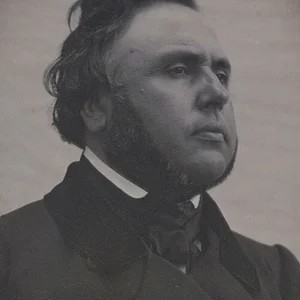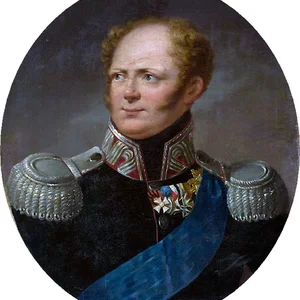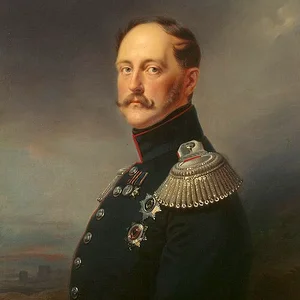

Nicholas I (1796-1855) was Emperor of Russia, King of Poland, and Grand Duke of Finland from 1825. An autocratic and conservative sovereign, he crushed the Decembrist revolt upon his accession and embodied a reactionary monarchy founded on order, orthodoxy, and nationality.
Nicholas I of Russia(1796 — 1855)
Nicholas I of Russia
Empire russe
6 min read
Frequently asked questions
Key Facts
- Ascends the throne in 1825 and immediately crushes the Decembrist revolt
- Establishes strict censorship and the political police of the Third Section
- Brutally suppresses the Polish uprising of 1830-1831
- Nicknamed the “gendarme of Europe” after his intervention against the Hungarian revolution in 1849
- Dies in 1855 during the Crimean War (1853-1856), which exposes Russia's backwardness
Works & Achievements
The first act of his reign: crushing the liberal officers laid the lasting foundation for his repressive, autocratic rule.
The establishment of a secret political police charged with surveillance, censorship, and hunting down opponents.
A vast codification of Russian law led by Speransky, which organized the whole body of the Empire's laws for the first time.
The official state ideology formulated by Minister Uvarov, the bedrock of the reign's conservative policy.
The crushing of the Polish revolt and the abolition of the kingdom's autonomy, binding it more tightly to Russia.
The dispatch of the Russian army to crush the Hungarian revolution on Austria's behalf, earning Nicholas the nickname “gendarme of Europe.”
The opening of the first major rail line connecting the two capitals, a rare instance of modernization under an otherwise conservative reign.
Anecdotes
Nicholas I was not supposed to become tsar: he was the third son of Paul I. But his eldest brother Alexander I died without an heir in 1825, and the other brother, Constantine, secretly renounced the throne. This confusion over the succession triggered the Decembrist revolt on the very day of his accession.
On 14 December 1825, liberal officers refused to swear allegiance to Nicholas and gathered their troops on Senate Square in Saint Petersburg. The new tsar ordered the cannons fired on the insurgents. Five ringleaders were hanged and hundreds deported to Siberia: Nicholas remained scarred for life by this fear of revolution.
Nicholas I was obsessed with military order and discipline. It is said that he liked to inspect his regiments personally and would correct the slightest misaligned button. His nickname throughout Europe was “the gendarme of Europe,” because he sent his army to crush revolutions, as in Hungary in 1849.
The tsar created the “Third Section,” a secret police force tasked with monitoring opponents and the press. Censorship was so strict that famous writers such as Pushkin were placed under Nicholas's personal surveillance, with the tsar himself acting as the censor of their texts.
Nicholas I died in 1855 in the midst of the Crimean War, while Russia was suffering heavy defeats against France and the United Kingdom. Some historians believe that, humiliated by these setbacks, he let himself die of pneumonia by refusing treatment.
Primary Sources
Orthodoxy, Autocracy, Nationality: these are the three fundamental pillars upon which the salvation and strength of Russia rest.
The conspirators, having made an attempt upon the sacred person of the Emperor and upon the order of the State, are condemned — the five ringleaders to death, the others to forced labour and exile in Siberia.
Russia is governed by the discipline of a military camp; all there is silence, but a silence that resembles that of the tomb rather than that of peace.
Emperor Nicholas had an imposing bearing; his steely gaze commanded obedience, and no one dared to meet his eyes for long.
Key Places
Capital of the Empire and the tsar's main residence. It was here, on Senate Square, that the Decembrist revolt of 1825 took place.
Official residence of the tsars and seat of imperial power in Saint Petersburg. Nicholas I governed here and received the court.
Site of the Decembrist uprising of 14 December 1825, crushed by artillery on Nicholas I's orders at the very start of his reign.
Imperial summer residence near Saint Petersburg, where the tsar's family stayed away from the capital.
Military port in Crimea besieged during the Crimean War, a symbol of Russia's military setbacks at the end of the reign.
Capital of the Kingdom of Poland, under Russian rule. The uprising of 1830-1831 was severely repressed there by Nicholas I.
Typical Objects

Nicholas I almost always wore his uniform, a symbol of his cult of discipline. He attended to every detail, from the cut to the decorations.

Insignia of the tsars' power, adorned with thousands of diamonds and a red spinel. It symbolized absolute autocracy.

Held during coronation ceremonies, they represented command and dominion over the Empire. The scepter bore the famous Orlov diamond.

Nicholas I ordered cannon fire on the Decembrists in 1825. Artillery was a central instrument for maintaining tsarist order.

A written document setting out strict rules for controlling the press and the written word. Censorship governed all intellectual life under Nicholas I.

Emblem of the imperial dynasty, present on flags, seals, and official buildings. It embodied the continuity of Russian autocracy.
School Curriculum
Vocabulary & Tags
Key Vocabulary
Daily Life
Morning
Nicholas I rose early and led a soldier's life. His morning began with a spartan wash and the examination of state affairs, for he wanted to control everything personally.
Afternoon
The afternoon was devoted to military inspections, troop reviews, and receiving ministers. The tsar also rode on horseback through the streets of Saint Petersburg to oversee public order.
Evening
In the evening, the imperial court held balls, concerts, and receptions at the Winter Palace. Nicholas enjoyed this splendor but remained committed to a strict, military etiquette.
Food
At the imperial table, a refined cuisine was served, blending Russian and French dishes: soups, game, Baltic fish, and pastries. The tsar himself, however, led a sober life and ate simply.
Clothing
Nicholas I almost always wore a military uniform, fitted and impeccable, adorned with decorations. For ceremonies, he donned the ceremonial robes of the autocrat: an ermine mantle and the imperial regalia.
Housing
He resided at the Winter Palace in Saint Petersburg, a vast baroque dwelling with hundreds of gilded halls. In summer, the imperial family withdrew to the palaces of Tsarskoye Selo and Peterhof, surrounded by vast gardens.
Historical Timeline
Period Vocabulary
Liens externes & ressources
Références
Œuvres
Répression de la révolte décembriste
1825
Création de la Troisième Section
1826
Recueil complet des lois de l'Empire russe
1832
Doctrine « Orthodoxie, Autocratie, Nationalité »
1833
Répression de l'insurrection polonaise
1831
Intervention en Hongrie
1849
Développement du chemin de fer Saint-Pétersbourg–Moscou
1851