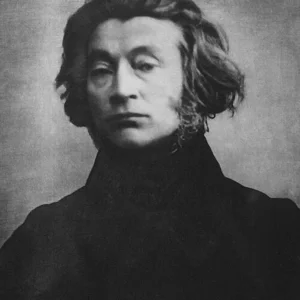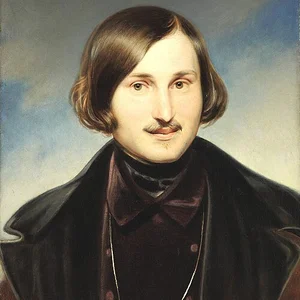

Russian writer and playwright of Ukrainian origin, a major figure of 19th-century Russian literature. A master of satirical realism and the grotesque, he denounced the failings of society and of the imperial Russian administration.
Nikolai Gogol(1809 — 1852)
Nikolai Gogol
Empire russe
6 min read
Frequently asked questions
Famous Quotes
« What are you laughing at? You are laughing at yourselves!»
Key Facts
- Born in 1809 in Sorochyntsi, in Ukraine, then part of the Russian Empire
- Published the satirical comedy *The Government Inspector* (*The Inspector General*) in 1836, a critique of corruption
- Released the first part of *Dead Souls*, his major work, in 1842
- Wrote famous short stories such as *The Overcoat* (1842) and *The Nose* (1836)
- Died in 1852 in Moscow after burning the sequel to *Dead Souls*
Works & Achievements
A collection of tales drawn from Ukrainian folklore that introduced Gogol to the Russian public.
An epic novel about the Cossacks of Ukraine, blending historical sweep and legend.
A short story in which a lowly civil servant descends into madness, a pioneer of Russian psychological fiction.
An absurd tale in which a civil servant's nose takes on a life of its own in Saint Petersburg: the height of Gogolian grotesque.
A satirical comedy about the corruption of a small town thrown into panic by a fake inspector.
A major novel in which a swindler buys dead serfs still listed on the census: a ferocious portrait of serf-era Russia.
A short story about the humble fate of a poor clerk; an entire generation of Russian writers would claim it as their inspiration.
Anecdotes
It was the great poet Alexander Pushkin who is said to have suggested to Gogol the subjects of his two masterpieces: the play “The Government Inspector” and the novel “Dead Souls.” Gogol admired Pushkin so much that his death in a duel, in 1837, deeply shook him.
At the premiere of “The Government Inspector” in Saint Petersburg in 1836, Tsar Nicholas I attended the play himself. According to tradition, he laughed and then exclaimed: “Everyone got what they deserved, and I most of all!”
Before becoming a famous writer, Gogol was briefly appointed professor of history at the University of Saint Petersburg, in 1834. A disastrous speaker, he skipped his lectures and resigned after a year.
In the final days of his life, gripped by a mystical crisis and influenced by a severe priest, Gogol threw the manuscript of the second volume of “Dead Souls” into the fire. He died a few days later, in 1852, after refusing to eat.
His first stories, “Evenings on a Farm Near Dikanka,” plunge into the Ukrainian folklore of his childhood: witches, devils and village festivals. Their success was immediate and made the young Gogol known throughout the empire.
Primary Sources
Don't blame the mirror if your face is crooked.
Russia, where are you racing to? Answer me. There is no answer.
In a certain ministry there was a clerk... a clerk of whom one cannot say that he was very remarkable.
Be not dead writers, but living men.
Key Places
Village in the Poltava region where Gogol was born in 1809, into a family of minor landed gentry. The Ukrainian folklore of his childhood would nourish his earliest tales.
School where the young Gogol studied between 1821 and 1828. There he took part in plays and began to dream of a literary career.
Imperial capital where Gogol settled in 1828 and launched his career. The bureaucratic, fog-shrouded city becomes the backdrop of “The Nose,” “The Overcoat,” and “Diary of a Madman.”
City where Gogol stayed at length from 1837 onward and where he wrote much of “Dead Souls.” There he found the light and calm he had lacked in Russia.
Place of pilgrimage that Gogol reached in 1848, in the throes of a religious crisis. The journey to the Holy Land disappointed him and deepened his spiritual torment.
City where Gogol spent his final years and where he died in 1852, shortly after burning the sequel to “Dead Souls.”
Typical Objects

Everyday tools of the 19th-century writer, who dipped the sharpened quill into the inkwell to fill the pages with ink. Gogol filled entire notebooks with heavily crossed-out drafts this way.

Paper notebooks covered in Gogol's handwriting, which he reworked tirelessly. The second volume was thrown into the fire by the author himself a few days before his death.

A heavy winter garment, essential in the cold of Saint Petersburg. At the heart of the short story “The Overcoat”, it symbolizes the pitiful dream and the poverty of the lowly clerk.

A Russian copper kettle used to brew tea continuously. A central object of domestic life and of the long conversations of 19th-century Russia.

A small box holding snuff tobacco, a common accessory of civil servants and landowners. Gogol often uses it to depict his bureaucrat characters.

A team of three horses pulling a sleigh or carriage along the roads of the empire. At the end of “Dead Souls”, Gogol turns it into the speeding emblem of all Russia.

The only source of light for writing and reading at night before electricity. Gogol often worked late by candlelight in his lodgings in Saint Petersburg or Rome.
School Curriculum
Vocabulary & Tags
Key Vocabulary
Daily Life
Morning
Gogol wakes up and often devotes the morning to writing, his desk covered with crossed-out drafts. In Rome, he then likes to stroll through the sunlit streets and watch the passers-by.
Afternoon
The afternoon is divided between reading, visits to writer friends and long walks. Gogol endlessly rereads and corrects his texts, a perfectionist to the point of obsession.
Evening
In the evening, by candlelight, he likes to read his pages aloud before a circle of friends to test their comic effect. In his final years, prayer and religious anguish overtook his evenings.
Food
Rich Russian and Ukrainian cuisine: soups, *kasha* (cooked cereal porridge), pastries and scalding tea served from the samovar. In Rome, Gogol discovers Italian pasta, of which he is extremely fond, before his mystical crisis drives him to fasting.
Clothing
Like the educated men of his time, Gogol wears a shirt, waistcoat, frock coat and a heavy overcoat in winter. Mindful of his appearance, he loved well-kept clothes and brightly colored waistcoats.
Housing
Gogol lives as a tenant, from furnished rooms in **Saint Petersburg** to Roman apartments. Often without fortune or a fixed home, he long stays with friends, notably in **Moscow**, where he dies.
Historical Timeline
Period Vocabulary
Liens externes & ressources
Références
Œuvres
Les Soirées du hameau près de Dikanka
1831-1832
Tarass Boulba
1835
Le Journal d'un fou
1835
Le Revizor (L'Inspecteur général)
1836
Les Âmes mortes
1842