Character Catalog

Historical Library

CollectionGalaxy
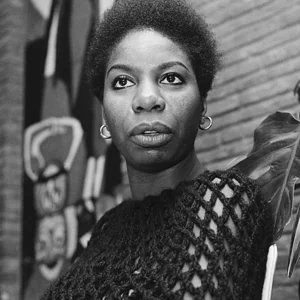
Portrait de Nina Simone

Nina Simone

Nina Simone

1933 — 2003

États-Unis

MusicSocietyChanteur/seMusicien(ne)Activiste20th CenturyPianist, singer, civil rights activist

American jazz singer, pianist, composer, and civil rights activist for Black people

Émotions disponibles (6)

N

Neutre

par défaut

I

Inspirée

P

Pensive

S

Surprise

T

Triste

F

Fière

Key Facts

    Works & Achievements

    Mississippi Goddam (1964)

    A protest song written in response to the Birmingham church bombing and the assassination of Medgar Evers. It is Nina Simone's most politically explicit work, and was boycotted in several Southern states.

    I Loves You Porgy (1958)

    A cover of a Gershwin standard that propelled Nina Simone to the forefront of the American music scene. This first major commercial success revealed her exceptional talent as both a pianist and a vocalist.

    Feeling Good (1965)

    A cover of a song originally written for a British musical, transformed by Nina Simone into an anthem of freedom and rebirth. One of her most covered and recognizable interpretations worldwide.

    To Be Young, Gifted and Black (1969)

    Written as a tribute to her friend Lorraine Hansberry, the first Black female playwright on Broadway. The song became an anthem of Black pride and was adopted as the unofficial anthem of the Black Power movement.

    Four Women (1966)

    A song depicting four archetypes of Black American women throughout history, from slavery to rebellion. Some radio stations censored it, deeming it too provocative. It remains one of her most analyzed and celebrated works.

    Why? (The King of Love Is Dead) (1968)

    Composed by her bassist Gene Taylor on the night of Martin Luther King's assassination, and performed two days later at a concert in New York in an atmosphere of striking grief and anger.

    Anecdotes

    At the age of 12, Nina Simone gave her first classical piano recital in her hometown of Tryon, North Carolina. Her parents, seated in the front row, were forced to move to make room for white audience members. Nina refused to play until they had returned to their seats — the audience complied. This act of dignity foreshadowed her entire life as an activist.

    Nina Simone dreamed of becoming the first great Black American classical pianist. She was rejected by the Curtis Institute of Music in Philadelphia in 1951, a prestigious institution. Convinced that this rejection was motivated by the color of her skin, she never fully recovered from it, and the wound it left ran deep throughout her entire body of work.

    In 1963, following the bombing of a Birmingham church that killed four young Black girls, Nina Simone composed 'Mississippi Goddam' in under an hour, in a state of cold fury. She herself said she had wanted to make a bomb to seek revenge, but had ultimately chosen music as her weapon. The song was boycotted in several Southern states.

    During a concert in Westbury, New York, in 1995, Nina Simone threatened to leave the stage because audience members were talking while she played. She stopped, stared at the crowd in silence for several minutes, then resumed once the hall was perfectly quiet. This absolute demand for respect toward the music was a constant throughout her performances.

    Nina Simone spent the last years of her life in France, particularly in Carry-le-Rouet near Marseille. She had left the United States as a protest against racism, feeling misunderstood in her own country. In Europe she found the artistic recognition and relative peace she had never fully found in America.

    Primary Sources

    I Put a Spell on You — Nina Simone's autobiography (1991)
    I wanted to be the first great Black classical pianist. That was no ordinary ambition for a little Black girl from the South, but nobody ever told me it was impossible, so I never stopped believing it.
    Interview for Jazz Hot magazine (1968)
    Freedom for me is the absence of fear. On stage, I can be free. On the streets of America, I never truly was.
    Speech to the SNCC (Student Nonviolent Coordinating Committee) (1965)
    A Black artist who does not reflect his time is not an artist. He is an impostor. My duty is to reflect the times I live in, the pain of my people.
    Open letter published in Ebony Magazine (1970)
    I play what I feel. I cannot separate my music from my politics. For me, it is the same thing — a cry for human dignity.

    Key Places

    Tryon, North Carolina, United States

    Nina Simone's hometown, in the segregationist South. It was there that she grew up in poverty and learned the piano, and where she experienced her first racial humiliations that would forge her political consciousness.

    Curtis Institute of Music, Philadelphia, United States

    A prestigious classical music school that rejected Nina Simone in 1951. This rejection, which she attributed to racism, was one of the defining events of her life and her activism.

    Village Gate, New York, United States

    A jazz club in Greenwich Village where Nina Simone performed regularly throughout the 1960s. It was in these New York venues that she honed her style and her civil commitment.

    Montreux, Switzerland

    Nina Simone performed several times at the famous Montreux Jazz Festival and was acclaimed by European audiences. Europe offered her a recognition she felt had been denied to her in America.

    Carry-le-Rouet, Provence, France

    Nina Simone's final home, where she spent more peaceful days far from American turmoil. She died there in 2003 and chose to be buried in Africa, the symbolic continent of her roots.
    Typical Objects

    Steinway grand piano

    Nina Simone learned classical piano from the age of 3, taught by a neighbor who gave her lessons. The piano was both her instrument of choice, her working tool, and her most powerful means of political expression.

    Bach and Beethoven sheet music

    Nina Simone considered herself first and foremost a classical pianist. She studied the great European composers and incorporated their techniques into her jazz playing, creating a unique style at the crossroads of genres.

    Vintage stage microphone (1950s–1960s)

    Nina Simone's deep, powerful voice was her second instrument. On stage, the microphone became the vehicle for her most direct political messages, transforming each concert into an act of resistance.

    African headdresses and outfits

    From the 1960s onward, Nina Simone regularly wore clothing and hairstyles inspired by African cultures, asserting her identity and her solidarity with the Black Power movement and Pan-Africanism.

    Civil rights movement buttons and badges

    An active activist, Nina Simone wore the visual symbols of the civil rights movement (NAACP, SNCC) and took part in fundraising efforts. These badges were markers of visible commitment.

    33 rpm vinyl records

    Nina Simone's albums were played in Black American homes and clubs, becoming objects of communal sharing. Some records, such as 'Nina Simone Sings the Blues', circulated clandestinely in states where she was boycotted.

    School Curriculum

    Vocabulary & Tags

    Key Vocabulary

    Tags

    societechanteurmusicienactiviste

    Daily Life

    Morning

    Nina Simone woke up late, often after nighttime concerts that ended in the early hours of the morning. She would begin her day with classical piano exercises, maintaining a discipline of study inherited from her childhood. She read the newspapers carefully, looking for news related to civil rights and political movements.

    Afternoon

    Afternoons were often devoted to rehearsals with her musicians or to composition. She sometimes received activist and artist friends — James Baldwin, Lorraine Hansberry — with whom she debated politics, culture, and strategy for the movement. She also studied poetry and literature that inspired her lyrics.

    Evening

    Evenings were dominated by stage performances, several nights a week. On stage, Nina Simone demanded absolute silence from the audience and could extend a piece by twenty minutes if she felt it was necessary. After concerts, she spent time with other musicians in clubs, discussing music until dawn.

    Food

    Raised in a modest family in the American South, Nina Simone had kept a taste for soul food — grilled meats, stewed vegetables, cornbread. In Europe, she gradually adopted Mediterranean cuisine. She sometimes drank cognac to unwind after concerts, unlike many jazz musicians who consumed other substances.

    Clothing

    Nina Simone's clothing choices evolved through different periods of her life. In the 1950s and 60s, she wore elegant stage gowns and high heels. From the 1960s onward, she increasingly adopted African attire — boubous, turbans, ethnic jewelry — to assert her Black identity and her attachment to her cultural roots.

    Housing

    Nina Simone first lived in modest apartments in New York, in the Harlem neighborhood and then in Mount Vernon. After her voluntary exile, she lived successively in Barbados, Liberia, Switzerland, Paris, and finally in a Provençal villa in Carry-le-Rouet. Her homes were always adorned with African art and a large number of books.

    Historical Timeline

    1933Naissance d'Eunice Kathleen Waymon Ă  Tryon, Caroline du Nord, dans une famille modeste de six enfants
    1954Arrêt Brown v. Board of Education : la Cour Suprême déclare inconstitutionnelle la ségrégation scolaire aux États-Unis
    1955Rosa Parks refuse de céder sa place dans un bus à Montgomery — début du mouvement des droits civiques moderne
    1958Premier grand succès de Nina Simone avec 'I Loves You Porgy', qui entre dans le Top 20 américain
    1960Sit-ins de Greensboro : des étudiants noirs protestent pacifiquement contre la ségrégation dans les restaurants
    1963Attentat contre l'église baptiste de la 16e rue à Birmingham : quatre fillettes noires tuées. Nina Simone compose 'Mississippi Goddam'
    1963Marche sur Washington : Martin Luther King prononce le discours 'I Have a Dream' devant 250 000 personnes
    1965Marche de Selma à Montgomery pour le droit de vote des Noirs, réprimée violemment ('Bloody Sunday')
    1965Nina Simone se produit lors de concerts de soutien aux marches pour les droits civiques aux côtés de Mahalia Jackson et James Baldwin
    1968Assassinat de Martin Luther King. Nina Simone compose 'Why? (The King of Love Is Dead)' le soir mĂŞme
    1970Nina Simone quitte les États-Unis pour la Barbade puis l'Afrique, désillusionnée par la situation raciale américaine
    1978Nina Simone s'installe en Europe, notamment Ă  Paris, oĂą elle retrouve une audience internationale
    1993Retour partiel sous les feux de la scène internationale avec de nouvelles tournées européennes
    2003Mort de Nina Simone à Carry-le-Rouet, France, à l'âge de 70 ans. Elle est enterrée en Afrique, en signe de ses convictions panafricaines

    Period Vocabulary

    Segregation — The legal and forced separation of Black and White populations in public spaces (schools, transportation, restaurants) practiced in the United States until the Civil Rights Acts of 1964–1965.
    Jim Crow (laws) — A body of state laws in force in the American South between 1877 and 1965 that institutionalized racial segregation and discrimination against African Americans in all aspects of public life.
    Civil Rights Movement — The American civil rights movement of the 1950s and 1960s that fought peacefully — though not without resistance — to achieve legal and social equality for African Americans, leading to the landmark legislation of 1964 and 1965.
    Black Power — A political and cultural movement of 1965–1975 advocating for the autonomy, pride, and self-determination of Black Americans, often represented by the raised fist and associated with the Black Panther Party.
    Contralto — The lowest female voice type in the classification of singing voices. Nina Simone's voice, exceptionally deep and powerful for a woman, was of the contralto type, giving it an emotional depth unlike any other.
    Pan-Africanism — A political and cultural movement advocating the unity of all peoples of African origin across the world, beyond national borders. Nina Simone embraced it and symbolically chose to be buried in Africa.
    Sit-in — A form of nonviolent protest used by civil rights activists: Black individuals would sit at spaces reserved for White people (restaurant counters, libraries) and refuse to leave despite harassment and violence.
    NAACP (National Association for the Advancement of Colored People) — The leading American organization for the defense of civil rights for African Americans, founded in 1909. Nina Simone actively supported it through fundraising concerts and direct militant engagement.
    Soul music — An African American musical genre born in the 1950s, rooted in gospel and rhythm and blues, characterized by deep emotional expressiveness. Although Nina Simone transcended categories, this genre profoundly influenced her repertoire.
    Boycott — A collective and organized refusal to purchase a product or patronize a place, used as an economic weapon of protest. The Montgomery Bus Boycott of 1955 and the boycott of Nina Simone's records in the South are two emblematic examples from that era.

    Gallery

    
Oak leaves [electronic resource]

    Oak leaves [electronic resource]

    Primer plano mural (Nina Simone, Liudmila Pavlichenko, Billy Jean King)

    Primer plano mural (Nina Simone, Liudmila Pavlichenko, Billy Jean King)

    Lyudmila Pavlichenko - mural ciudad lineal (cropped)

    Lyudmila Pavlichenko - mural ciudad lineal (cropped)

    David C. Driskell Oral History, 2019, Getty Trust and Bancroft Library

    David C. Driskell Oral History, 2019, Getty Trust and Bancroft Library

    Nina Simone Statue Tryon, North Carolina

    Nina Simone Statue Tryon, North Carolina

    Nina Simone Playing Piano in NC

    Nina Simone Playing Piano in NC

    Nina Simone Plaza

    Nina Simone Plaza

    Nina Simone Statue

    Nina Simone Statue

    Nina Simone 1965 - restoration1

    Nina Simone 1965 - restoration1

    Liberdade e nao ter medo a historia de mariana cardoso e do eletrica brecho, HistĂłria no Museu da Pessoa (196766)

    Liberdade e nao ter medo a historia de mariana cardoso e do eletrica brecho, HistĂłria no Museu da Pessoa (196766)

    Visual Style

    Le style visuel de Nina Simone conjugue l'élégance sombre des clubs de jazz des années 1960, les couleurs profondes de l'Afrique et la force visuelle du mouvement des droits civiques américains.

    #2C1810
    #8B4513
    #D4A853
    #1C2B4A
    #6B1E1E
    AI Prompt
    1960s African-American civil rights era aesthetic. A powerful woman at a grand piano, stage spotlight casting warm amber light on dark skin. Head wrap or natural afro hair, draped in flowing Afrocentric robes in deep earth tones — ochre, burnt sienna, deep indigo, ebony. The stark contrast of a Black woman in a space traditionally reserved for white classical musicians. Black and white photography grain mixing with vivid concert color photography. Bold political imagery: fists raised, marching crowds, protest signs. The elegance of jazz clubs — velvet curtains, candlelight, cigarette haze — contrasting with the rawness of outdoor civil rights marches. Deep shadows, expressive faces, emotional intensity.

    Sound Ambience

    L'univers sonore de Nina Simone mêle le jazz intime des clubs new-yorkais, la rigueur du piano classique et la profondeur émotionnelle du blues, avec une voix de contralto rare et une tension politique sous-jacente.

    AI Prompt
    Late night jazz club atmosphere, 1960s New York. The resonant, deep notes of a grand piano played with classical precision yet soulful freedom. Blues harmonics blending with Bach-like counterpoint. The hum of a club audience, the clink of glasses, cigarette smoke hanging in dim light. A powerful contralto voice, raw and commanding, cutting through the room. Outside, distant street noise of Greenwich Village. The creak of a piano bench, the pedal's soft thud, fingers sliding across ivory keys. Occasional crowd murmurs transforming into hushed reverence. The emotional weight of civil rights tension palpable beneath the music.

    Portrait Source

    Wikimedia Commons