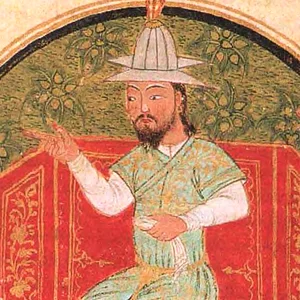

Nuh ibn Mansur (961–997) was the Samanid emir who ruled over Khorasan and Transoxiana. His reign witnessed the flourishing of Persian culture, and he welcomed the young Avicenna to his court, where the latter began his medical career.
Nuh ibn Mansur
Nuh ibn Mansur al-Samani
8 min read
Frequently asked questions
Key Facts
- Reigned from 961 to 997 as Samanid emir
- Controlled Khorasan and Transoxiana from his capital Bukhara
- Welcomed Avicenna into his royal library in Bukhara around 997
- His reign marked the beginning of the Samanid decline in the face of the Ghaznavids and the Karakhanids
- Fostered the renaissance of Persian culture and language
Works & Achievements
Nuh ibn Mansur maintained and enriched the legendary royal library of Bukhara, which held thousands of manuscripts organized across several thematic rooms. It was this institution that he opened to the young Avicenna, allowing him to acquire an encyclopedic education that shaped his entire career.
The Samanid court was the cradle of the renaissance of poetry and prose in the Persian language. By funding poets and translators, Nuh ibn Mansur helped make Persian the great cultural and literary language of the Islamic East.
Faced with the rebellion of governors and Qarakhanid pressure, Nuh ibn Mansur called upon the Ghaznavids to defend his empire. This decision temporarily saved the Samanids but accelerated their military dependence on their own vassals.
For more than twenty years, Nuh ibn Mansur maintained the nominal unity of an empire stretching from the Caspian Sea to the borders of present-day India. His reign bears witness to the administrative, diplomatic, and cultural practices of a great medieval power in a phase of decline.
Anecdotes
The young Ibn Sina (Avicenna), then around sixteen years old, succeeded in curing Emir Nuh ibn Mansur of a serious illness that the court physicians had been unable to treat. As a token of gratitude, the emir granted him unrestricted access to the royal library of Bukhara, one of the richest in the Islamic world. Avicenna later recounted that he discovered works there that he had never seen before and would never see again in his lifetime.
The court of Bukhara was the beating heart of the Persian language renaissance. Poets such as Rudaki composed verses there in refined literary Persian, transforming the language into a vehicle of cultural prestige throughout the Islamic East. Nuh ibn Mansur generously funded these scholars, making Bukhara an intellectual capital to rival Baghdad.
Despite his title of sovereign emir, Nuh ibn Mansur gradually saw real power slip away to Turkish military commanders. Subuktigin, governor of Ghazna, established himself as the true master of Khorasan while maintaining the facade of Samanid loyalty, even receiving the honorary title of “Nasir al-Dawla” (Defender of the State) from the emir’s own hands. This situation foreshadowed the dynasty’s imminent end.
The royal library of Bukhara was organized into several thematic rooms dedicated to the sciences, philosophy, religion, and poetry. Its destruction in a fire shortly after Avicenna’s time caused humanity to lose hundreds of irreplaceable manuscripts, and some blamed Mahmud of Ghazna for the disaster — a charge he flatly denied.
Toward the end of his reign, Nuh ibn Mansur found himself caught between the Ghaznavids to the south and the Qarakhanids to the north. These Muslim-converted Turkish nomads had crossed the Syr Darya and were directly threatening Bukhara. It was finally two years after his death, in 999, that the Qarakhanids seized the Samanid capital, erasing a dynasty that had shone for more than a century.
Primary Sources
Emir Nuh ibn Mansur suffered from an illness that physicians had been unable to cure. Ibn Sina was summoned; he treated him and restored him to health. As a reward, the emir granted him access to his royal library, where he discovered books he had never heard of before.
Subuktigin served the Samanid emir Nuh ibn Mansur faithfully, repelling incursions by Hindus and rebels in Khorasan on behalf of his overlord, and receiving in return honors and investitures.
The Samanid emirs maintained at Bukhara a court of unrivaled magnificence, where poets, physicians, and scholars from across the Islamic East gathered, perpetuating the tradition of royal patronage.
The Samanids were among the most just and most generous rulers toward scholars and men of letters. Their court served as a model of Islamic governance for the dynasties that succeeded them.
Key Places
Capital of the Samanid Empire and official residence of Nuh ibn Mansur. Bukhara was home to the famous royal library and served as a major intellectual and commercial hub in Central Asia.
The principal city of Khorasan and second administrative center of the Samanid Empire. Nishapur was a major commercial and cultural crossroads on the Silk Road between Iran and Central Asia.
A great city of Transoxiana and a center of paper production, Samarkand was a key city of the Samanid Empire. It fell to the Qarakhanids shortly after the death of Nuh ibn Mansur, in 999.
Capital of the Ghaznavid dynasty, a nominal vassal of the Samanids. It was from Ghazni that Subuktigin and then his son Mahmud organized their rise to power, which gradually supplanted the Samanids.
A great oasis of Khorasan and a major stopping point on the Silk Road, Merv was an important administrative and military center of the Samanid Empire, controlling the gateways into Central Asia.
Typical Objects

The Samanids minted silver dirhams renowned throughout the Islamic world for their purity and quality. These coins bore the name of the reigning emir and circulated as far as Scandinavia through the Volga trade routes.

Samarkand, in the Samanid empire, was the primary paper-production center in the eastern Islamic world. The thousands of manuscripts in the royal library of Bukhara, which Avicenna had access to, were written on this high-quality paper.

The emir granted robes of honor, crafted in the royal workshops, to deserving dignitaries, poets, and scholars as a mark of favor. These garments symbolized the personal bond between the ruler and the recipient.

Every decree, letter, or diploma issued by the Samanid chancery was authenticated by the emir's seal, engraved on metal or precious stone. This seal guaranteed the authenticity of official documents and committed the full authority of the sovereign.

An emblematic instrument of medieval Islamic civilization, the astrolabe was used to calculate prayer times, the direction of Mecca, and the positions of celestial bodies. The Samanid court, which patronized astronomers and physicians, possessed many finely crafted examples of great precision.

The Samanid emir commanded an army composed largely of Turkish cavalrymen (ghulams). The shamshir, a saber with a slightly curved blade forged in the workshops of Khorasan, was the signature weapon of this elite cavalry.
School Curriculum
Vocabulary & Tags
Key Vocabulary
Daily Life
Morning
The emir's day began with the dawn prayer (fajr) in the company of his court. After a careful grooming routine attended to by specialized servants, he received senior officials — viziers and secretaries — to review dispatches and handle the empire's urgent affairs.
Afternoon
The afternoon was devoted to public audiences (diwan) where the emir dispensed justice and received ambassadors and petitioners. Horseback riding sessions or royal hunting in the plains around Bukhara also punctuated his days, hunting being an essential mark of lordly prestige in the Iranian world.
Evening
In the evening, the emir hosted literary gatherings (majlis) where poets, physicians, and philosophers vied in eloquence. The recitation of Persian poetry, music, and learned discussions characterized these refined evenings, a testament to the high cultural level of the Samanid court.
Food
The emir's table was plentiful: spiced rice dishes (pilaf), roasted or braised lamb, stuffed poultry, and garden vegetables. Fresh and dried fruits from Khorasan (pomegranates, apricots, grapes), honey sweets, and sherbets (flavored iced drinks) rounded out meals served on large silver platters.
Clothing
The emir wore long embroidered silk robes (qaba) in vivid colors, a symbol of his rank. A carefully wound turban crowned his head, and gold embroideries on his garments (tiraz) proclaimed his official titles. Outside of ceremonies, he dressed in more modest attire, always made from the finest fabrics of Khorasan.
Housing
The palace of Bukhara was a complex of fired-brick buildings surrounding several inner courtyards adorned with fountains and gardens. The reception halls were decorated with carved stucco, tilework, and embroidered hangings. The royal library occupied a separate building composed of several specialized rooms, a sign of the importance placed on learning in Samanid culture.
Historical Timeline
Period Vocabulary
Liens externes & ressources
Références
Œuvres
Entretien et enrichissement de la bibliothèque royale de Boukhara
976-997
Mécénat de la renaissance de la littérature persane
976-997
Alliance avec Subuktigin contre les Qarakhanides et les rebelles
994
Gouvernance du Khorasan et de la Transoxiane
976-997