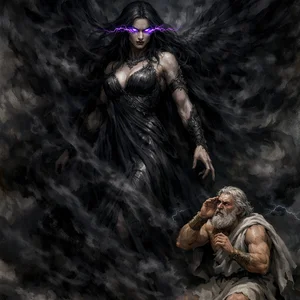

Primordial goddess of Night in Greek mythology, born from the original Chaos. Mother of countless deities including Hypnos (Sleep), Thanatos (Death), and the Moirai (Fate). So fearsome that even Zeus refused to cross her.
Nyx
Nyx
9 min read
Frequently asked questions
Famous Quotes
« “Night, veiled in dark clouds, passed through the air.” (Hesiod, Theogony, written tradition)»
Key Facts
- Born from the original Chaos according to Hesiod's Theogony (c. 700 BC)
- Mother of Hypnos (Sleep), Thanatos (Death), Eris (Discord), the Moirai, and many other deities
- Dwells at the edges of the world, in the depths of Tartarus according to some versions
- Even Zeus hesitates to confront her, according to Homer's Iliad (Book XIV)
- Personification of cosmic night, she crosses the sky each evening veiled in dark clouds
Works & Achievements
Without any male union, Nyx alone gave birth to Erebus (the Darkness of the Underworld), then, united with him, brought forth Aether and Hemera (the Day). This act of creation represents the very foundations of the universe in Greek cosmogony.
Nyx gave birth to the twins Hypnos (Sleep) and Thanatos (Death), two fundamental forces of human existence. The two brothers dwelt with her at the edges of the world, watching over the rest of the living and welcoming the souls of the dead.
Hesiod presents Nyx as the mother of the three Moirai — Clotho, Lachesis, and Atropos — who spin, measure, and cut the thread of life of every mortal. Through them, Nyx wields a power over fate that even Zeus himself cannot contradict.
Nyx gave birth to Nemesis (divine Retribution and distributive Justice) and Eris (Discord), two forces that govern moral order and disorder in the world of both mortals and gods.
Through her perpetual dance with her daughter Hemera, Nyx establishes the fundamental rhythm that structures human time. This immutable alternation is the most concrete and universal gift of the goddess of Night to all living beings.
In Orphic theology, Nyx holds the role of universal demiurge. Orphic initiates venerated her and invoked her name in the gold tablets intended to guide souls through the afterlife after death.
Anecdotes
In Homer's *Iliad*, the god of Sleep Hypnos — son of Nyx — had hidden in his mother's arms after putting Zeus to sleep against his will. When the master of Olympus discovered the trick, his anger was immense, but he stopped short: even Zeus did not dare confront Nyx, so great was the awe the goddess of the Night inspired in him.
According to Hesiod's cosmogony in the *Theogony*, Nyx is one of the very first deities to emerge from primordial Chaos, even before the Olympian gods. She alone gave birth to a multitude of dark forces: Thanatos (Death), the Moirai (Fate), Nemesis (divine Vengeance), and Eris (Discord).
The Greeks imagined that Nyx and her daughter Hemera (the Day) lived in the same palace at the edge of the world, but never crossed paths: when one returned, the other departed at once. This perpetual dance symbolized the unchanging alternation of day and night, the very foundation of human time.
In the *Orphic Hymns*, Nyx is described as a cosmic figure of absolute power, predating any established order. Initiates of the Orphic movement offered her prayers to cross through the world of the dead, for she alone knew the paths through eternal darkness.
According to Aristophanes in his comedy *The Birds*, it was Nyx who laid the primordial Egg from which Eros, the god of Love, was born. This poetic image reveals how deeply the Night was perceived not only as darkness and death, but also as the mysterious source of all life.
Primary Sources
“From Chaos came forth Erebus and black Night; but of Night were born Aether and Day, whom she conceived and bore from her union in love with Erebus.”
“[Hypnos said:] I could lull to sleep any other eternal god [...] but Zeus, son of Cronus, I would not dare approach or send him to sleep. For once already you taught me how severe his commands are, that day when I put Zeus to sleep [...] and Nyx saved me as I fled.”
“I will sing of Night, mother of gods and men, Night who gave birth to all that is. [...] You carry the stars upon your luminous head, and you rush on in your course, surrounded by darkness mingled with light.”
“In the beginning there was only Chaos, Night, dark Erebus, and vast Tartarus. [...] Dark-winged Night conceived a wind-egg, and from it, when the seasons were fulfilled, was born the much-desired Eros.”
“From Night, according to the Greeks, were born Heaven and Earth, then Ocean and all the ancient divine beings; and from these unions were born the gods the Greeks call the Titans.”
Key Places
The mythic place of origin from which Nyx emerged, according to Hesiod. Impossible to locate geographically, Chaos represents the primal void that preceded all creation — the goddess's first dwelling before the world took shape.
The deepest abyss in Greek cosmology, lying beneath the Underworld, where Nyx is said to dwell in certain traditions. At the very edge of this chasm stands her palace, where the dark roots of the cosmos converge.
The mythic home of Nyx at the outermost boundary of the inhabited world, where Ocean meets darkness. It is here that she and her daughter Hemera take turns in an eternal relay — one departing as the other arrives, never crossing paths.
Home of the Olympian gods, and the one place where Nyx — according to the *Iliad* — inspires fear even in Zeus. Though she is not an Olympian goddess herself, her shadow falls over the sacred mountain as a reminder of the powers that came before.
The Panhellenic religious center where creation myths — including the role of Nyx — were taught to initiates and priests. Delphi was regarded as the navel of the world, a meeting point between mortals and the primordial divine forces.
Typical Objects

Nyx is depicted draped in a dark veil scattered with stars, a symbol of the night sky she unfurls across the world each evening. This mantle of darkness was her most distinctive divine attribute in ancient iconography.

The goddess crossed the sky each night in a chariot drawn by black horses, spreading darkness in her wake. This cosmic chariot symbolized her perpetual journey at the boundaries of the known world.

The torch held upside down, flame pointing toward the ground, is the iconographic attribute of Nyx and her sons Hypnos and Thanatos. It represents extinguished light, deep sleep, and the passage toward death.

The poppy flower, source of opium and symbol of deep sleep, is associated with Nyx as the mother of Hypnos. It evokes the porous boundary between sleep and death in Greek thought.

In Orphic cosmogony, Nyx is associated with the primordial Egg from which Eros was born. This egg symbolizes the origin of all things — life and love emerging from absolute darkness.

The cypress, the funerary tree of ancient Greece, sometimes adorned the head of Nyx in cultic representations. It symbolized the close bond between night, death, and the passage into the afterlife.
School Curriculum
Vocabulary & Tags
Key Vocabulary
Daily Life
Morning
At sunrise, Nyx returns to her palace at the edge of the world, crossing paths with her daughter Hemera, who emerges from it to spread light across the earth. The Greeks imagined this moment as a silent and solemn cosmic threshold, where darkness retreats before the dawn without ever truly disappearing.
Afternoon
During the day, Nyx rests in her shadowy palace surrounded by mists and darkness, at the place where the Ocean meets the boundaries of the known world. Her children — Sleep, Death, and the Dreams — wander through the twilight regions, patiently awaiting their mother's return.
Evening
At nightfall, Nyx mounts her chariot drawn by black horses and sweeps across the sky, unfurling her great starry veil over the sleeping earth. Her sons Hypnos and Thanatos accompany her, spreading sleep over mortals and gently welcoming the souls of the departed.
Food
As a primordial deity, Nyx does not feed like the Olympian gods, who consume ambrosia and nectar. She drinks from darkness itself, drawing her energy from the shadows of the cosmos, of which she is the living and eternal embodiment.
Clothing
Nyx is depicted wearing a long robe or great dark veil, often midnight blue or black, scattered with silver stars symbolizing the night sky. Her hair is adorned with a crown of stars, and her wings — in some depictions — are as dark as the deepest night.
Housing
Her mythical home lies at the edge of the inhabited world, where the Ocean dissolves into primordial darkness. This palace of mist and shadow is never lit by the sun, separated from the rest of the cosmos by immense abysses — Tartarus and the Underworld — of which she is the immemorial sovereign.
Historical Timeline
Period Vocabulary
Liens externes & ressources
Références
Œuvres
Enfantement des forces cosmiques primordiales
Temps mythiques
Naissance d'Hypnos et Thanatos
Temps mythiques
Enfantement des Moires
Temps mythiques
Création de Némésis et Éris
Temps mythiques
Institution de l'alternance jour-nuit
Temps mythiques
Rôle central dans les Mystères orphiques
VIe siècle av. J.-C. – IIe siècle apr. J.-C.