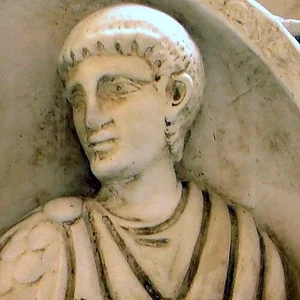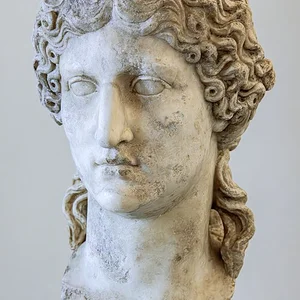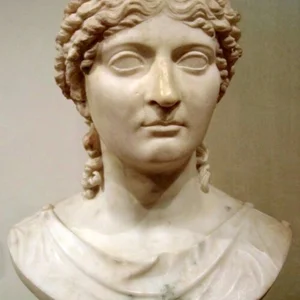

Roman imperial prefect of Egypt in the early 5th century, based in Alexandria. A Christian but concerned with civil order, he opposed the growing grip of Bishop Cyril and was devastated by the murder of the philosopher Hypatia, his friend, in 415.
Orestes(399 — 499)
Orestes
Rome antique
5 min read
Frequently asked questions
Key Facts
- Appointed imperial prefect (praefectus augustalis) of Egypt, residing in Alexandria, around 412-415.
- Enters into open conflict with Cyril, Bishop of Alexandria, over the division of civil and religious power.
- Victim of an assault by monks from Nitria, one of whom (Ammonius) wounds him in the head around 415.
- A friend of the philosopher and mathematician Hypatia, he is appalled by her murder by a Christian mob in 415.
- A figure of the decline of the autonomy of civil power in the face of the rise of episcopal authority in Late Antiquity.
Works & Achievements
As Augustal Prefect, Orestes oversaw the administration, justice, and tax collection in the Empire's richest grain-producing province.
He firmly opposed the extension of Cyril's power over civil affairs, asserting the primacy of imperial government within the city.
After being wounded, he had the monk who had assaulted him tried and condemned, an act that upheld public order and Roman law.
Shaken by the murder of the philosopher, he informed the court of Constantinople of the violence ravaging Alexandria.
Faced with clashes between communities and armed gangs, he sought to preserve public peace in a city gripped by tension.
Anecdotes
As the imperial prefect of Alexandria, Orestes was one of the friends and protectors of the philosopher Hypatia, a scholar renowned for her teaching of mathematics and astronomy. Their friendship fueled the suspicions of Bishop Cyril's faction, which accused Hypatia of turning the prefect against the Church.
According to the historian Socrates of Constantinople, Orestes was nearly killed during a riot: a monk named Ammonius threw a stone that struck him on the head. The prefect had his attacker arrested and executed, which further inflamed the conflict with Cyril.
Orestes was a baptized Christian, yet he refused to submit to the bishop's growing authority over the civil affairs of the city. He insisted that, as the emperor's representative, the governance of Alexandria was his to exercise.
When Hypatia was savagely murdered by a mob in 415, the prefect sent a report to the emperor in Constantinople. But no serious punishment was imposed, and Orestes then disappears from the historical record.
The conflict between Orestes and Cyril illustrates a tension typical of late antiquity: who holds the true authority over a great city of the Empire — the imperial governor or the bishop?
Primary Sources
Orestes, the prefect of Alexandria, looked with displeasure upon the growing authority of the bishops, because they encroached on the powers of those who governed in the emperor's name.
One of the monks, named Ammonius, struck Orestes on the head with a stone, so that his whole face was covered with blood.
A rumour spread among the Christian people that it was Hypatia who prevented Orestes from reconciling with the bishop.
Key Places
Great metropolis of Roman Egypt where Orestes served as Augustal Prefect. A city of learning and commerce, but also the stage for violent conflicts between civil and religious power.
A former imperial temple turned church, located near the harbor; it was in this place, according to the sources, that Hypatia was dragged and killed.
Capital of the Eastern Roman Empire, seat of Emperor Theodosius II, to whom Orestes had to answer and submit his reports.
The city's intellectual center where Hypatia, a friend of Orestes, taught, and a symbol of the scientific influence of Late Antiquity.
Typical Objects

Official document and insignia handed over by the emperor certifying the appointment of a senior official such as the Augustal prefect. They symbolized the authority delegated by the sovereign.

Ceremonial robe worn by senior Roman magistrates in Late Antiquity, often adorned with purple bands marking rank.

A law issued by the emperor that the prefect had to enforce and post throughout the city. It established the civil order that Orestes sought to preserve.

Official vehicle used by senior officials to travel through the city and display their dignity. It was from such a carriage that Orestes was attacked according to the accounts.

A stable gold coin created by Constantine, in use throughout the Empire in the 5th century. It was used to pay soldiers and officials.

A common writing surface in Roman Egypt, used for official correspondence and reports sent to the emperor.
School Curriculum
Vocabulary & Tags
Key Vocabulary
Daily Life
Morning
Upon rising, the prefect received his secretaries and read the official correspondence sent from Constantinople. He then held audience to dispense justice and hear the petitions of the inhabitants.
Afternoon
The afternoon was devoted to administration: overseeing taxes, monitoring the grain supply, and inspecting the city. He constantly had to arbitrate between the city's factions.
Evening
In the evening, he might frequent learned circles, such as that of Hypatia, where philosophy and the sciences were discussed. Banquets sometimes gathered the notables of Alexandria.
Food
A senior official's diet was based on wheat bread, olive oil, wine diluted with water, fish, and the fruits that were plentiful in Egypt. Banquets offered more refined dishes.
Clothing
He wore a tunic and a ceremonial cloak (chlamys) trimmed with bands marking his rank. Insignia and an official belt signaled his standing as an imperial magistrate.
Housing
The prefect resided in a vast administrative palace in Alexandria, equipped with offices, audience halls, and a guard. These residences combined Roman luxury with Egyptian comfort.
Historical Timeline
Period Vocabulary
Liens externes & ressources
Références
Œuvres
Administration civile de l'Égypte
vers 412-415
Défense de l'autorité impériale face à l'évêque
412-415
Enquête sur l'émeute et exécution d'Ammonios
415
Rapport impérial sur la mort d'Hypatie
415
Maintien de l'ordre civil à Alexandrie
412-415