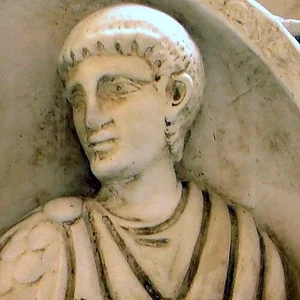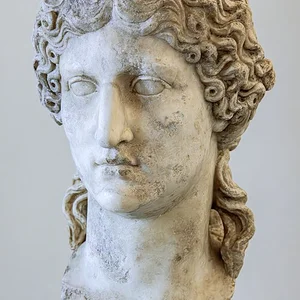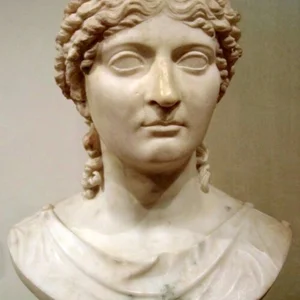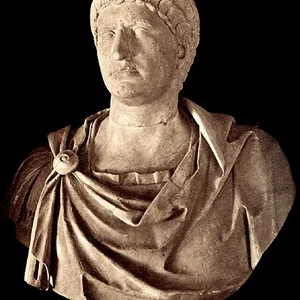

Otho was the seventh Roman emperor, in power for three months in the year 69. A former governor of Lusitania and companion of Nero, he came to the throne after having Galba assassinated, before being defeated by Vitellius and taking his own life.
Otho(32 — 69)
Otho
Rome antique
6 min read
Frequently asked questions
Key Facts
- Born in 32 AD into the gens Salvia, a family of senatorial rank close to the imperial court
- Governor of the province of Lusitania for about ten years under Nero
- Proclaimed emperor by the Praetorian Guard on 15 January 69, after the assassination of Galba that he had organized
- Defeated by Vitellius's troops at the Battle of Bedriacum in April 69
- Took his own life on 16 April 69 after only three months of reign, to avoid a new civil war
Works & Achievements
A moderate and fair governance of the province for ten years, which revealed unexpected administrative qualities in Nero's former favorite.
Otho was one of the first governors to rally behind Galba against Nero, contributing to the fall of the Julio-Claudian dynasty.
Relying on the discontented Praetorian Guard, Otho overthrew and had Galba killed, becoming the seventh Roman emperor.
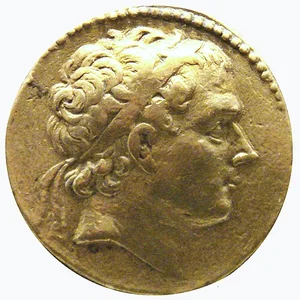
The issuing of gold and silver coins bearing his likeness, a classic instrument of legitimization and propaganda for Roman emperors.
Otho sought to win over the Senate and the people, showing himself clement and moderate to erase the violent image of his seizure of power.
The organization of the defense of northern Italy against the legions of Germania, culminating in the decisive Battle of Bedriacum.
Anecdotes
Otho was at first a close drinking companion of Nero. Legend has it that he married the beautiful Poppaea Sabina, but that Nero, captivated by her, sent him away from Rome by appointing him governor of the distant province of Lusitania (present-day Portugal) around 58, in order to win Poppaea for himself.
For ten years, Otho governed Lusitania with moderation and wisdom, in striking contrast to his reputation as a spendthrift young man. This far-off province was a kind of gilded exile that lasted until the fall of Nero in 68.
Otho had supported Galba in his revolt, hoping to be named his heir. When Galba instead adopted the young Piso, Otho, furious and crushed by debt, bribed the Praetorian Guard, who hailed him as emperor and murdered Galba in the Forum in January 69.
After his defeat at the Battle of Bedriacum against the forces of Vitellius, Otho refused to prolong a bloody civil war. Rather than sacrifice more Roman soldiers, he chose to take his own life, an act that ancient authors judged surprisingly noble for a man of such a frivolous reputation.
On the night before his suicide, according to Suetonius, Otho slept soundly, put his affairs in order, distributed money to his servants, and consoled those who wept. In the morning, he pierced his chest with a dagger, having reigned only about three months.
Primary Sources
He reigned only ninety-five days. Seeing that his troops were still ready to fight, he chose to die rather than expose so many brave men and so fine an army to the perils of another battle.
Otho addressed a final exhortation to his soldiers: others had held the empire longer, but none had left it with greater courage; he would not allow so much of Rome's youth, so many splendid armies, to be sacrificed for him any longer.
Otho declared that it was nobler and more just to perish alone than to cause the death of so many citizens, and he took his own life with a steady hand.
Although he had lived in luxury and indulgence, Otho died with a resolve worthy of the greatest men, ending his life to spare the shedding of Roman blood.
Key Places
Capital of the Empire where Otho was proclaimed emperor by the Praetorian Guard after the assassination of Galba on the Forum in January 69.
Roman province of the Iberian Peninsula that Otho governed for ten years, from 58 to 68, in a form of exile imposed by Nero.
Town on the Po Plain where Otho's armies were defeated by those of Vitellius in April 69, sealing the fate of his reign.
Town in northern Italy, on the Po, where Otho had established himself with his reserve forces and where he took his own life on 16 April 69 after the defeat at Bedriacum.
Etruscan city often considered the place of origin of the family of Salvius Otho, who was of Etruscan descent.
Typical Objects

Short sword of the Roman army, the main weapon of the legionaries and praetorians who acclaimed Otho. It was also with a dagger that the emperor took his own life.

Ceremonial garment dyed purple, reserved for the emperor and the supreme symbol of power in Rome. Otho donned it after being proclaimed by the praetorians.

Gold coin struck during his brief reign, bearing his portrait and titles. These rare coins also served to buy the loyalty of the soldiers.

Otho, whose hair was thinning, wore according to Suetonius a wig so well fitted that no one noticed it. It was a sign of his great care for his appearance.

Sacred standard of each Roman legion, carried by the aquilifer. The rallying of the eagles determined the legitimacy of an emperor during the civil war of 69.

Small dagger carried by Roman soldiers and officers. It was the weapon with which Otho pierced his own chest to end his life.
School Curriculum
Vocabulary & Tags
Key Vocabulary
Daily Life
Morning
As Emperor, Otho received the salutatio at dawn — those morning visits from clients, senators, and officers who came to pay their respects. Known for being meticulous about his appearance, he devoted time to his grooming, his wig, and his ointments before attending to public affairs.
Afternoon
The afternoon was taken up with audiences, reading the correspondence of the Empire, and, during the civil war, military councils with his generals. He had to constantly manage the fragile loyalty of the Praetorians and the legions.
Evening
In the evening, just as in his youth alongside Nero, Otho enjoyed banquets where guests dined reclining on couches (triclinium), enlivened by music and conversation. Wine diluted with water and refined dishes were passed around at length.
Food
The Roman elite ate bread, olives, fruit, fish, and meats seasoned with garum (fermented fish sauce). At imperial feasts, elaborate dishes were served accompanied by wines from Campania.
Clothing
Otho wore the toga, and as emperor the purple toga along with fine tunics. Highly vain, he took care of his body, removed his body hair, and concealed his baldness beneath a wig, according to the ancient biographers.
Housing
As emperor, he resided in the imperial palace on the Palatine Hill in Rome, a vast complex of marble, frescoes, and mosaics. On campaign, he lodged in the homes of notables or under the commander's tent, the praetorium.
Historical Timeline
Period Vocabulary
Liens externes & ressources
Références
Œuvres
Administration de la Lusitanie
58-68
Soutien à la révolte de Galba
68
Coup d'État et accession au trône
janvier 69
Frappe monétaire impériale
69
Mesures d'apaisement à Rome
69
Campagne militaire contre Vitellius
69