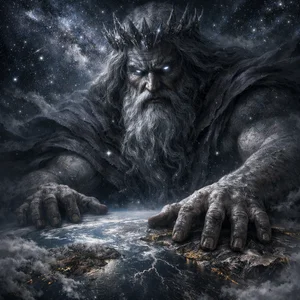

A primordial Greek deity personifying the starry Sky, Ouranos is the husband of Gaia (the Earth) and the father of the Titans, the Cyclopes, and the Hecatoncheires. Hated by the children he refused to release, he was castrated by his son Cronus, giving rise to Aphrodite according to the Hesiodic tradition.
Ouranos
Ouranos
9 min read
Frequently asked questions
Famous Quotes
« No words directly attributed to Ouranos are recorded in the sources — he is not a speaking character in Hesiod's Theogony.»
Key Facts
- Ouranos is one of the first primordial deities of Greek cosmogony, according to Hesiod's Theogony (around 700 BCE)
- He united with Gaia (the Earth) to father the twelve Titans, the three Cyclopes, and the three Hecatoncheires
- He imprisoned his children within Gaia's womb, refusing to let them be born
- Gaia, in agony, forged a sickle of adamant and persuaded Cronus to castrate Ouranos
- From the blood and severed genitals of Ouranos that fell into the sea, Aphrodite, goddess of love, was born (Hesiodic version)
Works & Achievements
Ouranos's most fundamental act is being the sky itself: he embodies and forms the starry vault that covers the Earth. This is the first great cosmic separation, the condition for all life and all order in the Greek universe.
Through his union with Gaia, Ouranos fathers the twelve Titans, the first generation of ruling gods. These immense beings become the primordial forces — Oceanus, Hyperion, Mnemosyne, Cronus — who would govern the cosmos before Zeus.
Ouranos is the father of the three Cyclopes (divine smiths with a single eye) and the three Hecatoncheires with their hundred arms. Though he imprisoned them out of fear, these beings would play a decisive role in Zeus's victory during the Titanomachy.
Through his castration, Ouranos unwittingly fathers Aphrodite, goddess of love and beauty. This paradox — extreme violence giving birth to love — is one of the richest metaphors in Greek mythology.
According to some sources, Ouranos prophesied that the Titans would be overthrown by their own descendants. This prophecy comes to pass with the rise of Zeus, establishing a recurring logic of parricide at the heart of Greek cosmogony.
Anecdotes
Ouranos, whose name literally means “sky” in ancient Greek, was considered the very first male god in the Greek cosmogony. Hesiod, in the Theogony, describes him as stretching over Gaia from all sides, like a living, animate vault. This image of a sky-god wedded to the Earth is one of the oldest fertility metaphors in Greek religious thought.
Ouranos so feared his offspring that he thrust his children back into the depths of the Earth the moment they were born. Among the victims of this tyranny were the twelve Titans, but also the Cyclopes and the Hecatoncheires with their hundred arms. This obsession with absolute power and the fear of being overthrown by one’s own descendants is a recurring theme in Greek mythology, found again in both Cronus and Zeus.
To avenge her imprisoned children, Gaia forged a sickle of adamant — a legendary metal of absolute hardness — and persuaded her son Cronus to use it. As Ouranos approached Gaia under cover of night, Cronus severed his genitals and cast them into the sea. This brutal act marked the end of the primordial Sky’s reign and inaugurated the age of the Titans.
From the blood of Ouranos spilled upon the Earth were born the Erinyes (goddesses of vengeance), the Giants, and the Meliades (ash-tree nymphs). As for his severed genitals, cast into the sea, they formed a foam (aphros in Greek) from which Aphrodite, goddess of love, emerged. This paradox — the most extreme violence giving birth to the goddess of beauty and love — is one of the richest metaphors in all of Greek mythology.
After his castration, Ouranos does not vanish: he becomes the celestial vault itself, separated forever from Gaia. According to some traditions, he prophesied that the Titans would in turn be overthrown by their own descendants — a prophecy fulfilled when Zeus dethroned Cronus during the Titanomachy, confirming the inexorable logic of fate in Greek thought.
Primary Sources
"Ouranos came, bringing night with him, and longing for love he lay around Gaia, spreading himself over her on all sides. Then his son, from his hiding place, grasped the great long-toothed sickle and swiftly cut off his own father's members."
"The divine members, cut by iron, were carried long upon the sea, and a white foam spread around them from the immortal flesh; within that foam a maiden grew."
"Let Earth hear it, and the broad Heaven above, and the waters of Styx that flow beneath the earth — the greatest and most terrible oath for the blessed gods."
"Ouranos imprisoned Gaia's children in Tartarus as soon as they were born, for he feared being overthrown by them. Gaia, angered, persuaded the Titans to band together against their father."
"Immortal Ouranos, father of all that is, origin of the world, dwelling of the gods, you whose starry body revolves endlessly around the Earth — receive my prayers."
Key Places
Ouranos is both a god and a space: his divinity merges with the starry vault arching over the Earth. After his castration, he remains present as a cosmic expanse forever separated from Gaia.
A primordial abyss lying beneath the bowels of the Earth, Tartarus was the prison where Ouranos cast his most fearsome children. A mythical realm of absolute darkness, it symbolizes paternal tyranny and its boundless excess.
According to some versions of the myth, it was near Cythera that the severed organs of Ouranos touched the waves, giving birth to Aphrodite — hence her epithet "Cytherea." The island became a major center of worship for the goddess.
Another traditional site of Aphrodite's birth from the sea-foam of Ouranos, Cyprus gave her the epithet "Cypris." The sanctuary at Paphos celebrated this founding myth of divine femininity.
The symbolic meeting point between Gaia and Ouranos, Olympus is the axis of the Greek world and the home of the Olympian gods who succeed the Titans. It embodies the junction between Earth and Sky that the myth of Ouranos brings to life.
Typical Objects

Forged by Gaia from an indestructible metal, this sickle is the instrument Cronus used to castrate Ouranos. It symbolizes the violent transfer of power and the inevitable end of paternal tyranny.

Ouranos is himself the star-studded celestial dome — his divine body forms the night sky that envelops the Earth. The stars are at once his divine ornaments and the eternal witnesses of his reign.

In Greek cosmogony, rain represents the intimate union of Ouranos and Gaia: the Sky fertilizes the Earth with its rainfall. This symbolism is a metaphor for divine procreation and the renewal of nature.

The severed members of Ouranos cast into the sea produce a supernatural foam from which Aphrodite, goddess of love, is born. This element connects the primordial Sky to the birth of one of the most venerated deities in the Greek pantheon.

Ouranos used the darkness of Tartarus as a prison for his most powerful children. These invisible bonds represent his absolute power and his fear of being dethroned — a fear that ultimately brought about his own downfall.

In later artistic representations, Ouranos is depicted holding a star-covered globe symbolizing the vault of the sky he embodies. This attribute became a standard emblem of celestial deities in Greco-Roman iconography.
School Curriculum
Vocabulary & Tags
Key Vocabulary
Daily Life
Morning
As the personification of the daytime sky, Ouranos awakens with the dawn: his luminous vault stretches above the Earth, embracing Gaia with his infinite presence. The Greeks imagined this moment as the daily renewed union of the two primordial deities, a source of dew and benevolent light.
Afternoon
At the heart of the day, Ouranos manifests his power through the brilliant azure that contains the sun (Helios) and the clouds. The Titans and gods, his children, traverse beneath his vault the cosmic space he delimits, forming an ordered cosmos of which he is the upper boundary.
Evening
At night, Ouranos takes on his most mysterious aspect: covered in countless stars, he stretches over Gaia in the nocturnal union described by Hesiod. It is in this star-strewn darkness that the castration unfolds which will bring his reign to an end — the night itself being the setting for the reversal of power.
Food
An abstract primordial deity, Ouranos does not feed in any human sense: he sustains himself on the luminous ether that makes up his celestial substance. In Greek cosmology, ether (aither) is the pure matter of the higher gods, distinct from the air (aer) breathed by mortals and from the darkness inhabited by the gods of the underworld.
Clothing
In later artistic representations (Roman mosaics, vases), Ouranos wears a star-studded robe or a deep blue mantle scattered with constellations, sometimes holding a celestial globe. His body is often depicted arched in a curve to represent the vault of the sky enveloping the Earth.
Housing
The “dwelling” of Ouranos is the sky itself — he does not inhabit a place, he is the place. According to Hesiod, he covers and surrounds the Earth on all sides, forming an infinite and eternal space. After his castration, this sky remains present but forever separated from the Earth, transformed into cosmic space rather than an active god.
Historical Timeline
Period Vocabulary
Liens externes & ressources
Références
Œuvres
Création de la voûte céleste
Temps primordiaux
Engendrement des Titans
Temps primordiaux
Engendrement des Cyclopes et des Hécatonchires
Temps primordiaux
Naissance d'Aphrodite (indirecte)
Temps primordiaux
Prophétie sur la chute des Titans
Temps primordiaux (tradition tardive)