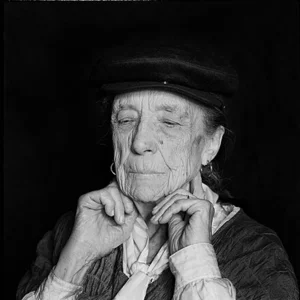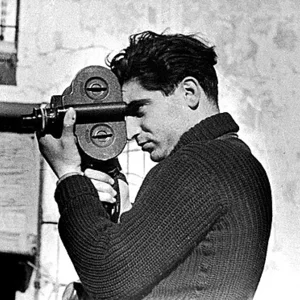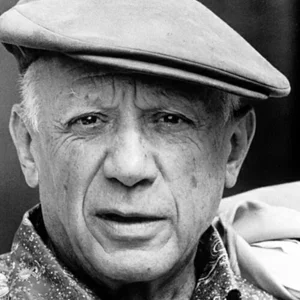

Spanish painter, sculptor and printmaker (1881-1973), Pablo Picasso was the co-founder of Cubism and one of the most influential figures in modern art. His work revolutionized artistic representation in the 20th century through radical formal innovations and political engagement, particularly against war.
Pablo Picasso(1881 — 1973)
Pablo Picasso
Espagne
9 min read
Frequently asked questions
Famous Quotes
« Every child is an artist. The problem is how to remain an artist once we grow up.»
« Art washes away from the soul the dust of everyday life.»
« I paint not what I see, but what I think.»
Key Facts
- 1901-1904: Blue Period, characterized by dark tones and melancholic themes
- 1907: Creation of Les Demoiselles d'Avignon, a founding work of Cubism and modern art
- 1912-1914: Development of Synthetic Cubism with the invention of collage
- 1937: Creation of Guernica in response to the bombing of the Basque city by the Nazi air force, becoming a symbol of the horrors of war
- 1950-1973: Late period marked by increased formal freedom and mythological themes
Works & Achievements
Monumental canvas (244 × 234 cm) held at MoMA in New York, considered the founding act of Cubism. Through the radical distortion of bodies and the influence of African masks, it definitively breaks with Western pictorial tradition.
Immense painting in black, white, and grey (349 × 776 cm), commissioned by the Spanish Republican government for the Paris International Exposition. A masterpiece of political realism, it denounces the bombing of the Basque city of Guernica and has become a universal symbol against war.
Portrait of the American collector and writer Gertrude Stein, produced after 80 sitting sessions. This painting marks the transition between the Rose Period and Picasso's first proto-Cubist experiments.
An emblematic work of Analytic Cubism, in which forms are broken down into interlocking geometric facets to the point of making the subject almost unrecognisable. The title borrows a refrain from a popular song, grounding the work in everyday life.
Lithograph depicting a white dove with outstretched wings, created at the request of the World Peace Movement. This drawing instantly became an international symbol of pacifism and resistance to the Cold War.
Large symbolist canvas from the Blue Period depicting two couples facing each other, rendered in cold, melancholic tones. It is often interpreted as a meditation on love, suffering, and the human condition, following the death of Picasso's friend Carlos Casagemas.
A series of 58 paintings completed in a few months, constituting a Cubist reinterpretation of Velázquez's famous painting. This series bears witness to the constant dialogue Picasso maintained with the Old Masters throughout his career.
Anecdotes
Picasso was considered a child prodigy: at 14, he passed the entrance exam to the Barcelona School of Fine Arts in a single day — a competition for which adult candidates were given an entire month. His father, himself a painter, symbolically handed him his brushes in acknowledgment that his son had surpassed him.
In 1907, when Picasso unveiled Les Demoiselles d'Avignon to his painter and poet friends, the reaction was almost unanimously negative. Georges Braque himself declared that it felt as though Picasso wanted to 'make people drink kerosene and spit fire'. Yet this canvas would go on to revolutionize the history of art.
During the German Occupation of Paris, Picasso continued to paint despite the restrictions imposed by the Nazis, who regarded his art as 'degenerate'. A German officer, showing him a reproduction of Guernica, asked: 'Did you do this?' Picasso replied: 'No, you did.'
Picasso was superstitious and kept objects he considered lucky charms: a baby tooth from his son Paulo, locks of hair, old shoes. He believed that destroying one of his works would bring him bad luck, which partly explains the colossal volume of his preserved output.
Well into his 90s, Picasso still worked daily in his studio. Over the course of his life he produced more than 20,000 works — paintings, sculptures, ceramics, engravings — making him one of the most prolific artists in the entire history of art.
Primary Sources
I seek to paint what I think, not what I see. Painting is a way of seizing life.
I paint objects as I think them, not as I see them. Every act of creation is first an act of destruction.
I am a communist and my painting is communist. I have sought, through painting and drawing, since those are my weapons, to penetrate ever deeper into a knowledge of the world and of mankind.
There is no abstract art. You must always start with something. Afterwards you can remove all traces of reality.
In the panel on which I am working, which I shall call Guernica, and in all my recent works of art, I clearly express my abhorrence of the military caste which has sunk Spain in an ocean of pain and death.
Key Places
Picasso's birthplace, where he was born on October 25, 1881. The Picasso Museum in Málaga today houses many of his early works and traces his Andalusian origins.
A collective studio located at 13 place Émile-Goudeau in Paris, where Picasso lived and worked from 1904 to 1909. It was there that he painted Les Demoiselles d'Avignon and met Braque, Apollinaire, and Gertrude Stein.
A Basque town bombed on April 26, 1937 by the Nazi Condor Legion and Italian fascist air forces, killing hundreds of civilians. This tragedy inspired Picasso to create his most famous political masterpiece.
A ceramics town where Picasso settled in 1946 and revolutionized local craftsmanship. He produced over 4,000 ceramic works there and painted War and Peace on the walls of the castle's Romanesque chapel.
Located in the Hôtel Salé in the Marais district, this museum holds the largest public collection of Picasso's works in the world, assembled from the donation of his estate to the French state in 1979.
A Provençal village where Picasso spent his final years at his villa Notre-Dame-de-Vie. He died there on April 8, 1973, having continued to paint until the day before his death.
Typical Objects

Picasso worked with a wide variety of brushes and palettes cluttered with colors. His studio was renowned for its creative disorder, where tools lay scattered among canvases and collected objects.

A committed communist, Picasso regularly read L'Humanité, the newspaper of the French Communist Party. He published drawings in it and expressed his political commitments against war and fascism.

The discovery of African and Oceanic masks at the Trocadéro museum in 1907 was a revelation for Picasso and directly influenced the creation of Les Demoiselles d'Avignon. These objects opened the way for him towards an expressionist distortion of faces.

From 1946 onwards, Picasso became passionate about ceramics in Vallauris. He used the potter's wheel to create thousands of original pieces, exploring a new medium with the same inventiveness he brought to painting.

The guitar is a recurring object in Picasso's work, a symbol of his Spanish origins and a favourite theme of his Cubist period. He also created a guitar in sheet metal and wire in 1912, a revolutionary three-dimensional sculpture.

Picasso never travelled without a sketchbook. Dozens of sketchbooks have been preserved, bearing witness to his perpetually moving visual thinking and the genesis of his major works.
School Curriculum
Vocabulary & Tags
Key Vocabulary
Daily Life
Morning
Picasso rarely got up before noon. He devoted his mornings to reading the press, particularly L'Humanité, and to receiving visitors in his bed, a habit typical of the bohemian artists of Montparnasse. He would have a strong black coffee before starting work.
Afternoon
The afternoon was dedicated to intensive work in the studio, often until nightfall. Picasso could paint for hours on end in focused silence, but also in a frenetic agitation, moving from one canvas to another without a break.
Evening
Evenings were often social: Picasso frequented the cafés of Montparnasse such as Le Dôme or La Rotonde, meeting up with his poet friends (Apollinaire, Éluard), gallerists (Kahnweiler), and collectors. He might also return to the studio to work until the early hours of the morning.
Food
Picasso appreciated Spanish cuisine: paella, tapas, gazpacho. In Paris, he enjoyed simple bistros and red wine. In Vallauris, he savored local produce from the Côte d'Azur: grilled fish, olives, and vegetables from the Provençal market.
Clothing
In his Montmartre youth, Picasso wore painter's overalls, often stained with colors, and a Basque beret. As he aged and after achieving success, he adopted more relaxed yet neat attire: a striped marinière shirt, loose trousers, and espadrilles on the Côte d'Azur.
Housing
In Paris, Picasso lived in studios often cluttered with miscellaneous objects, stacked canvases, and collected curiosities. At the Bateau-Lavoir, conditions were spartan and precarious. After his fortune was made, he settled into large properties: the Villa La Californie in Cannes, then Notre-Dame-de-Vie in Mougins, where he had vast working spaces.
Historical Timeline
Period Vocabulary
Visual Style
Esthétique cubiste : formes géométriques fragmentées, points de vue multiples superposés, contours noirs tranchants, palette alternant les gris dramatiques de Guernica et les ocres chauds des périodes rose et classique.
Sound Ambience
L'univers sonore de l'atelier de Picasso à Paris : pinceaux sur la toile, bruits de la rue montmartroise, accordéon de café et conversations en espagnol et en français.
Liens externes & ressources
Références
Œuvres
Les Demoiselles d'Avignon
1907
Ma Jolie (Femme à la guitare)
1911-1912
La Colombe de la paix
1949