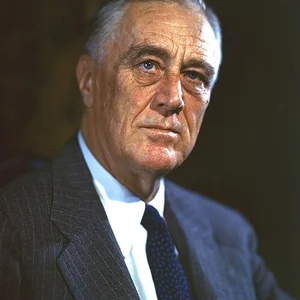
Franklin D. Roosevelt
Franklin Delano Roosevelt
1882 — 1945
États-Unis
President of the United States from 1933 to 1945, Franklin D. Roosevelt led the country through the Great Depression and World War II. He implemented the New Deal, a sweeping program of social and economic reforms, and played a decisive role in the Allied victory.
Émotions disponibles (6)
Neutre
par défaut
Inspiré
Pensif
Surpris
Triste
Fier
Famous Quotes
« The only thing we have to fear is fear itself. »
« A date which will live in infamy. »
« The test of our progress is not whether we add more to the abundance of those who have much; it is whether we provide enough for those who have too little. »
Key Facts
- Elected president in 1932 at the height of the Great Depression
- Launched the New Deal (1933): a program of economic and social reforms including job creation, aid to farmers, and social welfare protections
- Led the United States through World War II (1941–1945) following the attack on Pearl Harbor
- Yalta Conference (February 1945): met with Churchill and Stalin to shape the post-war world order
- Died in office on April 12, 1945, shortly before the end of the war in Europe
Works & Achievements
A vast program of economic and social reforms comprising dozens of laws and federal agencies to combat the Great Depression. It permanently transformed the role of the federal government in the American economy.
The founding law of the American social protection system, establishing old-age insurance, unemployment insurance, and family assistance. It remains the cornerstone of social security in the United States.
A program allowing the United States to supply military equipment to the Allies even before entering the war. It was crucial in supporting Great Britain and the USSR against the Axis powers.
A joint declaration with Churchill defining the principles of a world order founded on freedom, the right of peoples to self-determination, and international cooperation. It foreshadowed the Declaration of the United Nations.
Roosevelt was one of the principal architects of the United Nations project, whose charter was signed in San Francisco in June 1945, two months after his death.
A landmark speech in which Roosevelt outlined the four fundamental freedoms that the United States must defend throughout the world: freedom of speech, freedom of worship, freedom from want, and freedom from fear.
Anecdotes
In 1921, at the age of 39, Franklin Roosevelt was struck by poliomyelitis, which paralyzed both his legs. Despite this disability, he refused to abandon politics and learned to stand upright with steel braces, concealing his wheelchair from the public as much as possible. This determination forged his image as a man capable of overcoming any ordeal.
At his inauguration in March 1933, in the depths of the Great Depression, Roosevelt delivered a phrase that became famous: "The only thing we have to fear is fear itself." This speech galvanized a nation on the brink of despair and marked the beginning of a presidency of unprecedented energy.
Roosevelt was the first American president to make extensive use of radio to address citizens directly. His Fireside Chats, broadcast between 1933 and 1944, allowed him to explain his policies in simple, reassuring language. It is estimated that up to 60 million Americans listened to these broadcasts.
He is the only President of the United States to have been elected four consecutive times, in 1932, 1936, 1940, and 1944. This exception led to the adoption of the 22nd Amendment to the Constitution in 1951, which now limits the presidency to two terms.
Roosevelt had a passion for philately and owned a collection of more than one million stamps. He regularly devoted his evenings to sorting and examining his stamps, even during the most critical periods of the war, claiming that the activity helped him relax and think.
Primary Sources
So, first of all, let me assert my firm belief that the only thing we have to fear is fear itself — nameless, unreasoning, unjustified terror which paralyzes needed efforts to convert retreat into advance.
I want to talk for a few minutes with the people of the United States about banking. [...] I can assure you that it is safer to keep your money in a reopened bank than under the mattress.
Yesterday, December 7th, 1941 — a date which will live in infamy — the United States of America was suddenly and deliberately attacked by naval and air forces of the Empire of Japan.
We look forward to a world founded upon four essential human freedoms: freedom of speech, freedom of worship, freedom from want, freedom from fear.
Their countries seek no aggrandizement, territorial or other. They desire to see no territorial changes that do not accord with the freely expressed wishes of the peoples concerned.
Key Places
The Roosevelt family estate where Franklin was born and raised. Now a national historic site, it is also where he is buried alongside Eleanor.
The presidential residence where Roosevelt lived for more than twelve years, an absolute record. It was from the Oval Office that he led the country through the Depression and the war.
A thermal spa resort where Roosevelt regularly came to treat his paralyzed legs in the warm waters. It is there that he died on April 12, 1945, in what he called his "Little White House".
Site of the famous February 1945 conference bringing together Roosevelt, Churchill, and Stalin to decide the fate of post-war Europe and the creation of the United Nations.
American naval base attacked by Japan on December 7, 1941, an event that led Roosevelt to ask Congress to declare war and to engage the United States in the global conflict.
Typical Objects
Roosevelt used a wheelchair adapted from a kitchen chair, which he had modified to be as discreet as possible. This object symbolizes both his disability and his determination never to appear diminished.
His long cigarette holder tilted upward became an iconic symbol of his public image. He always held it with confidence, projecting an air of assurance and optimism.
An essential instrument of his famous "Fireside Chats", the CBS or NBC radio microphone allowed him to reach millions of American households directly.
Roosevelt frequently wore a Navy cape, a reminder of his deep attachment to the United States Navy and his former position as Assistant Secretary of the Navy.
His philatelic collection contained more than one million stamps from around the world. He devoted time each day to this passion, which had accompanied him since childhood.
After contracting polio, Roosevelt wore metal braces weighing approximately 5 kg each, allowing him to stand upright and walk a few steps while leaning on someone's arm.
School Curriculum
Vocabulary & Tags
Key Vocabulary
Tags
Concept
Daily Life
Morning
Roosevelt typically started his day late, around 8:30–9 AM, having breakfast in bed while going through a stack of newspapers and reports. He would then receive his closest advisors in his bedroom, still in his pajamas, for informal morning briefings. This routine was partly explained by the physical difficulty of getting dressed with his leg braces.
Afternoon
The afternoon was devoted to official meetings in the Oval Office, bill signings, and press conferences, which he conducted with remarkable ease. Roosevelt excelled at the art of conversation and could move through back-to-back appointments with diplomats, lawmakers, and military commanders. He rarely took notes, preferring to memorize information.
Evening
In the evenings, Roosevelt often dined in a small circle with close friends, advisors, or distinguished guests, enjoying lively conversation and cocktails that he mixed himself. After dinner, he would retire to work on his stamp collection or watch films in the White House screening room. During the war, evenings were often devoted to communications with Allied heads of state.
Food
Roosevelt enjoyed simple American fare: scrambled eggs, grilled fish, and his famous hot dogs, which he even served to the King and Queen of England during their 1939 visit. He enjoyed mixing cocktails, particularly Martinis, which he served during the 'Children's Hour,' his end-of-day social ritual. His diet grew simpler during the war, as the White House symbolically observed rationing.
Clothing
Roosevelt wore elegant three-piece suits, often in dark colors, paired with a patterned tie and his iconic cigarette holder. He was particularly fond of his Navy cape and soft felt hat, which became iconic elements of his public image. At Hyde Park, he adopted a more relaxed style with tweeds and sweaters.
Housing
The White House was his primary residence for more than twelve years, but Roosevelt maintained a deep attachment to Springwood, the family estate in Hyde Park overlooking the Hudson. He traveled regularly to Warm Springs, Georgia, where he had built a modest cottage near the thermal springs. These three places formed the triangle of his daily life.
Historical Timeline
Period Vocabulary
Gallery
Franklin D. Roosevelt - Portrait by Jacob H. Perskie
Franklin Delano Roosevelt portrait painting LCCN2016894437

Franklin D. Roosevelt - Portrait by Henry Salem Hubbell
Portrait paintings of Franklin Delano Roosevelt, George Washington and Alexander Hamilton on May 24, 2023 in the Oval Office of the White House - P20230524AS-0223
Franklin D Roosevelt statue, Kelvingrove Museum, Glasgow - DSC06230

FDR statue, Grosvenor Square
Franklin D. Roosevelttitle QS:P1476,en:"Franklin D. Roosevelt"label QS:Len,"Franklin D. Roosevelt"
Joseph Stalin, Franklin D Roosevelt and Winston Churchill, in Teheran, 1943, edit
FDR 1944 Color Portrait
Visual Style
Style visuel inspiré du réalisme américain des années 1930-1940, mêlant l'esthétique Art Déco des affiches du New Deal et la gravité des photographies de guerre. Les tons chauds dorés et sépia contrastent avec le bleu marine de l'autorité présidentielle.
AI Prompt
1930s-1940s American political realism with Art Deco influences. Strong vertical lines echoing New Deal architecture and WPA murals. Warm sepia and golden tones reminiscent of vintage photographs, contrasted with the deep navy blue of presidential authority. Propaganda poster aesthetics with bold geometric shapes and heroic compositions. Interior scenes lit by warm desk lamps casting dramatic shadows, evoking the intimacy of fireside radio broadcasts. Exterior scenes show grand federal buildings, industrial progress, and wartime mobilization. The overall style balances optimism and gravitas — muscular New Deal modernism meets the somber weight of a world at war. Typography inspired by 1930s American newspaper headlines.
Sound Ambience
Ambiance mêlant la chaleur d'un salon américain des années 1930 avec le crépitement d'un poste de radio, et les sons plus graves d'un quartier général en temps de guerre. L'atmosphère évoque à la fois la proximité des causeries au coin du feu et la tension d'une nation en guerre.
AI Prompt
Crackling radio static transitioning into a warm, resonant male voice speaking through a vintage microphone. Background sounds of a 1930s American living room: a ticking mantel clock, the soft creak of a wooden rocking chair, a fireplace gently crackling. Distant sounds of a bustling Washington D.C. street — car horns from 1940s automobiles, newsboys shouting headlines. Occasional sounds of typewriters clacking in a busy press room. Military sounds fade in: distant aircraft engines, naval ship horns in a harbor, the organized bustle of a war room with officers murmuring over maps. The ambient tone shifts between domestic warmth and the gravity of wartime command.
Portrait Source
Wikimedia Commons — CC BY 2.0 — Leon Perskie — 1944
Aller plus loin
Références
Œuvres
Le New Deal
1933-1938
Social Security Act
1935
Loi prêt-bail (Lend-Lease Act)
1941
Création de l'ONU
1944-1945
Discours des Quatre Libertés
1941