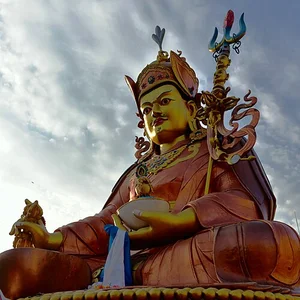

Indian tantric Buddhist master of the 8th century, regarded as the founder of Tibetan Buddhism. Nicknamed Guru Rinpoche (“precious master”), he is said to have introduced Vajrayana Buddhism to Tibet and founded the country's first monastery.
Padmasambhava(717 — 762)
Padmasambhava
6 min read
Frequently asked questions
Key Facts
- 8th century: tantric master originally from the region of Oddiyana (northwestern part of the Indian subcontinent)
- Around 770-780: invited to Tibet by King Trisong Detsen to establish Buddhism there
- Took part in the founding of Samye, the first Buddhist monastery in Tibet
- Regarded as the founder of the Nyingma school, the oldest tradition of Tibetan Buddhism
- A figure venerated under the name Guru Rinpoche, surrounded by numerous hagiographic accounts
Works & Achievements
Padmasambhava is credited with establishing Tantric Buddhism in Tibet, lastingly transforming the country's culture and spirituality.
According to tradition, he consecrated the site and subdued the spirits that were obstructing the construction, making possible the building of the first Tibetan monastery.
The oldest of the four great schools of Tibetan Buddhism claims him as its founder and the source of its teachings.
He is said to have hidden countless spiritual treasures throughout Tibet, thereby founding a tradition of revelation that remains alive to this day.
This famous guide for navigating the intermediate states after death is traditionally attributed to him as a terma.
He is said to have transmitted the teachings of the “Great Perfection,” the pinnacle of the Nyingma school's contemplative path.
He trained a circle of accomplished disciples, including Yeshe Tsogyal and King Trisong Detsen, guardians of the transmission of his lineage.
Anecdotes
According to Tibetan tradition, Padmasambhava was not born from a mother but is said to have appeared miraculously, seated upon a fully bloomed lotus flower in the middle of Lake Dhanakosha. This is why he is called "Padmasambhava
which means "the one born from the lotus.
Legend has it that the Tibetan king Trisong Detsen was trying to build the monastery of Samye, but local spirits and demons would destroy each night what the workers built during the day. Padmasambhava was called upon and, through his tantric powers, is said to have subdued these hostile forces and converted them into protectors of Buddhism.
Padmasambhava is credited with hiding spiritual treasures called "termas
: texts
objects
and teachings concealed in rocks
lakes
or even the realm of the mind
meant to be rediscovered centuries later by predestined masters known as
tertöns.
Tradition attributes to him eight different manifestations, the "Eight Names" or "Guru Tsen Gye
each corresponding to a stage of his life or a mode of action: from the peaceful sage Padmasambhava to the fearsome Dorje Drolö riding a tigress.
According to the accounts, his principal disciple and spiritual consort, Yeshe Tsogyal, is said to have written down his teachings and helped him hide the termas throughout Tibet, becoming herself a revered figure of Tibetan Buddhism.
Primary Sources
Born from a lotus in the heart of the lake, with neither father nor mother, he appeared as an eight-year-old child, radiant with the marks of perfection.
The master subdued the eight classes of gods and demons of Tibet and bound them by oath to protect the doctrine.
For future generations, I have concealed countless treasures of teaching; in due time, the destined tertöns will reveal them.
King Trisong Detsen invited the master of Oddiyana to pacify the spirits that opposed the construction of Samyé.
Key Places
Legendary lake where Padmasambhava is said to have appeared upon a lotus flower. Oddiyana is often located in the Swat Valley, in present-day Pakistan.
The first great Buddhist monastery in Tibet, whose completion Padmasambhava is said to have made possible by subduing hostile spirits. Located in the Yarlung Valley.
Nepalese cave where, according to tradition, Padmasambhava attained realization through the practice of the phurba. A major site of Buddhist pilgrimage.
A complex of meditation caves near Lhasa where Padmasambhava and his disciples are said to have retreated to practice. A major sacred site of central Tibet.
A mythical paradise where, according to tradition, Padmasambhava still resides, having not died but departed for a pure land. A place of spiritual pilgrimage and meditative visualization.
Liens externes & ressources
Références
Œuvres
Introduction du bouddhisme vajrayana au Tibet
VIIIe siècle
Achèvement du monastère de Samyé
v. 767–779
Fondation de l'école Nyingma
VIIIe siècle
Dissimulation des termas
VIIIe siècle
Le Livre des morts tibétain (Bardo Thödol)
VIIIe siècle (révélé au XIVe)
Transmission du Dzogchen
VIIIe siècle
Formation des vingt-cinq disciples
VIIIe siècle