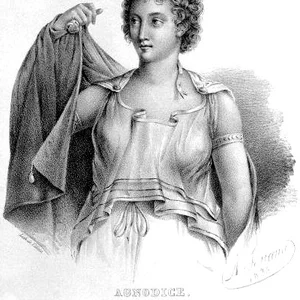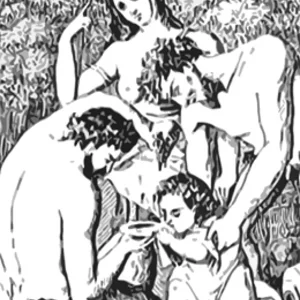

Greek goddess of universal healing, daughter of Asclepius and Epione. She personified the remedy capable of curing all ailments. Her name, meaning “she who heals all” in Greek, is the origin of the word “panacea” in modern languages.
Panacea
Panacea
8 min read
Frequently asked questions
Key Facts
- Daughter of Asclepius, god of medicine, and Epione, goddess of the soothing of pain
- Venerated alongside her sisters Hygieia (goddess of health) and Iaso (goddess of healing)
- Her Greek name Πανάκεια literally means “she who heals all” (pan = all, akos = remedy)
- She was associated with medicinal plants and universal healing preparations
- Her name gave rise to the word “panacea” in English, denoting a supposed cure for all ailments
Works & Achievements
Founding text of Western medical ethics, which invokes Panacea by name. This mention confirms her status as the tutelary goddess of medicine and links her cult to the professional practice of physicians.
A short liturgical poem celebrating Asclepius and his daughters as bestowers of health upon mortals, representing one of the earliest literary attestations of the divine group to which Panacea belongs.
A collection of accounts of miraculous healings inscribed in stone at the sanctuary of Epidaurus, bearing witness to the popular belief in the power of healing deities, of which Panacea was one.
A Greek comedy depicting a miraculous healing in a temple of Asclepius, vividly illustrating Athenian belief in divine curative powers during the practice of incubation.
A geographical and religious guide mentioning representations and cults of Panacea in the Asclepieia. An essential source for understanding the goddess's place in the Greek healing pantheon during the Imperial period.
Anecdotes
Panacea is among the deities invoked in the Hippocratic Oath, written in the 5th century BCE. This founding text of Western medicine mentions her name alongside Apollo, Asclepius, and Hygieia, reflecting the importance placed on universal healing in ancient Greek medical thought.
The name Panacea literally means "she who heals all" in Greek, formed from pan (all) and akos (remedy). This etymology has traveled through the centuries and given rise to the word "panacea" in modern languages, used today to describe a supposedly universal cure — often with a hint of skepticism.
Panacea was one of the daughters of Asclepius and Epione, forming with her sisters a true divine college of health. Her sisters Hygieia (prevention), Iaso (the healing of diseases), and Aceso (the process of convalescence) complemented her role: together, they covered every aspect of care, from prevention to complete recovery.
The sanctuaries of Asclepius, known as Asclepieia, were pilgrimage sites where the sick came seeking healing. There they practiced incubation: patients slept on-site, hoping to receive in a dream a healing vision from the god or his daughters, including Panacea. These practices blended the religious and the medical in an inseparable way in ancient Greece.
Panacea's cup, filled with potions and medicinal herbs, is her main attribute in ancient iconography. The Greeks believed that certain plants, notably mandrake and hellebore, possessed near-universal healing properties, reflecting the belief in a plant-based panacea that the goddess was said to hold and distribute to mortals.
Primary Sources
I swear by Apollo the physician, by Asclepius, by Hygieia and Panacea, and by all the gods and goddesses, making them my witnesses, that I will fulfill according to my ability and judgment this oath and this covenant.
The suppliants lay down in the temple of Asclepius. The priestess extinguished the lamps and ordered everyone to sleep in silence. The healing god and his divine daughters came to bring remedies and relief to those in need.
To Asclepius and Panacea, a votive offering of thanksgiving for the healing granted after the sacred sleep in the sanctuary. The god appeared in a dream and revealed the remedy that dispelled the illness.
At Epidaurus stands the sanctuary of Asclepius. There one sees statues of his daughters Hygieia and Panacea, placed beside the god. Sacrifices are offered to the divinities of healing before entering the sacred temple.
I sing of Asclepius, son of bright Apollo, great healer of painful diseases. Beside him, his gentle-handed daughters dispense health and universal remedy to all suffering mortals.
Key Places
The principal Panhellenic sanctuary dedicated to Asclepius and his daughters, including Panacea. This major site welcomed sick pilgrims from across the Greek world to practice incubation healing rituals.
Sanctuary on the birthplace of Hippocrates, where the cult of Asclepius and his daughters intertwined with the emerging practice of rational medicine. Panacea was honored here as the patron of universal remedies.
Sanctuary founded around 420 BCE at the base of the sacred Acropolis rock, where Panacea and her sisters were venerated at the heart of the principal Greek city.
The site where the Roman cult of Aesculapius was established in 293 BCE, along with his daughters including Panacea. This small island in the Tiber became a religious and medical center perpetuating the tradition of the Greek healing sanctuaries.
An important Hellenistic city housing a renowned Asclepieion, frequented notably by the physician Galen in the 2nd century CE. The cult of Panacea flourished here as it did in all the great healing sanctuaries.
Liens externes & ressources
Références
Œuvres
Serment d'Hippocrate
Ve siècle av. J.-C.
Hymnes homériques — Hymne à Asclépios (XVI)
VIIe–VIe siècle av. J.-C.
Stèles d'Épidaure (Iamata)
IVe–IIIe siècle av. J.-C.
Ploutos (Aristophane)
388 av. J.-C.
Description de la Grèce (Pausanias)
IIe siècle apr. J.-C.