
Papa Legba is the loa guardian of crossroads in Haitian Vodou religion. Depicted as an old man with a cane, he is the essential intermediary between humans and the other spirits. No ceremony can begin without first invoking his permission.
Papa Legba
Papa Legba
10 min read
Frequently asked questions
Key Facts
- Papa Legba traces his origins to the god Legba of the Fon people (Dahomey, present-day Benin), brought to the Americas by enslaved Africans in the 17th–18th centuries
- He is the first loa invoked in any Vodou ceremony: without him, no other spirit can be reached
- His symbol is the crossroads, a threshold between the world of the living and the world of spirits
- He is associated with the rising sun, children, and communication, and manifests as a limping old man leaning on a cane
- In Haitian syncretic religion, he is often associated with Saint Lazarus or Saint Anthony from Catholic iconography
Works & Achievements
A lengthy liturgical prayer in Haitian Creole and langaj (African ritual language) recited at the beginning of every Vodou ceremony. Papa Legba is invoked first, as guardian of the 'barrier' (baryè) between the visible and invisible worlds.
A sacred graphic symbol depicting an equal-armed cross, drawn in cornmeal or rice flour on the floor of the peristyle before each ceremony. This 'spiritual emblem' is one of the oldest and most fundamental in the Haitian Vodou pantheon.
A corpus of Creole songs passed down orally among houngans and mambos to invoke Papa Legba. The best-known song opens with 'Attibon Legba, ouvri baryè pou moin' ('Legba, open the barrier for me') and serves as the obligatory threshold of every ceremony.
A visual and spiritual fusion between Papa Legba and the Catholic image of Saint Lazarus, depicted as an old man on crutches. This syncretic creation stands as a testament to the cultural resistance of Haitian enslaved people under the Code Noir regime.
The first rigorous and comprehensive anthropological study of Haitian Vodou, published by Franco-Swiss scholar Alfred Métraux following several extended stays in Haiti. This landmark work contains detailed documentation on Papa Legba — his rites, attributes, and central role in Vodou cosmology.
A presidential decree under Jean-Bertrand Aristide officially recognizing Haitian Vodou as a national religion, granting Vodou ceremonies (baptisms, marriages) legal standing. This act institutionally consecrated the status of Papa Legba and the lwa within Haitian culture.
Anecdotes
Papa Legba has his roots in the Legba deity of the Fon and Ewe peoples of Dahomey (present-day Benin). When millions of Africans were forcibly transported to Saint-Domingue in the 17th and 18th centuries, they brought their beliefs with them. Legba survived the Middle Passage and was transformed on Haitian soil into the guardian of the crossroads between the world of the living and the world of spirits.
In Haitian Vodou practice, no ceremony can begin without first invoking Papa Legba. Houngans (priests) and mambos (priestesses) sing the opening prayer — the Priyè Ginèn — addressing him so that he will open the invisible 'barrier' separating humans from the lwa. Without his permission, no spirit can be contacted.
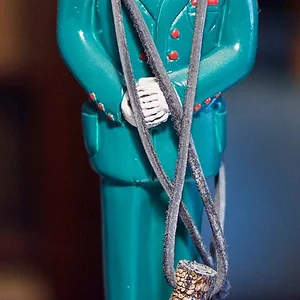
Papa Legba is associated with Saint Lazarus in Haitian popular Catholicism, a phenomenon known as syncretism. Enslaved people forced to convert to Christianity adopted Catholic imagery while continuing to honor their traditional lwa. Saint Lazarus, depicted as a poor old man leaning on crutches, visually recalled the form of Papa Legba as an elderly man with a cane.
Papa Legba's vévé — his ritual symbol drawn in cornmeal or rice flour on the ground before a ceremony — represents an equal-armed cross, the universal symbol of the crossroads. This ritual drawing acts as a 'spiritual address,' allowing the lwa to be located and invited into the ceremony. Each lwa has its own vévé, but Legba's is always drawn first.
The figure of Papa Legba crossed the Atlantic in the other direction with the enslaved people brought to Louisiana. In New Orleans, he became a central figure in Louisiana Voodoo. In the Afro-American musical traditions of the American South, the character of the old man guarding the crossroads left a lasting mark on the collective imagination, particularly in the lore surrounding the blues.
Primary Sources
It is an assembly of all manner of supernatural beings whose chief is called Vaudoux. He is the great serpent [...] The King or Queen open the dance in his honor, after invoking the intermediary spirits.
The Negroes of the Juda coast [...] hold a particular veneration for the serpent, especially for a certain species of snake [...] They consult their priests, whom they call Ganga, before any important undertaking.
We order all our subjects [...] to have baptized and instructed in the Catholic, Apostolic and Roman religion all the enslaved persons in our islands [...] We forbid all religions other than the Catholic.
The enslaved people of the hills gather at night to practice their African dances and ceremonies [...] They invoke their deities through songs in Creole and African languages before any gathering.
Before beginning their dances and invocations, the Blacks always address a spirit they call the guardian of the gate, without whose permission they say the other spirits cannot be reached.
Key Places
Sacred city of the Kingdom of Dahomey and birthplace of the Legba cult among the Fon and Ewe peoples. It was from this coastal region of West Africa that thousands of captives were deported to Saint-Domingue, carrying with them the worship of the vodun Legba.
Site of the Voodoo ceremony held on August 14, 1791, traditionally regarded as the starting point of the uprising that led to Haitian independence. This place symbolizes the connection between Voodoo spirituality, lwa such as Papa Legba, and political resistance.
Capital of Haiti and a vibrant center of contemporary Voodoo practice. The peristyles (Voodoo temples) of Port-au-Prince house altars dedicated to Papa Legba, and the city hosts public ceremonies each year in which he is the first lwa to be invoked.
The city where Louisiana Voodoo developed in the 18th century, brought by enslaved Africans imported through the port of New Orleans. Papa Legba was venerated there in adapted forms, leaving an enduring mark on the culture and music of the Mississippi Delta.
A major pilgrimage site in Haiti where thousands of Voodoo and Catholic devotees gather each July. The crossroads and water sources there are regarded as points of contact between the human world and that of the lwa, reflecting Legba's role as guardian of thresholds and passages.
Liens externes & ressources
Références
Œuvres
La Priyè Ginèn — prière d'ouverture des cérémonies vaudou
XVIIe–XVIIIe siècles (tradition orale codifiée)
Vévé de Papa Legba — dessin rituel codifié
XVIIe–XVIIIe siècles
Chants rituels dédiés à Papa Legba ('Attibon Legba, ouvri baryè pou moin')
XVIIIe–XIXe siècles (tradition orale)
Syncrétisme Legba/Saint Lazare dans l'iconographie populaire haïtienne
XVIIIe–XIXe siècles
Le Vaudou haïtien — Alfred Métraux
1958
Reconnaissance officielle du vaudou comme religion nationale — République d'Haïti
2003