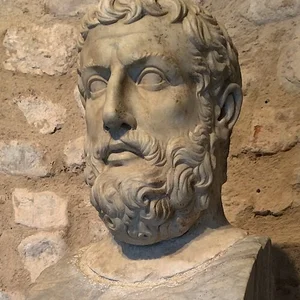

Greek philosopher of the 5th century BC and founder of the Eleatic school. He developed a radical metaphysics asserting that Being is one, unchanging, and eternal — rejecting any notion of change or multiplicity.
Parmenides(514 av. J.-C. — 469 av. J.-C.)
Parmenides
7 min read
Frequently asked questions
Famous Quotes
« What is, is; what is not, is not.»
« You must learn all things: both the unshaken heart of well-rounded Truth, and the opinions of mortals, in which there is no true belief.»
Key Facts
- Born around 515 BC in Elea, a Greek colony in southern Italy
- Founder of the Eleatic school, a Pre-Socratic philosophical movement
- Author of the philosophical poem 'On Nature' (Περὶ φύσεως), around 475 BC
- Directly influenced Plato, who dedicated a dialogue to him ('Parmenides')
- Taught Zeno of Elea, famous for his paradoxes about motion
Works & Achievements
The only known work of Parmenides, written in dactylic hexameter — the meter of Homer. Structured in two parts (the Way of Truth and the Way of Opinion), this philosophical poem is the first Western text to address the question of Being in a rigorous way.
A legal code attributed to Parmenides by Diogenes Laërtius and Plutarch. Although no text has survived, their reputation was such that the citizens of Elea renewed their oath to uphold them every year for several centuries.
Around sixty fragments of the poem have survived through quotations by Aristotle, Simplicius, and Sextus Empiricus. These passages form the essential basis of our knowledge of Parmenides' thought.
Anecdotes
Parmenides is said to have met the young Socrates during a visit to Athens, around 450 BC. Plato immortalized this encounter in his dialogue *Parmenides*, where the elderly philosopher rigorously challenges the ideas of the future Socrates with formidable intellectual force.
Parmenides wrote his philosophy in the form of an epic poem, in the tradition of Homer and Hesiod. This surprising literary choice was likely intended to give his abstract thought the solemnity and authority of the great sacred works of ancient Greece.
According to Diogenes Laërtius, Parmenides drafted laws for his native city of Elea, and his fellow citizens upheld and renewed them every year for several centuries. He was therefore as much a statesman as a thinker.
Parmenides argued that motion and change are pure illusions of the senses. In his view, what we perceive of the world is mere deceptive appearance: only Being — unique, motionless, and eternal — is real. This unsettling idea would go on to shape Western philosophy for millennia.
His disciple Zeno of Elea invented famous paradoxes to defend his master's ideas, including the paradox of Achilles and the Tortoise: the swift hero can never catch the slow tortoise, because he must first cover an infinite number of intermediate distances. A provocative way of showing that motion is an illusion.
Primary Sources
The mares that carry me as far as my spirit could reach conveyed me, once the goddesses had guided me along the famous road that leads, through all cities, the man who knows.
You must learn all things: both the unshaking heart of well-rounded Truth, and the opinions of mortals in which there is no true belief.
Parmenides was already well advanced in years, with hair quite white, but of noble appearance and fine bearing… Zeno was at that time about forty years old.
Our father Parmenides bequeathed us this thesis from our childhood and upholds it throughout his life: never shall this be proved — that things that are not, are.
Parmenides seems to consider the One in terms of reason, Melissus in terms of matter… Parmenides says the One is according to definition, Melissus that the One is according to matter.
Key Places
A Greek city on the Tyrrhenian coast, founded around 540 BC by Phocaean colonists, and the birthplace of Parmenides' Eleatic school of philosophy. Known today as Velia, in Campania (southern Italy), the archaeological site has been partially excavated.
The intellectual capital of the classical Greek world, which Parmenides is said to have visited around 450 BC during the Great Panathenaea, according to Plato's account in his dialogue of the same name. It was there that he reportedly met the young Socrates.
The birthplace of Greek philosophy, where Thales, Anaximander, and Anaximenes were born. Parmenides was familiar with their work, and his reflections on Being developed in dialogue with this earliest philosophical tradition.
A city of Magna Graecia where Pythagoras taught, whose influence on Parmenides' thought is attested by several ancient sources. It is believed that Parmenides had contact with Pythagoreans from this region.
Typical Objects

The primary writing medium in ancient Greece, on which Parmenides is said to have composed the verses of his philosophical poem. Presocratic philosophers wrote and circulated their ideas through these scrolls, copied by hand and preserved in great libraries.

In the proem of his poem, Parmenides depicts himself being carried toward the light of Truth by a chariot guided by goddesses. This symbolic object evokes Greek religious representations of the sun and divine revelation.

An instrument associated with epic and didactic poetry in ancient Greece. By choosing to philosophize in verse, Parmenides placed himself within the tradition of bards and god-inspired poets, lending his thought a sacred character.

A common tool for note-taking and teaching in antiquity. Parmenides and his disciples likely used them to work out the logical formulations of their arguments before committing them to papyrus.

Parmenides is credited with drafting the laws of Elea, which were inscribed on stone steles displayed in public. This object reflects his role as a lawgiver as much as a thinker.

The typical footwear of Greek philosophers, who walked the streets of their cities to teach and debate. Presocratic philosophy was practiced as much through walking and discussion as through solitary retreat.
School Curriculum
Vocabulary & Tags
Key Vocabulary
Daily Life
Morning
Parmenides rose at sunrise, as most ancient Greeks did. He likely performed a purification ritual (libation or prayer to the gods) before beginning his day. Early each morning, he would receive his disciples for the first philosophical discussion session, often walking beneath the colonnades of the agora in Elea.
Afternoon
The middle of the day, during the intense Mediterranean heat, was devoted to solitary reflection or composing his poem on wax tablets. As a respected figure in the city, he might also sit on the council or handle public affairs in his role as lawgiver.
Evening
Evening brought the cool air suited to philosophical banquets (symposia), where Parmenides debated with his close companions and students over a simple meal. Conversations centered on the nature of Being, truth, and the illusions of the senses, by the light of oil lamps.
Food
Parmenides followed the classic Mediterranean diet: barley or wheat bread, olives and olive oil, legumes (lentils, broad beans), goat or sheep's cheese, fish from the Tyrrhenian Sea, and wine diluted with water at symposia. Some Presocratic philosophers, influenced by Pythagoreanism, observed dietary restrictions, including abstaining from meat.
Clothing
Parmenides wore the chiton (a wool or linen tunic) and the himation (a large draped cloak), the standard garments of a free Greek man. As an elder philosopher and respected statesman, his himation was likely made of fine white wool, a symbol of dignity and wisdom. He wore leather sandals with straps when moving about the city.
Housing
Parmenides lived in a typical Greek house (oikos) of stone and mud brick, organized around an inner courtyard (aulé) that served as the center of daily life and teaching. The main rooms were the andron (the men's hall, used for symposia) and the gynaeceum (the women's quarters). The house likely contained a small library of scrolls and a dedicated space for reflection, opening onto the courtyard where a few olive trees grew.
Historical Timeline
Period Vocabulary
Visual Style
Scène philosophique classique grecque baignée de lumière méditerranéenne, mêlant l'architecture coloniale d'Élée, les teintes chaudes de la céramique à figures rouges et la sérénité d'un penseur en méditation face à l'infini.
Sound Ambience
L'ambiance sonore d'Élée mêle le souffle de la mer Tyrrhénienne, les discussions philosophiques sous les portiques ombragés et le bruit de fond d'une cité grecque coloniale prospère du Ve siècle av. J.-C.
Liens externes & ressources
Références
Œuvres
De la Nature (Peri Physeos)
vers 480-470 av. J.-C.
Lois d'Élée (perdues)
vers 500-480 av. J.-C.
Fragments conservés (environ 160 vers)
transmis par les sources antiques
See also
Related Characters
Alexander II of Macedon
Anaxagoras of Clazomenae
499 av. J.-C. — 427 av. J.-C.
Anaximander
609 av. J.-C. — 545 av. J.-C.
Aspasia
469 av. J.-C. — 399 av. J.-C.
Catiline
107 av. J.-C. — 61 av. J.-C.
Confucius
550 av. J.-C. — 478 av. J.-C.