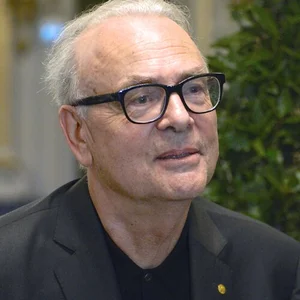

Patrick Modiano is a French writer born in 1945, winner of the Nobel Prize in Literature in 2014. His work, haunted by memory, the Occupation and the search for identity, explores the Paris of yesteryear and the shadowy corners of the past.
Patrick Modiano(1945 — ?)
Patrick Modiano
France
6 min read
Frequently asked questions
Famous Quotes
« I am a product of the dunghill of the Occupation.»
« Memory has become the magic word of our era.»
Key Facts
- Born on 30 July 1945 in Boulogne-Billancourt.
- Published his first novel, La Place de l'étoile, in 1968.
- Received the Prix Goncourt in 1978 for Rue des boutiques obscures (Missing Person).
- Co-wrote the screenplay for the film Lacombe Lucien with Louis Malle in 1974.
- Received the Nobel Prize in Literature in 2014.
Works & Achievements
His first novel and the opening volume of his “Occupation trilogy,” which boldly confronts France's past under the Occupation.
A novel awarded the Grand Prix du Roman of the Académie française; a son searches for traces of his father in the Paris of the Occupation.
A screenplay co-written with filmmaker Louis Malle about a young man sliding toward collaboration; the film left its mark on French cinema.
Prix Goncourt: an amnesiac detective investigates his own identity, a metaphor for Modiano's entire body of work.
An investigative narrative about a deported Jewish teenager, prompted by a 1941 missing-person notice; the pinnacle of his work on memory.
A spare autobiographical narrative in which Modiano traces his origins and early years up to the publication of his first book.
A choral novel centered on an enigmatic young woman in 1960s Paris, which became one of his most widely read titles.
Anecdotes
As a teenager, Patrick Modiano took mathematics lessons from the writer Raymond Queneau, a friend of his mother. Queneau introduced him to the Parisian literary world and to the publisher Gallimard, which released his first novel, *La Place de l'étoile*, in 1968. Modiano was only 22 years old at the time.
In 1988, Modiano stumbled upon a missing-person notice published in the newspaper *Paris-Soir* in December 1941: a Jewish teenager, Dora Bruder, had run away from her boarding school. For years, he searched through the archives to reconstruct her story and discovered that she had been deported to Auschwitz. He devoted an entire book to her in 1997.
Modiano's younger brother, Rudy, died at the age of ten in 1957. This loss deeply marked the writer, who dedicated several of his early books “to Rudy.” Absence, mourning, and memory became central themes throughout his work.
In 1974, Modiano co-wrote with the filmmaker Louis Malle the screenplay for the film *Lacombe Lucien*, which tells how a young peasant slides into collaboration. The film caused a scandal by directly confronting a subject long considered taboo in France: collaboration under the Occupation.
In 2014, Patrick Modiano received the Nobel Prize in Literature “for the art of memory with which he has evoked the most ungraspable human destinies.” A very private man, he admitted that he had at first thought it was a joke and learned the news while walking through Paris. He became the fifteenth French writer to be awarded this prize.
Primary Sources
In June 1942, a German officer walks up to a young man and says: “Excuse me, sir, where is the Place de l'Étoile?” The young man points to the left side of his chest.
I am nothing. Nothing but a pale shape, that evening, on the terrace of a café.
Missing: a young girl, Dora Bruder, 15 years old, height 1.55 m, oval face, grey-brown eyes... Send any information to M. and Mme Bruder, 41 Boulevard Ornano, Paris.
Key Places
Town in the western suburbs of Paris where Patrick Modiano was born on July 30, 1945.
Modiano lives and works in Paris, on the Left Bank, near the Luxembourg Gardens. The city is the setting and the subject of nearly all his work.
Village in the Yvelines region where Modiano and his brother Rudy spent part of their childhood, often far from their parents.
Address of Dora Bruder's family in the 18th arrondissement, the starting point of Modiano's investigation into this deported teenage girl.
Swedish capital where Modiano received the Nobel Prize in Literature in December 2014.
Typical Objects

Modiano writes his novels by hand, slowly, crossing out and reworking his sentences. The manuscript is his primary working tool.

Pre-war and Occupation-era newspapers serve as his sources. It is in Paris-Soir that he discovers the missing-person notice for Dora Bruder.

Modiano consults old directories and address books to find addresses and reconstruct the trail of people who have vanished. The object becomes an instrument for investigating the past.

Old photographs, often blurry or anonymous, populate his stories like fragments of memory. They evoke the absent and erased lives.

Parisian topography — streets, buildings, neighborhoods — structures his novels. The city map becomes a chart of memory and of time lost.

A badge that the Nazi regime forced Jews to wear from 1942 onward in the occupied zone. The title La Place de l'étoile plays on this mark of stigmatization worn on the chest.
School Curriculum
Vocabulary & Tags
Key Vocabulary
Daily Life
Morning
Modiano writes in the morning, by hand, in notebooks, progressing slowly and crossing out a great deal. He describes writing as a patient labor of returning to the past rather than a sudden inspiration.
Afternoon
The writer is known for his long walks through Paris, where he observes streets, façades, and buildings. These wanderings feed the meticulous topography of his novels, alongside his work in archives and old directories.
Evening
Renowned for his discretion, Modiano leads a retiring, family-centered life on the Left Bank. His evenings are devoted to reading and quiet, far from literary social life.
Food
His daily life is that of a contemporary Parisian: simple meals and visits to neighborhood cafés. Cafés, places of passage and memory, recur often in his books.
Clothing
Modiano dresses in a plain, contemporary manner, true to his reserved temperament. He shuns pomp and cultivates a great deal of public discretion.
Housing
He lives in a Parisian apartment on the Left Bank, in the neighborhood near the Jardin du Luxembourg. This Parisian rootedness is inseparable from his work.
Historical Timeline
Period Vocabulary
Liens externes & ressources
Références
Œuvres
La Place de l'étoile
1968
Les Boulevards de ceinture
1972
Rue des Boutiques Obscures
1978
Dora Bruder
1997
Un pedigree
2005
Dans le café de la jeunesse perdue
2007