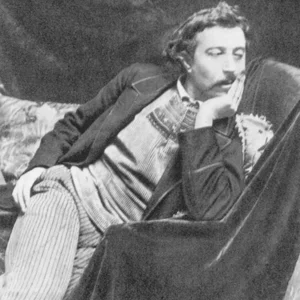

Paul Gauguin was a French Post-Impressionist painter and a major figure of modern art. Rejecting Western civilization, he settled in Polynesia, where he painted brightly colored works celebrating Tahitian life. His synthetist style profoundly influenced 20th-century art.
Paul Gauguin(1848 — 1903)
Paul Gauguin
France
6 min read
Frequently asked questions
Famous Quotes
« I shut my eyes in order to see.»
« Color! That language so deep and so mysterious, the language of dreams.»
Key Facts
- Born on 7 June 1848 in Paris, died on 8 May 1903 in Atuona (Marquesas Islands)
- Gave up his career as a stockbroker in 1883 to devote himself to painting
- Worked in Pont-Aven in Brittany and developed Synthetism from 1886 onward
- Had a turbulent stay with Vincent van Gogh in Arles in 1888
- First voyage to Tahiti in 1891, where he painted his most famous works, such as 'Where Do We Come From? What Are We? Where Are We Going?' (1897)
Works & Achievements
A key work of Synthetism: an unreal red background separates reality from the world imagined by Breton peasant women.
Painted in Pont-Aven, this canvas blends Breton folk religion with symbolic colors, a manifesto of his art.
A religious scene transposed to Tahiti, merging Christian iconography with the Polynesian world.
A famous Tahitian painting in which Gauguin links a young woman to the belief in the spirits of the night.
A portrait of two Tahitian women in dazzling colors, which became one of the most expensive paintings in history.
A vast testamentary fresco summing up his questions about life, death, and human destiny.
An illustrated account of his stay in Tahiti, combining text, woodcuts, and watercolors.
Anecdotes
Before becoming a painter, Gauguin worked as a stockbroker at the Paris Stock Exchange and earned a very good living. It was only around the age of 35, after the stock market crash of 1882, that he decided to give it all up and devote himself entirely to painting.
In 1888, Gauguin and Vincent van Gogh shared the “Yellow House” in Arles for nine weeks. Their cohabitation turned to tragedy: after a violent quarrel, Van Gogh mutilated part of his ear, and Gauguin left the town for good.
Gauguin spent part of his childhood in Peru, in Lima, with his mother's family. These memories of a distant and colorful world fueled his lifelong attraction to exotic lands and so-called “primitive” civilizations.
In 1891, he set sail for Tahiti, convinced he would find an unspoiled paradise there. Disappointed to discover an island already transformed by colonization, he nonetheless painted idealized scenes of Polynesian life that would make him famous.
His great canvas *Where Do We Come From? What Are We? Where Are We Going?* (1897-1898) was painted while he was ill and in despair; he claimed to have conceived it as a kind of artistic testament before a suicide attempt.
Primary Sources
Civilization is gradually leaving me. I am beginning to think simply, to feel only a little hatred for my neighbor — better still, to love him.
I am a great artist and I know it. It is because I am one that I have endured such suffering.
I wanted to establish the right to dare anything. The public owes me nothing, since my painted work is only relatively good; but the painters who today enjoy this freedom owe me something.
A word of advice: do not paint too much from nature. Art is an abstraction; draw it out of nature by dreaming before it, and think more about the act of creation than about the result.
Key Places
Gauguin's birthplace, where he worked as a stockbroker before becoming a painter and frequenting Impressionist circles.
Breton village where Gauguin stayed on several occasions and developed Synthetism alongside other artists of the Pont-Aven school.
Town in Provence where Gauguin shared Van Gogh's studio in 1888, a stay that ended in a famous tragedy.
Capital of French Polynesia where Gauguin landed in 1891 and painted his best-known works depicting Tahitian life.
Marquesan village where Gauguin spent his final years and died in 1903; he is buried there.
Typical Objects

Wooden support on which the painter mixes their colours. Gauguin used it to compose his flat areas of bright, non-naturalistic colour.

Metal colour tubes, a nineteenth-century invention that allowed painters to work outside the studio. They made plein-air painting and Gauguin's distant voyages possible.

A wooden plate cut to print engravings. Gauguin renewed woodcut printing with images inspired by Polynesian myths.

A statuette or bas-relief in carved wood inspired by the art of the islands. Gauguin carved idols and Marquesan motifs directly into the wood.

A piece of colourful cloth knotted around the body, the traditional garment of Polynesia. It appears in many of Gauguin's Tahitian canvases.

A notebook in which the painter draws motifs and studies. Gauguin recorded sketches, observations and texts in it, as in the illustrated manuscript of *Noa Noa*.
School Curriculum
Vocabulary & Tags
Key Vocabulary
Daily Life
Morning
In Tahiti, Gauguin rose early to make the most of the morning light and work before the heat. He observed the lush nature and village life that fed his paintings.
Afternoon
Afternoons were devoted to painting in his studio or outdoors, as well as to wood carving. Often ill, he alternated between intense work and long periods of rest.
Evening
In the evening, Gauguin wrote letters, composed his accounts such as *Noa Noa*, and jotted down his reflections on art. He also conversed with the locals and read by lamplight.
Food
In Polynesia, his diet relied on local resources: fruits such as mango and banana, fish, and breadfruit. This simple fare contrasted with the European cuisine of his Parisian youth.
Clothing
Gauguin adopted a casual style suited to the tropical climate, abandoning the strict suits of his former life as a financier. He sometimes wore local clothing and lived apart from European conventions.
Housing
In the Marquesas, he had a wooden hut built that he named the “House of Pleasure”, decorated with carvings. This modest, exotic dwelling reflected his rejection of Western civilization.
Historical Timeline
Period Vocabulary
Liens externes & ressources
Références
Œuvres
La Vision après le sermon (La Lutte de Jacob avec l'ange)
1888
Le Christ jaune
1889
Ia Orana Maria (Je vous salue Marie)
1891
Noa Noa
1893-1901