
Pope from 1534 to 1549, Alessandro Farnese was a major figure of the Catholic Counter-Reformation. He convened the Council of Trent, approved the Society of Jesus, and defended the dignity of the indigenous peoples of the Americas.
Paul III(1468 — 1549)
Paul III
États pontificaux
6 min read
Frequently asked questions
Key Facts
- Elected pope in 1534, the 220th pope of the Catholic Church
- Issued the bull Sublimis Deus in 1537, affirming that Native Americans have a soul and must not be enslaved
- Officially approved the Society of Jesus (Jesuits) founded by Ignatius of Loyola in 1540
- Convened the Council of Trent in 1545, the founding act of the Counter-Reformation
- Re-established the Roman Inquisition (Holy Office) in 1542 and died in 1549
Works & Achievements
Affirms the humanity, freedom, and right to property of Native American peoples, going against the justifications for colonial slavery.
Official recognition of the Jesuit order, a major force in education, missions, and the Counter-Reformation.
Creation of the Congregation of the Holy Office to combat Protestant heresy and defend Catholic doctrine.
Launch of the council that founded the Catholic Reformation, redefining dogma, liturgy, and discipline for centuries to come.
Monumental fresco in the Sistine Chapel, a pinnacle of Renaissance art and an expression of the spirituality of the age.
Establishment of a state for his son Pier Luigi Farnese, illustrating the pontiff's dynastic policy and nepotism.
Definitive break with the King of England, sealing the Anglican schism.
Anecdotes
Alessandro Farnese owed his career in part to his sister Giulia, who was very close to Pope Alexander VI: his rivals nastily nicknamed him the “Petticoat Cardinal” (Cardinale della gonnella), insinuating that he had obtained his cardinal's red robes thanks to her.
Before being ordained a priest, Alessandro Farnese had several children. Once he became pope, he showered favors on his son Pier Luigi by creating for him the Duchy of Parma and Piacenza in 1545 — an act of nepotism that shocked even those in his own circle.
Paul III was a great patron of the arts: it was he who commissioned Michelangelo to paint the fresco of the “Last Judgment” in the Sistine Chapel and tasked him with continuing the construction of St. Peter's Basilica.
In 1540, he officially recognized the Society of Jesus founded by Ignatius of Loyola, giving rise to the Jesuit order, which would become a spearhead of the Counter-Reformation and of education in Europe.
In 1537, through the bull “Sublimis Deus,” he affirmed that Native Americans were true human beings, endowed with a soul, who could neither be enslaved nor deprived of their possessions — a bold stance in the context of the Spanish conquest.
Primary Sources
The Indians themselves, as well as all other peoples who might later come to the knowledge of Christians, must in no way be deprived of their liberty or of the possession of their property, even if they are outside the faith.
Whoever desires to serve as a soldier of God beneath the banner of the cross in our Society, which we wish to be designated by the name of Jesus, and to serve the Lord alone as well as the Church his bride...
We decree and ordain that a holy ecumenical and general council be held and celebrated in the city of Trent for the rooting out of heresies and the reform of ecclesiastical morals.
We appoint inquisitors general and grant them the power, both on this side of the mountains and beyond, to prosecute all those who stray from the way of the Lord and from the Catholic faith.
Key Places
Town in northern Latium where Alessandro Farnese was born in 1468, stronghold of the powerful Farnese family.
Heart of his papacy, where he lived, governed the Church and died in 1549. There he turned the city into a great artistic workshop of the Renaissance.
Sumptuous family palace whose construction he carried on, part of it entrusted to Michelangelo; a symbol of the grandeur of the Farnese.
Place where he had Michelangelo paint the fresco of the Last Judgment, a manifesto of the religious art of the Counter-Reformation.
Imperial city where in 1545 he convened the ecumenical council intended to reform the Church and respond to Protestantism.
Typical Objects

Three-tiered crown worn by the pope during solemn ceremonies, symbolizing his spiritual and temporal authority. It set the supreme pontiff apart from all other prelates.

Ring bearing the image of Saint Peter drawing in his nets, unique to each pope and used to seal official documents. It was destroyed upon the pontiff's death.

A solemn document sealed with a lead seal (the bulla) by which the pope legislated for all of Christendom. Paul III issued crucial ones such as Sublimis Deus and the convocation of the Council of Trent.

A curved staff evoking the shepherd's crook, a sign of the role of shepherd of souls entrusted to the Bishop of Rome. The pope uses it during major liturgies.

Under Paul III, the new Roman Inquisition began monitoring and condemning writings deemed heretical, paving the way for the official Index published shortly afterward. A key tool for controlling thought in the age of the printing press.

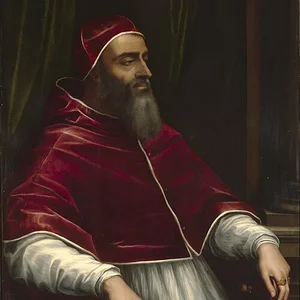
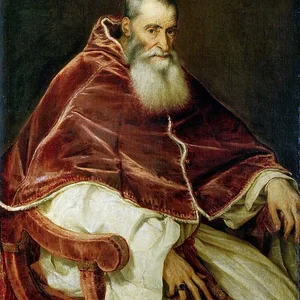
A cap and short cape of red velvet trimmed with ermine worn by the pope, immortalized in the famous portrait of Paul III by Titian. Ceremonial garments marking papal dignity.
School Curriculum
Vocabulary & Tags
Key Vocabulary
Daily Life
Morning
The pope's day began early with prayer and Mass in his private chapel. Next came the audiences with cardinals and ambassadors, where the affairs of the Church and of European diplomacy were settled.
Afternoon
The afternoon was devoted to governance: reviewing the bulls to be promulgated, meetings of the congregations, correspondence with the nuncios. Paul III also kept a close eye on Rome's artistic building sites.
Evening
In the evening, the pontiff sometimes received scholars, artists, and men of letters, for the papal court was a hub of the Renaissance. Religious offices and reading marked the close of the day.
Food
The papal table was refined: meats, game, fish, fruit, and fine Italian wines, served according to strict etiquette. The days of abstinence and fasting imposed by the liturgical calendar were observed.
Clothing
Paul III wore the white cassock, the red velvet mozzetta trimmed with ermine, and the camauro, along with the tiara and gilded ornaments during ceremonies. Titian's portrait captures this image of a shrewd and authoritative old man.
Housing
He resided in the Apostolic Palace of the Vatican and in the Roman residences of the Farnese, surrounded by frescoes, gardens, and works of art. These places combined spiritual power with princely splendor.
Historical Timeline
Period Vocabulary
Liens externes & ressources
Références
Œuvres
Bulle Sublimis Deus
1537
Approbation de la Compagnie de Jésus
1540
Institution de l'Inquisition romaine
1542
Convocation du concile de Trente
1545
Commande du Jugement dernier à Michel-Ange
1541
Création du duché de Parme et de Plaisance
1545
Excommunication d'Henri VIII
1538