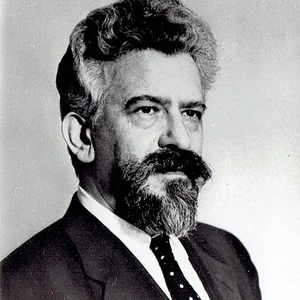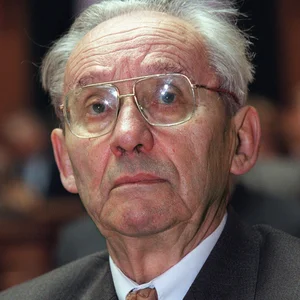

Paul Ricœur (1913-2005) was a major French philosopher of the 20th century. A leading figure of phenomenology and hermeneutics, he developed a vast body of thought on narrative, memory, identity and justice.
Paul Ricœur(1913 — 2005)
Paul Ricœur
France
6 min read
Frequently asked questions
Famous Quotes
« Oneself as Another.»
« The symbol gives rise to thought.»
Key Facts
- Born in 1913 in Valence, prisoner of war in Germany from 1940 to 1945
- Professor at the Sorbonne and then at Nanterre during the 1960s
- Published “Freud and Philosophy: An Essay on Interpretation” in 1965
- Published “Time and Narrative” (1983-1985), a major reflection on narrativity
- Published “Oneself as Another” in 1990; died in 2005 in Châtenay-Malabry
Works & Achievements
A vast multi-volume project (including *The Symbolism of Evil*) exploring freedom, fault and human limits. In it he inaugurates his hermeneutic approach to symbols.
A collection of essays on the meaning of history and the responsibility of the scholar. Ricœur examines the relationship between truth and action.
A major philosophical reading of psychoanalysis, in which Ricœur coins his notion of the “suspicion.” A key reference for thinking about interpretation.
A study of metaphor as the creation of meaning and an innovation of language. The work connects philosophy, rhetoric and poetics.
A foundational trilogy showing how narrative gives shape to the experience of time. It is one of his most influential works.
The summation of his philosophy of personal identity and ethics, grounded in the notion of “narrative identity.” A central text of contemporary thought.
A great meditation on the duty of memory, the work of the historian and forgiveness. A late work engaging with the questions of the twentieth century.
Anecdotes
During the Second World War, Paul Ricœur was taken prisoner in 1940 and spent five years in officers' camps in Germany. Rather than letting himself be defeated, he organized a veritable “captive university” there with his fellow prisoners and secretly translated, in the margins of his own copy, a difficult book by the German philosopher Edmund Husserl.
In 1968, Ricœur was teaching at the University of Nanterre, one of the hotbeds of the student revolt. Elected dean in 1969, he tried to engage in dialogue with the students, but the affair turned sour: one day, a student threw a trash can over his head. Hurt by the incident, he eventually left Nanterre.
Poorly understood in France, where structuralism dominated, Ricœur left to teach in the United States, notably at the University of Chicago, where he held a chair that had once belonged to the theologian Paul Tillich. He thus became one of the most widely read French philosophers in the English-speaking world.
In 2004, at the age of 91, Ricœur received the prestigious John W. Kluge Prize, considered a kind of “Nobel” of the humanities. True to his convictions, he devoted part of the award to charitable causes and research.
Throughout his life, Ricœur practiced what he called the “will to understand one's adversary”: before criticizing an idea, he would strive to present its strongest version. This intellectual honesty deeply influenced his students, including a certain... Emmanuel Macron, who was his editorial assistant in the late 1990s.
Primary Sources
Time becomes human time to the extent that it is articulated through a narrative mode, and narrative attains its full meaning when it becomes a condition of temporal existence.
The identity of the self is better understood as a narrative identity, distinct from the identity of sameness: what I am is not a permanent thing, but the story I can tell about myself.
I remain troubled by the disturbing spectacle of too much memory here, too much forgetting elsewhere, to say nothing of the influence of commemorations and of abuses of memory — and of forgetting.
Understanding others is a constitutive dimension of historical knowledge; to understand is to transport oneself into another life.
Key Places
Town in the Drôme department where Paul Ricœur was born in 1913 and spent part of his childhood. There he received an upbringing shaped by his family's Protestantism.
Ricœur taught philosophy here from 1948 onward, a fruitful period during which he developed his phenomenological thinking. It was an important stage in his academic career.
Ricœur helped found this university and became its dean; there he experienced the events of May 1968 head-on. The tensions eventually led him to leave.
Ricœur held a prestigious chair here from 1970, earning worldwide recognition. His stays in America fed a dialogue with English-language philosophy.
A town in the Paris suburbs where Ricœur lived during the last decades of his life, at Les Murs Blancs, a community inherited from Emmanuel Mounier. He died there in 2005.
Liens externes & ressources
Références
Œuvres
Philosophie de la volonté
1950-1960
Histoire et vérité
1955
De l'interprétation. Essai sur Freud
1965
La Métaphore vive
1975
Temps et récit
1983-1985
Soi-même comme un autre
1990
La Mémoire, l'histoire, l'oubli
2000