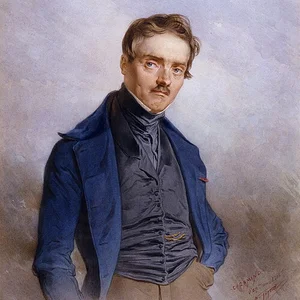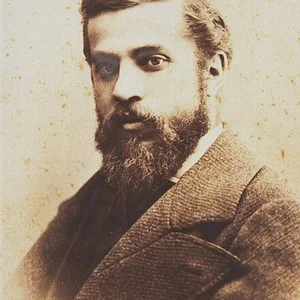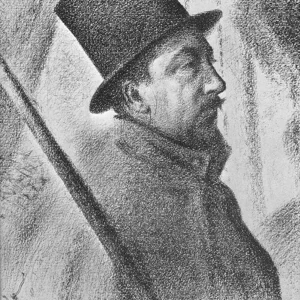

Paul Signac was a French painter and a major figure of Neo-Impressionism. Together with Georges Seurat, he developed and theorized Divisionism (or Pointillism), a technique based on the juxtaposition of strokes of pure color.
Paul Signac(1863 — 1935)
Paul Signac
France
6 min read
Frequently asked questions
Key Facts
- Born in 1863 in Paris and died in 1935
- Met Georges Seurat in 1884 and co-founded the Société des Artistes Indépendants the same year
- Developed the technique of Divisionism (Pointillism) based on the scientific theories of color (Chevreul)
- Published in 1899 the theoretical essay “From Eugène Delacroix to Neo-Impressionism”
- Settled in Saint-Tropez in 1892, where he painted many luminous seascapes
Works & Achievements
A vast utopian composition expressing Signac's anarchist and humanist ideals. It translates a dream of a harmonious society into Divisionist painting.
A brilliant seascape in which the coloured brushstrokes make the palace shimmer in the sunlight. An emblematic work of the artist's Divisionist maturity.
A portrait of the art critic and friend of Signac, set against a background of swirling, colourful motifs. A manifesto-painting of decorative Neo-Impressionism.
A luminous view of the harbour he made famous, vibrant with divided brushstrokes. It illustrates his love of the Mediterranean and of sailing.
A bourgeois interior scene rendered in rigorous Pointillism. It shows the application of the Divisionist technique to everyday life.
A foundational theoretical work explaining the division of colour. It had a lasting influence on the avant-gardes of the 20th century.
A set of watercolours depicting around a hundred French ports. A major project of his later years celebrating the coastline and the sea.
Anecdotes
In 1884, the young Signac, only 21 years old, met Georges Seurat at the first Salon des Indépendants. This encounter changed his life: together, they would found Neo-Impressionism and develop the theory of painting with small touches of pure colors placed side by side.
A passionate sailor, Signac owned more than thirty boats over the course of his life and cruised along the coasts of France and the Mediterranean. His voyages inspired countless watercolors of harbors, and he settled in Saint-Tropez as early as 1892, helping to make this little fishing port famous.
From a very young age, Signac was fascinated by the Impressionists. In 1880, at only 17, he visited an exhibition of Claude Monet's work and began teaching himself to paint. Legend has it that he was thrown out of a Degas exhibition for trying to copy a painting.
In 1908, Signac became president of the Société des Artistes Indépendants, a position he held until his death in 1935. True to the salon's motto — “neither jury nor awards” — he championed young avant-garde artists like Matisse and the Fauves, who stayed and painted alongside him.
Signac was not only a painter but also a theorist: in 1899, he published *From Eugène Delacroix to Neo-Impressionism*, a major work that scientifically explained the division of colors and would influence many 20th-century artists, including the Fauves and the Futurists.
Primary Sources
The Neo-Impressionist painter does not stipple, he divides. And to divide is to secure all the benefits of luminosity, of coloration and of harmony.
The more the color is divided, the more luminous, colorful and harmonious the painting will be.
Signac and Van Gogh painted together in the area around Asnières in the spring of 1887, exchanging ideas about color and the divided brushstroke.
The Société des Artistes Indépendants was founded in 1884 on the principle of “neither jury nor reward,” and Signac was one of its founding members.
Key Places
Signac's birthplace, where he trained as a self-taught artist and took part in founding the Salon des Indépendants. He died there in 1935.
A Mediterranean port that Signac discovered in 1892 and where he bought a villa, “La Hune.” He drew many painters there and developed his research into the light of the South.
A Parisian suburb along the Seine where Signac painted alongside Van Gogh in 1887. The riverbanks and open-air cafés provided him with many subjects.
A Catalan port in the south of France where Signac and the Neo-Impressionist and later Fauve artists came to paint the Mediterranean light.
An Italian city that Signac visited and painted several times, captivated by its reflections on the water and its luminous palaces.
Typical Objects

Brush used to lay down the small, regular dabs of pure colour characteristic of Divisionism. The shape and size of the dab are essential to the technique.

Palette on which Signac arranges the colours of the spectrum without mixing them, in order to juxtapose them directly on the canvas. The optical blending happens in the viewer's eye.

Portable case that Signac took along on his sailing trips to quickly sketch harbours and landscapes. Watercolour let him capture the light directly on the spot.

Signac was a passionate sailor who owned more than thirty boats. His sailboats served as floating studios and as subjects for his seascapes.

Diagram representing colours and their complementaries, based on the scientific research of Chevreul and Rood. It guides the reasoned juxtaposition of tones in Divisionism.

Lightweight, foldable support for painting directly in front of the subject. A legacy of the Impressionists, it accompanied Signac on quays and beaches.
School Curriculum
Vocabulary & Tags
Key Vocabulary
Daily Life
Morning
Signac often begins his day by observing light, the central element of his art. When staying in Saint-Tropez or while traveling, he heads out early with his watercolor box to capture the morning reflections on the water directly from life.
Afternoon
The afternoon is devoted to work in the studio, where he transposes his studies and sketches into large divisionist canvases. This methodical work of juxtaposing dabs of color demands patience and precision, sometimes taking several months for a single piece.
Evening
In the evening, Signac enjoys hosting and debating art, color, and politics with his painter and critic friends such as Félix Fénéon. A theorist as much as a painter, he also writes in his journal and prepares his writings on color.
Food
Signac shares the lifestyle of a cultured bourgeois of the Belle Époque, enjoying Provençal cuisine and Mediterranean produce during his stays in the South. His sailing voyages lead him to sample the specialties of the ports he frequents.
Clothing
He wears the bourgeois attire of his time: jacket, waistcoat, and hat for the city. At sea, he adopts the more practical garb of a sailor, true to his passion for sailing.
Housing
In Paris, Signac lives and works in an artist's studio. From 1892, he acquires the villa “La Hune” in Saint-Tropez, a vast house facing the sea that becomes his refuge and a gathering place for avant-garde painters.
Historical Timeline
Period Vocabulary
Liens externes & ressources
Références
Œuvres
Le Palais des Papes, Avignon
1909
Le Port de Saint-Tropez
1901-1902
Une dimanche (Un dimanche parisien)
1888-1890
D'Eugène Delacroix au néo-impressionnisme
1899
La série des Ports de France
1929-1931