Paul Verlaine
Paul Verlaine
1844 — 1896
France
A major French poet of the 19th century (1844–1896), Paul Verlaine is one of the central figures of Symbolism. Author of Poèmes saturniens and other groundbreaking collections, he revolutionized French poetry through his musicality and exploration of intimate emotional states.
Émotions disponibles (6)
Neutre
par défaut
Inspiré
Pensif
Surpris
Triste
Fier
Famous Quotes
« Music before all else »
« And all the rest is mere literature »
« I have often this strange and penetrating dream »
Key Facts
- 1866: Publication of Poèmes saturniens, his first major collection
- 1869: Publication of La Bonne Chanson, a collection of love poems
- 1872: Intensified literary and personal relationship with Arthur Rimbaud
- 1873: Violent incident in Brussels marking a turning point in his life
- 1884: Publication of Jadis et Naguère, a collection of varied poetry
Works & Achievements
Verlaine's first collection, still marked by Parnassian aesthetics but already pervaded by a deep personal melancholy. It contains the famous Chanson d'automne.
A poetry collection evoking the pictorial world of the painter Watteau, with masked festivities and secluded gardens. This collection reveals Verlaine's ability to create musical and dreamlike atmospheres.
A collection composed for his fiancée Mathilde Mauté, bearing witness to a simple and intimate happiness. It represents the brief period of conjugal serenity in Verlaine's life before the turbulence to come.
Written partly during his wanderings with Rimbaud in England and Belgium, this collection pushes Verlaine's musicality to the extreme and dissolves meaning into pure sensation.
A collection born of his Catholic conversion in prison, considered one of his masterpieces. It expresses a sincere spiritual quest and a poetry of interiority and repentance.
A critical essay devoted to six overlooked poets including Rimbaud, Mallarmé, and Corbière. Here Verlaine coins the concept of the 'poète maudit' and contributes to the posthumous recognition of his contemporaries.
A collection containing the Art poétique, a true aesthetic manifesto in which Verlaine defines his conception of poetry founded on music, nuance, and deliberate imprecision.
Anecdotes
In September 1871, Verlaine received a letter accompanied by poems from an unknown 17-year-old named Arthur Rimbaud. Captivated by his genius, he invited him to Paris, thus launching one of the most turbulent and fruitful literary relationships in the history of French poetry.
In July 1873, in Brussels, following a violent quarrel, Verlaine fired two pistol shots at Rimbaud and wounded him in the wrist. Sentenced to two years in prison, he served his time in Mons where, in his cell, he converted to Catholicism and wrote part of Sagesse.
Verlaine had a passionate fondness for absinthe, that green liqueur nicknamed 'the green fairy', which he consumed in great quantities in Parisian cafés. It is said that he would spend entire days at the Café François Ier or the Café Procope, scribbling verses on paper tablecloths between glasses.
Elected 'Prince of Poets' by his peers in 1894, two years before his death, Verlaine spent his final years in profound destitution, alternating between Parisian hospitals and squalid hotel rooms. His literary fame contrasted cruelly with his complete material poverty.
In 1884, Verlaine published Les Poètes maudits, a collection of critical portraits dedicated to little-known poets including Rimbaud, Mallarmé and Corbière. This book contributed greatly to bringing recognition to these authors and forged the very concept of the 'poète maudit'.
Primary Sources
Music above all else, / And for that prefer the Odd / More vague and more soluble in the air, / With nothing in it that weighs or poses.
Come, dear great soul, you are called, you are awaited. Here life is better for our common work.
The long sobs / Of the violins / Of autumn / Wound my heart / With a monotonous / Languor.
I had lost everything — wife, family, friends, health — and I found myself alone in that cell, face to face with God and my poetry.
These poets are not recognized during their lifetime, but their work is of such power that it will ultimately impose itself on posterity in spite of everything.
Key Places
Paul Verlaine's birthplace, born in 1844 in this Lorraine city. His childhood and military family origins are intimately tied to it.
Verlaine spent most of his creative life in Paris, frequenting the cafés of the Latin Quarter where he met the great poets of his time and wrote a large part of his work.
It was in this prison that Verlaine served a two-year sentence after wounding Rimbaud in Brussels. There he converted to Catholicism and wrote the poems that would form Sagesse.
The Hôtel Liégeois on the Rue des Brasseurs was the scene of the July 1873 drama: Verlaine shot Rimbaud there, ending their tumultuous relationship and permanently altering his fate.
Verlaine stayed in London several times with Rimbaud between 1872 and 1873, moving among the community of Commune exiles. These stays enriched his work with new sensations.
Typical Objects
Verlaine was a regular at Parisian cafés where he consumed absinthe in great quantities. This anise-flavoured, high-alcohol drink, nicknamed 'the green fairy', was associated with the artistic bohemian scene of the 19th century.
Verlaine would scribble his verses in notebooks or on café tablecloths, crossing out and rewriting endlessly. His manuscripts bear witness to the musical and meticulous crafting of each line.
A inveterate smoker, Verlaine used a long clay pipe, a typical accessory of the bohemian poets of the second half of the 19th century, and one often seen in his photographic portraits.
This literary journal published Verlaine's first poems in 1866, introducing him to Parisian Parnassian circles. It represented the literary movement in which Verlaine made his debut.
The weapon Verlaine used during his famous Brussels dispute with Rimbaud in July 1873, an event that led to his imprisonment and radically transformed his life and work.
Objects of his Catholic conversion experienced in prison in Mons, they symbolise the spiritual turning point that gave birth to the collection Sagesse, one of his masterpieces.
School Curriculum
Vocabulary & Tags
Key Vocabulary
Tags
Mouvement
Daily Life
Morning
Verlaine rose late, often after spending the night at a café. During his periods of relative stability, he would have a black coffee and read the morning literary newspapers. He sometimes began working on his verses right after waking, in the relative silence of a hotel room or a furnished lodging.
Afternoon
His afternoons were often devoted to wandering through Paris, from café to café, particularly on the Left Bank. There he would meet other writers, debate poetry and politics, and continue writing on tablecloths or in notebooks. These encounters directly nourished his work.
Evening
Verlaine's evenings were invariably spent in the taverns and brasseries of the Latin Quarter. Absinthe flowed freely, literary conversations grew heated. In his later years, these evenings often ended in poverty and drunkenness.
Food
Verlaine ate irregularly and frugally: bread, cheese, basic cold cuts, sometimes a soup at a wine merchant's. His budget went more to alcohol than to food, which contributed to his progressive physical decline.
Clothing
Verlaine wore dark and often worn clothing: a threadbare black frock coat or jacket, a dented bowler hat or top hat, a shirt with a sometimes faded collar. His appearance contrasted sharply with the Parnassian elegance of his early years and reflected his growing social decline.
Housing
Verlaine lived in a succession of maid's rooms, sordid furnished hotels, and lodging houses in the Latin Quarter and the faubourg Saint-Jacques district. In his later years, he alternated between these wretched accommodations and Parisian hospitals where his chronic illnesses forced him to stay.
Historical Timeline
Period Vocabulary
Gallery

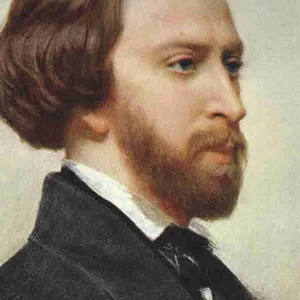
CarrierePortraitVerlain
French: Portrait d'un inconnu comme un troubadourPortrait of an anonymous as a Troubadourtitle QS:P1476,fr:"Portrait d'un inconnu comme un troubadour"label QS:Lfr,"Portrait d'un inconnu comme un tro

Louis Gustave Cambier - Dichter Paul Verlaine
French: Portrait de Paul Verlaine (1844-1896), poète title QS:P1476,fr:"Portrait de Paul Verlaine (1844-1896), poète "label QS:Lfr,"Portrait de Paul Verlaine (1844-1896), poète "
(Albi) Verlaine - Henry de Groux - Pastel sur papier
Paris 20130811 - Paul Verlaine by Auguste de Niederhausern
Fampoux, l'ancienne brasserie Fampoux ; 10 rue Verlaine (2)
Catalogue illustré des ouvrages de peinture, sculpture et gravure
(Albi) portrait de Verlaine - Louis Anquetin - pierre noire sur papier - Musée Toulouse-Lautrec
(Albi) portrait de Verlaine profil gauche - Louis Anquetin - pierre noire sur papier - Musée Toulouse-Lautrec
Visual Style
Esthétique impressionniste et post-impressionniste de la fin du XIXe siècle : intérieurs de cafés parisiens éclairés au gaz, atmosphères enfumées et palettes de mauves et de verts fanés.
AI Prompt
Late 19th century French Impressionist and Post-Impressionist aesthetic. Soft, blurred edges and muted tones evoking Verlaine's musical poetry. Dimly lit Parisian café interiors with warm amber gaslight, smoke-filled air, zinc bar counters. Bohemian atmosphere: rumpled dark clothing, top hats, absinthe glasses with their characteristic green glow. Street scenes at dusk with wet cobblestones reflecting gaslit lamps. Palette inspired by Édouard Vuillard and Edgar Degas: dusty mauves, faded greens, sepia browns, and soft yellows. Portraits in the style of Fantin-Latour's literary group paintings.
Sound Ambience
Ambiance sonore des cafés et ruelles de Paris à la Belle Époque : conversations feutrées, tintement de verres d'absinthe et pluie sur les pavés, avec en fond une mélodie de piano de salon.
AI Prompt
Ambient sounds of a Parisian café in the 1870s-1890s: murmur of conversations in French, clinking of glasses, the soft tinkle of absinthe spoons on crystal, café chairs scraping on tiled floors. In the background, distant piano music from a salon, perhaps a Fauré nocturne or a Chabrier waltz. Outside, the clatter of horse-drawn carriages on cobblestones, the cries of street vendors, the dull echo of iron wheels on wet pavement. Occasionally, the turning of newspaper pages, the scratch of a pen on paper, rain falling gently on the windows of a small Bohemian hotel room.
Portrait Source
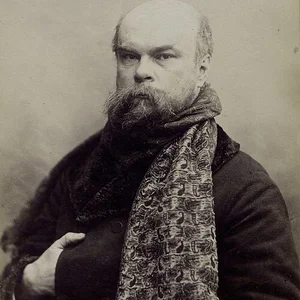
Wikimedia Commons — domaine public — Otto Wegener — 1893
Aller plus loin
Références
Ĺ’uvres
Poèmes saturniens
1866
FĂŞtes galantes
1869
La Bonne Chanson
1870
Romances sans paroles
1874
Les Poètes maudits
1884
Jadis et Naguère
1885