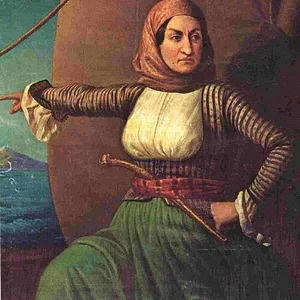

Laskarína Bouboulína was a Greek heroine of the War of Independence against the Ottoman Empire. Arming and financing her own war fleet, she took an active part in naval combat from 1821, most notably during the blockade of Nafplio. She is the only woman to have received the honorary title of admiral in the Russian Imperial Navy.
Laskarina Bouboulina(1771 — 1825)
Laskarína Bouboulína
Grèce, Empire ottoman
8 min read
Frequently asked questions
Key Facts
- Born in 1771 on Spetses, a Greek island under Ottoman rule, into a family of seafarers.
- In 1821, she armed a fleet of several ships at her own expense to support the Greek uprising against the Ottomans.
- She led the naval blockade of Nafplio, one of the first major military operations of the War of Independence.
- She was honored with the title of admiral in the Russian Imperial Navy, an exceptional distinction for a woman of her time.
- She was killed in 1825 during a family dispute on Spetses, becoming a martyred figure of the Greek cause.
Works & Achievements
Entirely financed by Bouboulina from her personal fortune, this warship was the most powerful vessel in the Spetses fleet. She took command of it and engaged it in the main naval operations of the revolution.
At the head of a squadron of several ships, Bouboulina organised and participated in the blockade of Ottoman ports and fortresses in the Peloponnese, cutting the enemy off from supplies and maritime reinforcements.
Bouboulina devoted a large part of her personal fortune to arming, paying the sailors, and supplying the insurgent troops, making her one of the principal benefactors of the war of independence.
The only woman admitted into this secret society, Bouboulina placed her networks, finances, and ships at the service of the clandestine organisation preparing the uprising against the Ottoman Empire.
According to several accounts, Bouboulina intervened to protect the women and children of the Ottoman governor's harem during the sack of Tripolitsa, demonstrating a personal ethics that went beyond mere military commitment.
Anecdotes
Laskarina Bouboulina was born in 1771 in a prison in Istanbul, where her mother had come to visit her father, a Greek captain imprisoned by the Ottomans. This tragic fate from birth seemed to forge her indomitable character and her hatred of Ottoman oppression.
Twice widowed from wealthy shipowners, Bouboulina inherited several ships that she had built or improved at her own expense. She personally oversaw the construction of the corvette Agamemnon, the largest ship in the Spetses fleet, which she financed by selling her jewelry and part of her fortune.
On March 13, 1821, several weeks before the official outbreak of the Greek Revolution, Bouboulina herself raised the flag of the insurrection on her ships at Spetses. She was thus one of the very first to take up arms against the Ottoman Empire, at the risk of her own life.
During the siege of Nafplion in 1822, Bouboulina actively participated in naval blockade operations. Legend — probably embellished — has it that she personally came ashore, pistol in hand, to encourage her sailors and lead ground assaults against the Ottoman fortifications.
Bouboulina was admitted as a member of the Filiki Eteria, the secret society that organized the Greek Revolution — an exceptional distinction, as no other woman was ever accepted into its ranks. This membership confirms the recognition of her political and military role by the leaders of the independence movement.
Primary Sources
Bouboulina, a widow of great wealth and resolution, had equipped at her own expense several vessels of war, which she commanded in person, and with which she joined the revolutionary forces at the commencement of the struggle.
A woman from Spetses, named Bouboulína, having armed at her own expense several brigs and corvettes, personally commands her crews and has distinguished herself by uncommon bravery in the blockade of the Ottoman coasts.
Bouboulína was a woman of extraordinary energy. She had equipped at her own expense the Agamemnon and other ships, and she personally took part in naval operations against the Turks.
Among the initiated members appears Laskarína Bouboulína, shipowner of Spetses, initiated on account of her considerable financial means and her total commitment to the cause of Hellenic freedom.
Key Places
Island in the Saronic Gulf, birthplace and operational base of Bouboulina. It was here that she was born (de facto, her family was established there), that she armed her fleet, and where she died in 1825.
Capital of the Ottoman Empire where Bouboulina was born in prison in 1771. She later returned there to defend her property rights before Ottoman authorities following her husband's death.
Ottoman stronghold besieged by Greek revolutionaries. Bouboulina took part in the naval blockade of the city in 1821–1822 and resided there after its fall.
Ottoman administrative capital of the Peloponnese, captured in October 1821 by Greek insurgents. Bouboulina is said to have intervened there to protect Ottoman civilians during the sack of the city.
Island neighbouring Spetses and a major Greek maritime power, whose fleet fought alongside that of Bouboulina. The two islands formed the backbone of the Greek revolutionary navy.
Typical Objects

A sidearm characteristic of Greek captains in the 19th century. Bouboulina was known for carrying pistols at her belt, a symbol of her military authority and readiness for combat.

An indispensable instrument for any naval commander of the era. From the deck of the Agamemnon, Bouboulina used it to observe the movements of Ottoman ships and coordinate the maneuvers of her fleet.

A cannon-equipped sailing warship personally financed and commanded by Bouboulina. The Agamemnon was the flagship of the revolutionary fleet of Spetses, bearing her name as a banner.

The shipowners of Spetses used detailed charts of the Greek and Ottoman coasts to plan their naval operations. Bouboulina, trained in navigation from childhood, was skilled at reading these instruments.

The women's dress of the Greek islands, consisting of an embroidered gown and a headscarf. Portraits of Bouboulina often depict her in Greek island attire, emphasizing her attachment to her Hellenic identity.

A metal-reinforced wooden chest used to store ship ownership documents, trade contracts, and funds intended to finance crews. Bouboulina's fortune, managed by her own hand, largely funded the war effort.
School Curriculum
Vocabulary & Tags
Key Vocabulary
Tags
Daily Life
Morning
Bouboulina rose early in her manor house on Spetses to oversee port activities. She inspected her ships with her captains, examined the cargoes, and received reports on the condition of the crews and armaments.
Afternoon
Afternoons were devoted to managing her shipowner affairs: negotiating contracts, corresponding with commercial agents in Constantinople or Marseille, and overseeing construction and maintenance work on her vessels at the family shipyard.
Evening
In the evenings, Bouboulina often gathered island notables, captains, and members of the Filiki Eteria for secret political discussions. She also managed her large household, made up of her children from her two marriages and numerous servants.
Food
Typical diet of a wealthy Greek islander of the 19th century: bread, olives, sheep's cheese (feta), grilled fish and seafood, roast lamb on feast days, garden vegetables dressed with olive oil, grapes and Spetses wine, Turkish coffee served in small cups.
Clothing
Bouboulina wore the traditional costume of wealthy women from the Greek islands: a long silk or velvet dress embroidered with gold and silver thread, a coloured headscarf, an ornate belt, and sometimes an embroidered vest. She wore gold jewellery inherited from her husbands, symbols of her wealth and status.
Housing
She lived in an imposing archontiko (manor house) on Spetses, a typical two-storey residence of prosperous Greek shipowners, with high ceilings, marble floors, carved wooden furniture, and painted shutters. The house overlooked the harbour, allowing Bouboulina to watch over her ships from her windows.
Historical Timeline
Period Vocabulary
Visual Style
Esthétique maritime grecque du début du XIXe siècle, entre lumière méditerranéenne intense et dramatisme romantique des scènes de bataille navale, avec les costumes brodés des insulaires de Spetses.
Sound Ambience
Ambiance maritime de la mer Égée au début du XIXe siècle : bruits de navires à voile, mer agitée, manœuvres d'équipage et échos des combats navals de la révolution grecque.
Liens externes & ressources
Références
Œuvres
Blocus naval des côtes du Péloponnèse
1821
Financement de l'effort révolutionnaire grec
1821-1822
Adhésion et soutien à la Filiki Eteria
1820
Protection des civils ottomans lors de la prise de Tripolitsa
1821