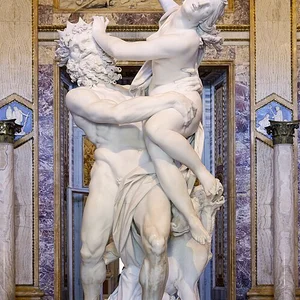

Persephone is a goddess of Greek mythology, daughter of Demeter and Zeus. Abducted by Hades, the god of the Underworld, she becomes queen of the dead and rules alongside her husband. Her myth explains the changing of the seasons: her annual return to her mother brings about spring and summer.
Persephone
Persephone
8 min read
Frequently asked questions
Key Facts
- Abducted by Hades, god of the Underworld, according to classical Greek myth
- Becomes queen of the Underworld and wife of Hades following her abduction
- Her annual return to her mother Demeter symbolizes the cycle of the seasons
- Spends six months in the Underworld and six months on earth (according to later versions of the myth)
- Associated with vegetation, fertility, and cyclical rebirth in Greek mythology
Works & Achievements
The founding myth of Persephone: abducted by Hades while she was picking flowers, she becomes Queen of the Underworld. This event marks the turning point of her fate and shapes her entire divine role.
The myth of Persephone explains the annual cycle of the seasons: her absence from Demeter (who mourns and causes all vegetation to cease) brings about autumn and winter, while her return gives rise to spring and summer.
Persephone reigns alongside her husband Hades over the kingdom of the dead, playing a crucial role in the justice and judgment of souls. She becomes one of the most powerful deities of Olympus.
Persephone is at the heart of the secret rites of Eleusis, where her myth was celebrated and reenacted. These mysteries were among the most important religious practices in ancient Greece.
Persephone embodies fertility, rebirth, and renewal. Her cyclical journey between the world of the living and the world of the dead symbolizes life, death, and resurrection in Greek thought.
The only goddess capable of moving between Olympus, the earth, and the Underworld, Persephone serves as a mediator and bridge between the three realms, which reinforces her cosmic importance.
Anecdotes
The myth of Persephone is first told in the Homeric Hymn to Demeter, an ancient text dating back to the 7th century BCE. This poem describes how Hades abducts Persephone in a black chariot while she is picking flowers in a meadow, causing her mother Demeter immense grief — grief so deep that she stops the crops from growing. It is one of the most important stories in Greek mythology.
At Eleusis, in Greece, the Eleusinian Mysteries honored the cult of Persephone and Demeter for over a thousand years. Thousands of pilgrims took part each year in secret rituals believed to ensure good harvests and offer salvation of the soul after death. These ceremonies reveal the profound religious and cultural importance of Persephone in the lives of the ancient Greeks.
The myth of Persephone served as an ancient explanation for the changing seasons: her abduction symbolizes the arrival of winter and its barrenness, while her annual return to Demeter marks the coming of spring and renewal. This mythological explanation shows how the Greeks made sense of natural cycles long before modern science.
In Greek art, Persephone is depicted as Queen of the Underworld, often shown alongside Hades on vases and sculptures. She bears royal attributes such as a crown and scepter, symbolizing her power and status as a formidable queen in the realm of the dead — a far cry from the image of a mere victim of abduction.
Across the various versions of the myth passed down by Greek and Roman authors such as Ovid and Hesiod, Persephone gradually embraces her role in the Underworld and becomes a wise and just queen. This evolution of the character shows that the Greeks viewed Persephone not as a passive victim, but as a woman who gains real power and authority.
Primary Sources
Demeter bore her daughter Persephone to the Oceanid Theia, to whom Zeus had joined her. Hades of the cruel heart carried her off from her mother.
The lord who receives so many guests, who possesses so many riches, Hades, carried off the young maiden. The goddess let out a piercing cry that no one could hear.
Persephone remains in the Underworld for three full months when the shades have need of their queen, then she returns to her mother, and with her the fair season is reborn.
Hades seized Persephone and led her to his underground palace. Zeus ordered her return to Demeter for six months of the year, while she remains in the Underworld for the other six.
Key Places
According to Greek mythology, Persephone was abducted by Hades in the plains of Sicily, near Enna. This location is central to the myth of her abduction and marks the beginning of her destiny as Queen of the Underworld.
Persephone reigns as queen of the dead alongside Hades in Tartarus, the Underworld of Greek mythology. According to the myth, she spends six months of the year there.
Located in Attica near Athens, Eleusis was the center of worship for Persephone and her mother Demeter. The Eleusinian Mysteries celebrated Persephone's annual cycle and the changing of the seasons.
Persephone, daughter of Zeus and Demeter, belongs to the divine Olympian family. Mount Olympus is the home of the gods from whom she descends, even though she does not rule over Olympus itself.
The subterranean kingdom of Hades is Persephone's primary domain as queen of the dead. There she exercises her authority and judgment over the souls of the deceased.
According to some versions of the myth, the Fields of Nysa in mainland Greece are the place where Persephone was gathering flowers with her companions when she was abducted by Hades.
Typical Objects

A symbolic fruit central to the myth of Persephone: she eats a few of its seeds while in the underworld, sealing her fate and her cyclical return to the surface. It is the key object in the myth explaining the changing seasons.

A royal attribute worn by Persephone as queen of the Underworld alongside Hades. It symbolizes her power and authority in the realm of the dead.

A symbol associated with Demeter, Persephone's mother, used in the Eleusinian Mysteries. It represents the search for her daughter and the light that defies the darkness of the Underworld.

The mythological vehicle of Hades, used to abduct Persephone. It is the dramatic symbol of her passage from the world of the living to the realm of the dead.

An attribute of Demeter and an indirect symbol of Persephone, representing agriculture and fertility. They are linked to the prosperity that returns with Persephone's annual journey back to the earth.

An emblem of divine and royal power carried by Persephone. It symbolizes her authority as both a goddess and a queen ruling alongside Hades.

A flower associated with the Underworld and Persephone, symbolizing eternal sleep and the realm beneath the earth. The poppy also evokes oblivion and the transition between worlds.

An iconic vessel of ancient Greece, often used in the rites and processions honoring Persephone during the Eleusinian Mysteries.
School Curriculum
Vocabulary & Tags
Key Vocabulary
Daily Life
Morning
Persephone wakes in her underground palace, its walls of black marble and gold. She presides over divine rituals honoring the souls of the dead and maintaining the balance of the Underworld. Before receiving newly arrived souls, she consults with Hades on the affairs of the realm.
Afternoon
The goddess spends the afternoon judging souls and presiding over divine councils alongside her husband Hades and the Furies. She hears the grievances of the dead and ensures the eternal laws of the kingdom are upheld. It is a time of royal authority, exercised beside the god of the Underworld.
Evening
As underground night falls, Persephone joins the divine banquets held in the halls of her palace. She surrounds herself with nymphs and mythological creatures that inhabit her realm. She shares the sacred meal with Hades in an atmosphere of solemn timelessness.
Food
As an immortal goddess, Persephone feeds on ambrosia and nectar, the divine food of the Greek gods. Her most symbolic meal remains the pomegranate she consumed in the Underworld, sealing her fate forever. During her stays with her mother, she receives the finest offerings brought by mortals.
Clothing
Persephone wears the majestic garments of a divine queen: a richly embroidered peplos of gold and purple, the colors of royal power. She is adorned with diadems and precious jewels befitting her status as a goddess. Her appearance shifts between radiant youthfulness and dark majesty depending on the season.
Housing
Persephone reigns from Hades' underground palace — a grand edifice of black marble columns and walls encrusted with precious stones. Located at the far reaches of the Underworld, the palace holds the treasures of the subterranean realm and the halls where souls are judged. Its architecture blends divine beauty with the somber, eternal atmosphere of the kingdom of the dead.
Historical Timeline
Period Vocabulary
Visual Style
Un style visuel classique et mystique mêlant la lumière dorée du printemps avec les teintes sombres de l'Hades, inspiré de la céramique grecque antique et de la peinture académique romantique. L'aesthetic évoque la dualité de Perséphone entre monde vivant et monde des morts.
Sound Ambience
Une ambiance sonore mystique et mélancolique combinant les sons sombres des Enfers avec l'essence délicate du printemps, évoquant le double rôle de Perséphone entre le monde des morts et celui des vivants.
Liens externes & ressources
Références
Œuvres
L'enlèvement par Hadès
Mythe intemporel
L'explication des saisons
Mythe intemporel
La royauté des Enfers
Mythe intemporel
L'initiation aux Mystères d'Éleusis
Mythe intemporel
La fertilité et la renaissance
Mythe intemporel
La médiation entre mondes
Mythe intemporel