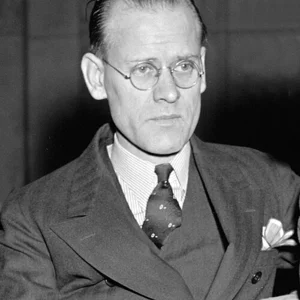

American inventor and pioneer of electronic television. As a teenager he conceived the principle of the image dissector tube and, in 1927, achieved the first transmission of a fully electronic image.
Philo Farnsworth(1906 — 1971)
Philo Farnsworth
États-Unis
7 min read
Frequently asked questions
Key Facts
- Born on August 19, 1906 on a farm in Utah (United States)
- Conceives at age 14 (around 1921) the principle of electronic image scanning
- Achieves on September 7, 1927 the first transmission of a fully electronic television image
- Files and defends his patents in a lengthy legal battle against RCA, which he wins in 1939
- Dies on March 11, 1971 in Salt Lake City
Works & Achievements
The first tube able to convert an image into an electrical signal in a fully electronic way. It made the true television camera possible.
Transmission of a simple straight line in his San Francisco laboratory: the practical birth of electronic television.
The founding patent protecting his complete electronic television system. It would be at the heart of the famous lawsuit against RCA.
The first presentation to the general public of a fully electronic television, in Philadelphia. It established Farnsworth's reputation.
Company founded in Fort Wayne to manufacture television and radio receivers, drawing on his many patents.
A nuclear fusion device designed in the later part of his career, still used today as a neutron source for research.
A body of inventions spanning television, radar, night vision, and fusion, reflecting an exceptional technical creativity.
Anecdotes
In 1921, at just 14 years old, Philo Farnsworth was plowing a potato field in Idaho. Seeing the perfectly parallel rows traced by the plow, he had a flash of insight: an image could be broken down into lines, scanned one by one, then reassembled. This farm boy's intuition would become the very principle behind electronic television.
In 1922, the young Philo sketched his television idea on the blackboard for his chemistry teacher, Justin Tolman, who kept the memory of that drawing. Twelve years later, when the giant RCA challenged his patent in court, Tolman reproduced the sketch from memory before the judge. This testimony helped Farnsworth win his case against an enormous company.
On September 7, 1927, in his San Francisco laboratory, Farnsworth transmitted the very first fully electronic image: a simple straight line. Tired of waiting for profitable results, one of his backers once asked when they would finally see some money: by way of reply, Philo transmitted the image of a dollar sign ($).
In 1957, Farnsworth appeared incognito under the name “Doctor X” on the television show I've Got a Secret. The panel had to guess his secret: “I invented electronic television.” None of them could. He left with 80 dollars and a carton of cigarettes — poignant proof that the inventor of television remained a complete unknown.
Toward the end of his life, Farnsworth took on an even greater challenge: producing energy through nuclear fusion, with a device called a “fusor.” In 1969, watching the first human steps on the Moon broadcast live, he confided to his wife Pem that this image, made possible by his own invention, had “made it all worthwhile.”
Primary Sources
Patent filed on January 7, 1927, and granted on August 26, 1930, describing a device meant to convert a light image into electrical signals and then reconstruct it as a visible image: the first fully electronic television system ever patented.
The former chemistry teacher recounts how, in 1922, his student had explained that he wanted to “send pictures through the air the way radio sent sound,” and he redraws the sketch he had once chalked on the blackboard.
The card introducing the guest's secret reads: “I invented electronic television.” Not a single panelist manages to guess who he is.
In her memoir, the inventor's wife recalls his words as they watched the first Moon landing broadcast on television: “Pem, this has made it all worthwhile.”
Key Places
Small town in Utah where Philo Farnsworth was born in 1906, in a log cabin. His family of Mormon pioneers lived there modestly.
Family farm in Idaho where the teenage Farnsworth, while plowing a field, came up with the idea of television scanned line by line.
Town where Farnsworth briefly pursued his studies and deepened his knowledge of electronics before striking out on his own.
Workshop at the foot of Telegraph Hill where Farnsworth achieved, on September 7, 1927, the first transmission of a fully electronic image. A plaque there commemorates the event.
City where the Farnsworth Television and Radio Corporation settled, producing television and radio receivers.
Capital of Utah where Philo Farnsworth died in 1971, after devoting himself to research on nuclear fusion.
Typical Objects

A vacuum tube invented by Farnsworth that turns a lit image into an electrical signal by analyzing it point by point. It is the heart of the electronic television camera.

A tube with a fluorescent screen that rebuilds the transmitted image by sweeping a beam of electrons across it. It is the ancestor of the television screen.

An electronic component used to amplify and control weak electrical signals. Essential to the earliest television and radio devices.

A disk pierced with holes arranged in a spiral, used by mechanical television to scan an image. Farnsworth found this method too slow and preferred a fully electronic solution.

A farming tool that cuts parallel furrows across fields. While plowing a potato field, Farnsworth got the idea of scanning an image line by line.

A device designed by Farnsworth in the 1960s to trigger the fusion of atomic nuclei. He hoped it would provide a clean and abundant source of energy.
School Curriculum
Vocabulary & Tags
Key Vocabulary
Tags
Daily Life
Morning
An early riser, Farnsworth reached his laboratory first thing in the morning to prepare his experiments: blowing the glass of the tubes, creating a vacuum inside them and checking the electrical circuits. Young and impatient, he jotted down his ideas in pencil in notebooks before his assistants arrived.
Afternoon
Afternoons were spent in repeated trials on the image-scanning tubes, often punctuated by failures and broken tubes. He talked with his team, adjusted the settings and regularly had to meet with his backers to convince them to keep funding his research.
Evening
In the evening, Farnsworth often carried his experiments late into the night, driven by his passion. When he came home, he was reunited with his wife Pem, herself involved in his work, with whom he discussed his discoveries and his difficulties.
Food
Born into a family of Mormon farmers, he had grown up on simple food: potatoes, bread, vegetables from the garden and farm produce. Like many practicing Mormons, he avoided in principle alcohol, coffee and tea, even though his life as an inventor was later marked by stress.
Clothing
In his laboratory of the 1920s, he wore the ordinary attire of a man of his time: a collared shirt, tie, trousers and waistcoat, sometimes protected by a work coat. A suit remained the rule for meeting investors and journalists.
Housing
As a child, he lived on modest farms in Utah and Idaho, sometimes without electricity. As an adult, he settled in urban housing in San Francisco and then in Fort Wayne, near his laboratories and his company.
Historical Timeline
Period Vocabulary
Liens externes & ressources
Références
Œuvres
Dissecteur d'image (image dissector)
1927
Première transmission d'une image électronique
7 septembre 1927
Brevet US 1 773 980 « Television System »
1930
Démonstration publique au Franklin Institute
1934
Farnsworth Television and Radio Corporation
1938
Fuseur de Farnsworth–Hirsch
1964
Plus de 160 brevets
1927-1971