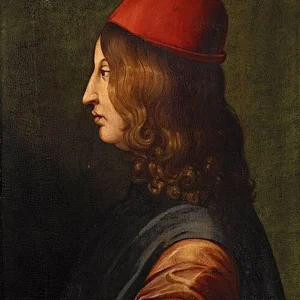

Italian Renaissance philosopher and humanist, a key figure of Florentine Neoplatonism. Author of the Oration on the Dignity of Man, he defends humanity's freedom to shape itself and attempts a synthesis of all knowledge.
Pico della Mirandola(1463 — 1494)
Giovanni Pico della Mirandola
duché de la Mirandole
6 min read
Frequently asked questions
Key Facts
- Born in 1463 in Mirandola, in northern Italy
- Writes the 900 Theses (Conclusiones) in 1486, whose prologue is the Oration on the Dignity of Man (Oratio de hominis dignitate)
- Thirteen of his theses are condemned as heretical by a papal commission in 1487
- Close to Marsilio Ficino and the Neoplatonic Academy of Florence, under the protection of Lorenzo de' Medici
- Dies prematurely in 1494 in Florence, at the age of 31
Works & Achievements
A manifesto text of Renaissance humanism, celebrating man's freedom to shape himself. Often called the “manifesto of the Renaissance.”
A collection of 900 theses drawn from every tradition (Greek, Arab, Jewish, Christian) that Pico wished to defend in order to demonstrate the unity of knowledge.
A defense written to answer the condemnation of thirteen of his theses by the papal commission. Paradoxically, it made his situation worse.
A sevenfold commentary on the seven days of Creation, blending biblical exegesis with Kabbalistic symbolism.
A treatise seeking to reconcile the philosophies of Plato and Aristotle on the notions of being and unity.
An unfinished, posthumous work refuting predictive astrology, which later influenced scientific thought.
Anecdotes
At just 23 years old, in 1486, Pico della Mirandola composed 900 theses that he offered to defend publicly in Rome against all the scholars of Europe, even promising to pay their travel expenses. The debate never took place: Pope Innocent VIII deemed thirteen of these theses suspect of heresy and forbade the disputation.
To introduce his 900 theses, Pico wrote a speech that has remained famous under the title 'Oration on the Dignity of Man'. In it, he imagines God telling Adam that he has neither a fixed place nor a determined form, but that he can freely shape himself, downward like the beast or upward like the angel.
Pico learned languages with a rare eagerness for his time: besides Latin and Greek, he studied Hebrew, Aramaic, and Arabic in order to read texts in their original language. He was one of the first Christians in the West to take a serious interest in Jewish Kabbalah.
Accused of heresy, Pico fled to France in 1488 but was briefly arrested and imprisoned there. He owed his rescue to the intervention of Lorenzo de' Medici, who brought him back to Florence under his protection.
Pico della Mirandola died in 1494 at only 31 years old, on the very day that King Charles VIII of France entered Florence. Analyses of his remains conducted in 2007 revealed traces of arsenic, suggesting that he may have been poisoned.
Primary Sources
You shall be able to degenerate into the lower forms of life, which are brutish; you shall be able, by your own decision, to rise again into the higher forms, which are divine.
There is no science that gives us greater certainty of the divinity of Christ than magic and the Kabbalah.
A man, or rather a hero, endowed with every gift of body and mind.
He distributed his goods to the poor and resolved to travel the world, a crucifix in hand, to preach Christ.
Key Places
A small lordship in northern Italy where Giovanni was born in 1463, the youngest son of a family of counts. He drew his famous name from it.
A major center of learning where Pico trained in the philosophy of Aristotle and Averroist thought. Padua was renowned for its secular, rationalist teaching.
The cultural capital of the Renaissance where Pico joined the Neoplatonic circle of Marsilio Ficino under the protection of the Medici. He spent his final years there and died there.
The city where Pico published his 900 theses in 1486 and hoped to organize a grand disputation. The pope condemned some of his propositions there.
During his flight to France in 1488, Pico was arrested near Lyon on the orders of the church authorities. He underwent a brief imprisonment there.
Pico, close to the preacher Savonarola, was buried in this Dominican convent after his death in 1494. He is said to have received the order's habit shortly before he died.
Typical Objects

A printed collection of 900 philosophical and theological propositions that Pico wished to defend publicly in Rome. It was one of the first great scholarly debates announced through the printing press.

Manuscripts in Hebrew and Aramaic that Pico had translated in order to study Jewish Kabbalah. In them he sought secret correspondences with Christian doctrine.

The everyday writing instruments of the Renaissance scholar, used for Latin correspondence and the drafting of treatises. Pico maintained a vast scholarly correspondence.

A collection of Greek, Latin, Hebrew, and Arabic texts that Pico assembled at great expense. It embodies the humanist ideal of synthesizing all forms of knowledge.

A long dark robe worn by the scholars and academics of the Italian Renaissance. It marked the intellectual status of its wearer.

According to his nephew, near the end of his life Pico considered roaming the world with a crucifix in hand to preach. The object symbolizes his religious turn under the influence of Savonarola.
School Curriculum
Vocabulary & Tags
Key Vocabulary
Daily Life
Morning
Upon rising, the humanist devotes his first hours to reading and to the study of ancient languages, making the most of daylight. Pico, blessed with a prodigious memory, reads Greek, Hebrew, and Arabic in order to compare texts in their original versions.
Afternoon
The afternoon is spent writing treatises, annotating manuscripts, and keeping up an abundant Latin correspondence with other scholars across Europe. Pico meets his friends from the Florentine circle, such as Marsilio Ficino and the poet Angelo Poliziano.
Evening
In the evening, the learned gather for philosophical banquets inspired by Plato, where they discuss love, the soul, and the divine. Scholarly conversation extends their study late into the night, by candlelight.
Food
A Florentine nobleman's table offers bread, wine cut with water, roasted meats, fish on lean days, fruit, and cheeses. Spices, a mark of wealth, season the dishes at banquets.
Clothing
Pico wears the long dark robe of the scholar, plain but of fine cloth, marking his standing as an intellectual. Renowned for his beauty and elegance in his youth, he gave up luxury toward the end of his life under religious influence.
Housing
He resides in opulent dwellings, at Mirandola and later in Florentine houses and villas made available to him by the Medici. These lodgings above all house his precious library of manuscripts, the heart of his life of study.
Historical Timeline
Period Vocabulary
Liens externes & ressources
Références
Œuvres
Discours sur la dignité de l'homme (Oratio de hominis dignitate)
1486
Les 900 Conclusions (Conclusiones nongentae)
1486
Apologie (Apologia)
1487
Heptaplus
1489
De l'Être et de l'Un (De ente et uno)
1491
Disputations contre l'astrologie divinatoire (Disputationes adversus astrologiam divinatricem)
1494