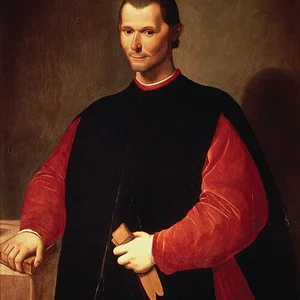

Florentine philosopher and statesman (1469–1527), Machiavelli is the author of The Prince, a treatise that laid the foundations of modern political realism. He analyzes power as it is actually exercised, not as it should be, revolutionizing political thought during the Renaissance.
Machiavelli(1469 — 1527)
Niccolò Machiavelli
République florentine
7 min read
Frequently asked questions
Famous Quotes
« A prince must know how to act like a beast, and among beasts he must choose the lion and the fox.»
« It is better to be feared than loved, if you cannot be both.»
« Men are so simple and so readily governed by present necessities.»
Key Facts
- 1469: Born in Florence
- 1498–1512: Career in the service of the Florentine Republic as Secretary of the Chancery
- 1513: Writing of The Prince, an analysis of political power based on empirical observation
- 1520–1527: Publication of his major works (The Prince, Discourses on the First Decade of Titus Livius)
- 1527: Death in Florence
Works & Achievements
A political treatise addressed to Lorenzo de' Medici, analyzing how to seize and hold power. A founding work of modern political realism, it shocked readers with its sharp separation of morality from politics.
A commentary on the first ten books of the Roman historian, in which Machiavelli develops his republican thinking and his reflections on civic virtues and freedom.
The only major work published during Machiavelli's lifetime, written in dialogue form. In it he argues for a national citizen army as opposed to reliance on mercenaries.
A satirical comedy considered one of the finest plays of the Italian Renaissance. It portrays the mechanics of cunning and seduction with humor and cynicism.
A history of Florence commissioned by Pope Clement VII (a Medici), tracing the city's political evolution from its origins through the fifteenth century. Machiavelli applies his method of analyzing political forces throughout.
A semi-historical, semi-fictional biography of a fourteenth-century condottiere, used by Machiavelli to illustrate his theories on the ideal military and political leader.
Anecdotes
After the fall of the Florentine Republic in 1512, Machiavelli was accused of plotting against the Medici, arrested, and tortured. He denied any involvement and was eventually released, but this painful experience of political disgrace deeply shaped his thinking about power and fortune.
Machiavelli wrote *The Prince* in just a few weeks in 1513, from his country house at Sant'Andrea in Percussina, where he had been sent into exile. He hoped to offer the work to the Medici in order to regain their favor and secure a post in the Florentine administration — to no avail.
Each evening, Machiavelli would put on his court clothes before sitting down at his writing table. He described this himself in a letter to his friend **Francesco Vettori**: he would change into fine dress to enter the company of the great men of Antiquity, as if paying them a visit.
Machiavelli served as secretary of the Florentine chancellery for fourteen years, from **1498** to **1512**. As a diplomat, he encountered figures as formidable as **Cesare Borgia**, Pope **Julius II**, and Emperor **Maximilian I** — encounters that directly informed his political analyses.
According to an anecdote passed down by his contemporaries, Machiavelli is said to have declared on his deathbed that he would rather go to hell with the great political and military figures than to heaven with the saints. Whether true or legendary, this quip captures both his sharp wit and his sulfurous reputation.
Primary Sources
It is necessary for a prince, if he wishes to maintain himself, to learn how to be able not to be good, and to use this or not use it according to necessity.
Men do good out of necessity; but as soon as they have freedom of choice and enjoy too much liberty, everything is at once filled with confusion and disorder.
When evening comes, I return home and enter my study. On the threshold I take off my workday clothes, covered with mud and dirt, and put on the garments of court and palace.
A prince who understands nothing of war cannot be respected by his soldiers, nor can he rely on them.
Florence has always been torn by factions, and its citizens have never been able to live in peace or concord.
Key Places
Seat of the Florentine government where Machiavelli worked for fourteen years as a secretary. It was here that he closely observed the mechanics of republican power.
The family estate where Machiavelli was exiled after 1512. It was in this country house that he wrote *The Prince* and maintained his famous correspondence.
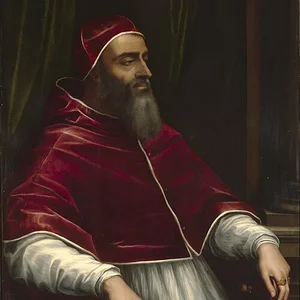
Machiavelli traveled to Rome several times on diplomatic missions and closely observed papal power — notably Julius II and Leo X — whom he analyses in *The Prince*.
Towns where Machiavelli met Cesare Borgia in 1502. This pivotal encounter inspired his model of the bold, unscrupulous prince described throughout his work.
Founded by the Medici, this library was the intellectual heart of the Florentine Renaissance. Machiavelli drew on its ancient manuscripts to shape his political thought.
Typical Objects

Machiavelli's everyday tool — he wrote his diplomatic reports, letters, and literary works by hand. His correspondence with Francesco Vettori remains a precious record of his intellectual life.

The Prince first circulated as hand-copied manuscripts before its publication in 1532. This condensed text of around a hundred pages revolutionized Western political philosophy.

Diplomats of the era used hand-drawn maps depicting the Italian principalities in perpetual conflict. Machiavelli consulted them to prepare his missions and analyze the balance of power.

During his official duties, Machiavelli wore the formal dress of a chancellery secretary. In his letters, he himself describes the ritual of changing clothes to move from everyday life into the realm of thought.

Machiavelli frequently played dice and other games at village taverns during his exile. This detail, which he recounts himself, illustrates the social degradation felt by this statesman forced into idleness.

Machiavelli drew heavily on ancient historians to illustrate his political theories. His Discourses on Livy bear witness to this assiduous reading of the Romans.
School Curriculum
Vocabulary & Tags
Key Vocabulary
Tags
Époque
Mouvement
Daily Life
Morning
Machiavelli rose early to oversee the work on his rural estate at Sant'Andrea, supervising woodcutters and peasants. This manual labor weighed on him and painfully contrasted with his former life as an active statesman.
Afternoon
He spent his afternoons in the tavern of the neighboring village, playing dice and conversing with common folk — millers, butchers, innkeepers. He ceaselessly observed human behavior, the raw material of his political thought.
Evening
In the evenings, he would withdraw to his study, don his court clothes out of respect for the ancient authors, and read or write late into the night. It was in this way that he wrote The Prince, as if in conversation with the great men of the past.
Food
In Florence, the diet of the educated middle classes consisted of bread, pasta, vegetables, pork and poultry, washed down with local Tuscan wine. During his rural exile, Machiavelli lived more simply, sharing peasant meals at the inn.
Clothing
In official service, Machiavelli wore the black robe of the chancellery secretaries, a symbol of his rank. Outside his duties, he dressed simply in a wool cloth tunic and cloak, attire he himself describes in his letters.
Housing
In Florence, Machiavelli lived in the Santo Spirito neighborhood, on the left bank of the Arno. After his disgrace, he lived in the modest family farm at Sant'Andrea in Percussina, a Tuscan stone house with a cellar, kitchen, and a small study that became his intellectual refuge.
Historical Timeline
Period Vocabulary
Visual Style
Le style visuel de l'univers de Machiavel s'inspire de la peinture florentine de la Haute Renaissance : tons chauds, clair-obscur dramatique et atmosphère d'austérité intellectuelle.
Sound Ambience
L'atmosphère sonore de Florence au XVIe siècle mêle le travail silencieux de la chancellerie, les cloches des églises et l'animation des rues marchandes, cadre quotidien de Machiavel l'observateur.
Liens externes & ressources
Références
Œuvres
Le Prince (Il Principe)
rédigé 1513, publié 1532
Discours sur la première décade de Tite-Live
1513-1519, publié 1531
L'Art de la guerre (Dell'arte della guerra)
1521
La Mandragore (La Mandragola)
vers 1518
Histoires florentines (Istorie fiorentine)
1525
De la vie de Castruccio Castracani
1520