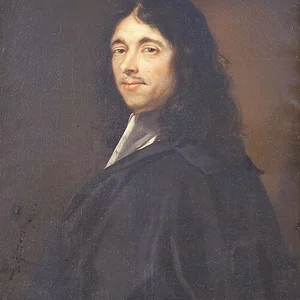

A French mathematician and magistrate of the 17th century, Pierre de Fermat left a lasting mark on the history of mathematics through his fundamental contributions to number theory, analytic geometry, and probability theory. Although he worked primarily as a counselor in the Parliament of Toulouse, his mathematical work inspired generations of mathematicians to come.
Pierre de Fermat(1607 — 1665)
Pierre de Fermat
France
7 min read
Frequently asked questions
Key Facts
- 1630–1660: Development of the method of tangents, a precursor to differential calculus, independently of Newton and Leibniz
- 1654: Correspondence with Pascal on probability theory and games of chance, laying the foundations of that discipline
- 1659: Statement of 'Fermat's Last Theorem' (xⁿ + yⁿ = zⁿ has no integer solution for n > 2), left unproved until 1995
- 1630s–1640s: Contributions to analytic geometry and the development of Cartesian coordinates
- Posthumous works: Publication of his results in number theory and arithmetic, which influenced Euler and modern mathematics
Works & Achievements
Fermat develops the foundations of analytic geometry, representing curves through algebraic equations, independently of and in parallel with Descartes's work.
A method for finding the maxima and minima of functions, a direct precursor to differential calculus. Newton and Leibniz drew directly from it to develop infinitesimal calculus.
The assertion that the equation xⁿ + yⁿ = zⁿ has no non-zero integer solutions for n > 2. This problem, left without a published proof, occupied mathematicians for 358 years.
A founding exchange of letters for probability theory. The two scholars formalize the 'problem of points' and lay the groundwork for modern probabilistic reasoning.
If p is a prime number and a an integer not divisible by p, then aᵖ⁻¹ ≡ 1 (mod p). This result is fundamental in modular arithmetic and modern cryptography.
Light always takes the path that minimizes its travel time. This principle foreshadows the laws of reflection and refraction and anticipates the great variational principles of physics.
Anecdotes
Fermat published almost no work during his lifetime, preferring to communicate his discoveries through letters to other scholars. It was in the margins of a copy of Diophantus's Arithmetica that he scribbled his famous note about his 'Last Theorem', claiming to have a proof 'too large to fit in the margin'. This note kept mathematicians in suspense for over 350 years, until Andrew Wiles provided the proof in 1995.
Fermat worked as a councillor in the Parliament of Toulouse and regarded mathematics as a mere pastime. He systematically refused honours and detested priority disputes. Yet his mathematical 'leisure' led him to discoveries that professionals such as Descartes deeply envied.
Fermat and Descartes independently developed the foundations of analytic geometry, but did not get along at all. Descartes, driven by jealousy, attempted to demonstrate errors in Fermat's work. Their epistolary rivalry, refereed by Father Marin Mersenne, captivated the entire European scholarly community.
Fermat corresponded with Blaise Pascal in 1654 on problems related to games of chance. These exchanges gave birth to modern probability theory. The two men solved the 'problem of points': how to fairly divide the stakes of an interrupted game according to each player's chances of winning.
Fermat formulated what is known as the 'principle of least time' in optics: light always takes the fastest path between two points. This insight, stated around 1662, foreshadows the great variational principles of modern physics and is still taught in all optics courses.
Primary Sources
Here is roughly my method for the problem of points: [...] If two players, playing several games, find themselves in a situation where the first is missing two games and the second three, and they wish to separate [...] I say that the first player should receive 11/16 of all the money.
Cubum autem in duos cubos, aut quadratoquadratum in duos quadratoquadratos, et generaliter nullam in infinitum ultra quadratum potestatem in duos eiusdem nominis fas est dividere. Cuius rei demonstrationem mirabilem sane detexi. Hanc marginis exiguitas non caperet.
To find the maximum or minimum of a quantity, one must substitute A+E for A in the expression, then equate the two sides and cancel the terms containing E as a common factor, and finally set E equal to zero.
I have found a great number of beautiful and new propositions and I am still searching for more. The introduction of plane and solid loci into algebra gives me a general method for solving all problems of geometry.
Key Places
City where Fermat served as a councillor at the Parliament for over thirty years. It was there that he spent his professional life and conducted most of his mathematical research.
Town in Tarn-et-Garonne where Pierre de Fermat was born around 1607. A statue dedicated to him stands in the main square as a tribute to this illustrious son of the region.
City where Fermat died on 12 January 1665, during a professional trip related to his duties as a magistrate.
Father Marin Mersenne's cell at the Convent of the Minims in Paris served as a nerve centre for European scientific exchanges. Fermat was part of this network through correspondence, and his work was regularly discussed there.
Typical Objects

The everyday tool of both magistrate and scholar, the goose quill allowed Fermat to write his legal documents as well as his mathematical demonstrations in letters and book margins alike.

The Latin edition annotated by Bachet (1621) was Fermat's mathematical bible. It is in its margins that he wrote his famous notes, including the statement of the Last Theorem.

Classical geometry instruments, indispensable for the constructions Fermat studied, even though his algebraic methods sought to go beyond purely geometric construction.

The black robe of the councillor at the Parlement symbolized Fermat's double life: a respected jurist by day, a prolific mathematician during his leisure hours.

Candlelight was the only means of working in the evening, and Fermat spent many nocturnal hours corresponding with European scholars and developing his theorems.

Since Fermat published almost nothing, his letters to Mersenne, Pascal, Descartes, and Huygens make up the bulk of his known scientific work.
School Curriculum
Vocabulary & Tags
Key Vocabulary
Daily Life
Morning
Fermat rose early and attended Mass, a common practice among Catholic magistrates of the 17th century. He then devoted the first hours of the day to studying legal cases pending before the Parlement de Toulouse before making his way to the courthouse.
Afternoon
Parliamentary sessions occupied much of the afternoon. Fermat deliberated on civil and criminal matters, drafted reports, and handed down rulings alongside his fellow councillors. His rank as a magistrate granted him a high social standing in Toulousain society.
Evening
The evening was his preferred time for mathematics. Seated at his desk by candlelight, he worked on his theorems, annotated his books, and composed lengthy letters in Latin to Mersenne, Pascal, and other European scholars to share his discoveries.
Food
The table of a parliamentary councillor was generous and reflected his bourgeois rank: wheat bread, roasted meats (poultry, mutton), garden vegetables, cheeses from Languedoc, and wine from the Toulouse region. On lean days prescribed by the Church, meats were replaced by fresh, dried, or salted fish.
Clothing
In official capacity, Fermat wore the black robe of a Parlement magistrate along with a square cap, symbols of his office and authority. In private life, he dressed in the bourgeois fashion of his era: doublet, breeches, stockings, and a ruff or lace collar, in keeping with his social status.
Housing
Fermat lived in a townhouse (hôtel particulier) in Toulouse, a multi-storey bourgeois residence typical of wealthy magistrates. The house included a well-stocked study lined with books, reception rooms, and likely an inner courtyard garden. He also owned land in his native region of Tarn-et-Garonne.
Historical Timeline
Period Vocabulary
Visual Style
Baroque français du XVIIe siècle : clair-obscur chaleureux, tonalités bordeaux et parchemin, portrait de magistrat-savant dans son cabinet de travail.
Sound Ambience
L'atmosphère feutrée d'un cabinet de travail toulousain du XVIIe siècle : craquement de la plume, feuillets froissés, cloches de la ville et feu de cheminée.
Liens externes & ressources
Références
Œuvres
Introduction aux lieux plans et solides (Ad locos planos et solidos isagoge)
vers 1629, publié posthume 1679
Methodus ad disquirendam maximam et minimam
vers 1636, publié posthume 1679
Grand Théorème de Fermat (note marginale)
vers 1637
Correspondance avec Blaise Pascal sur les probabilités
1654
Petit Théorème de Fermat
vers 1640, communiqué par lettre
Principe de Fermat (optique)
1662