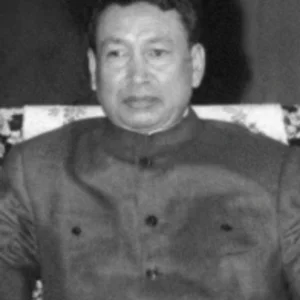

Pol Pot, whose real name was Saloth Sâr, was a Cambodian statesman and revolutionary, general secretary of the Communist Party of Kampuchea. As leader of the Khmer Rouge, he ruled Cambodia from 1975 to 1979 and bears responsibility for the Cambodian genocide, which killed around 1.7 million people.
Pol Pot(1925 — 1998)
Pol Pot
Cambodge, Indochine française, Kampuchéa démocratique, République populaire du Kampuchéa, République khmère, État du Cambodge, royaume du Cambodge
6 min read
Frequently asked questions
Key Facts
- Born in 1925 (Saloth Sâr) in Kampong Thom Province, Cambodia
- Seized power in Phnom Penh on 17 April 1975 at the head of the Khmer Rouge
- Established Democratic Kampuchea (1975-1979): evacuation of the cities, abolition of money, forced labor in the countryside
- Responsible for the Cambodian genocide (approx. 1.7 million dead, nearly a quarter of the population)
- Overthrown by the Vietnamese intervention in January 1979, he died in 1998 in the jungle
Works & Achievements
A clandestine organization led by Pol Pot, serving as the ideological and military nucleus of the future Khmer Rouge regime.
The establishment of a radical agrarian communist state aimed at completely refounding Cambodian society (“Year Zero”).
A program imposing wildly excessive rice production quotas, which led to mass famine and forced labor.
The deportation of millions of city dwellers to the countryside, one of the regime's deadliest decisions.
Total collectivization abolishing private property, money, and the traditional family in favor of the Angkar.
A secret police force and network of detention centers organizing the purges, torture, and mass executions.
Anecdotes
Born Saloth Sâr into a relatively well-off peasant family, the young Pol Pot earned a scholarship to study electronics and radio technology in Paris in the early 1950s. He failed his exams, but it was there that he discovered Marxism and frequented French communist circles.
Pol Pot was one of the most secretive leaders of the 20th century: for years, he concealed his true identity behind aliases. Many Cambodians did not even know who the “Brother Number One” ruling their country really was.
As soon as Phnom Penh fell on 17 April 1975, the Khmer Rouge emptied the capital within days, forcing hundreds of thousands of inhabitants — including the sick discharged from hospitals — to march into the countryside to work the land.
The regime declared “Year Zero”: money, schools, religions, private property, and modern medicine were abolished. The calendar was to start over from scratch in order to build an entirely new agrarian society.
Overthrown by the Vietnamese invasion in 1979, Pol Pot was never tried by an international court. He died in 1998 in the jungle, under house arrest by his own former Khmer Rouge comrades, who had placed him under arrest.
Primary Sources
More than two thousand years of the Cambodian people's history come to an end; an entirely new era begins.
Every prisoner was photographed upon arrival and forced to write detailed “confessions” before being executed.
All important means of production are the collective property of the people's State and the common property of the cooperatives.
My conscience is clear. I came to carry out the struggle, not to kill people.
Key Places
Birthplace of Saloth Sâr, where he was born into a relatively prosperous peasant family.
City where Pol Pot studied in the early 1950s and discovered Marxism in student communist circles.
Capital captured by the Khmer Rouge on 17 April 1975, then entirely emptied of its inhabitants within a few days.
A former high school turned into a detention and torture center where thousands of people were interrogated before being executed. Today it is a genocide museum.
Execution field near Phnom Penh where tens of thousands of victims were buried in mass graves. A memorial to the Cambodian genocide.
The last stronghold of the Khmer Rouge in the jungle, where Pol Pot was tried by his own people and then died in 1998.
Typical Objects

Traditional Cambodian checkered cotton scarf, worn around the neck or head. Under the Khmer Rouge, it became a uniform imposed on the entire population.

A peasant's pajama-like garment dyed black, imposed on everyone as a revolutionary uniform. It erased social differences in favor of an undifferentiated peasant mass.

An earthworking tool used in the rice paddies and irrigation projects. The regime forced the population into intensive farm labor to meet unrealistic rice quotas.

A broadcasting device installed in the cooperatives to transmit revolutionary slogans and songs glorifying the Angkar ("the Organization"). It set the rhythm of collective life and labor.

A weapon of war supplied by communist backers, emblematic of Khmer Rouge fighters, who were often very young recruits. It symbolizes the total militarization of society.

Notebooks in which the prisoners of the Tuol Sleng prison were forced to write false confessions before their execution. These archives are today major evidence of the genocide.
School Curriculum
Vocabulary & Tags
Key Vocabulary
Daily Life
Morning
Living in hiding and later in power, Pol Pot led a quiet and suspicious life, rising early in camps or guarded residences. His days began with secret meetings with the inner circle of Khmer Rouge leaders.
Afternoon
He devoted his afternoons to political and military planning, dictating the regime's broad directions. Obsessed with conspiracies, he spent a great deal of time organizing surveillance and internal purges within the party.
Evening
In the evening, he conferred with his close collaborators, often in the utmost secrecy. Very few photographs or accounts exist of his private life, which he carefully concealed.
Food
While the population suffered from famine, the leaders enjoyed a comparatively decent diet based on rice, fish, and vegetables. The gap between the egalitarian rhetoric and the actual daily life of the cadres was glaring.
Clothing
Pol Pot generally wore the plain attire of Khmer Rouge cadres: simple clothing, often dark, with no outward sign of power. This displayed austerity was part of his image as a self-effacing revolutionary.
Housing
He lived in jungle shelters, modest houses, or requisitioned buildings, frequently moving from place to place out of fear of betrayal. His location remained a state secret, even to many of the regime's cadres.
Historical Timeline
Period Vocabulary
Liens externes & ressources
Références
Œuvres
Fondation du Parti communiste du Kampuchéa
1960
Proclamation du Kampuchéa démocratique
1975-1976
Plan quadriennal agricole
1977
Évacuation forcée des villes
avril 1975
Système de coopératives et de communes rurales
1975-1979
Appareil de répression (Santebal et prison S-21)
1975-1979