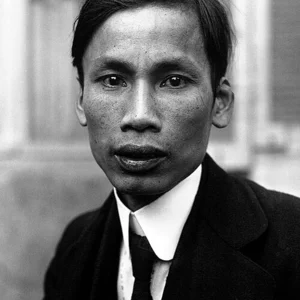

Vietnamese revolutionary and statesman, founder of the Indochinese Communist Party and later of the Democratic Republic of Vietnam. A leading figure in the anti-colonial struggle against France and then the United States, he embodies the independence and reunification of Vietnam.
Ho Chi Minh
Ho Chi Minh (born Nguyễn Sinh Cung)
6 min read
Frequently asked questions
Famous Quotes
« Nothing is more precious than independence and freedom.»
Key Facts
- 1911: leaves Vietnam and travels around the world (France, United States, United Kingdom)
- 1930: founds the Indochinese Communist Party
- 1941: creates the Viet Minh, a front for the independence struggle
- 2 September 1945: proclaims the independence of the Democratic Republic of Vietnam
- 1946-1954: leads the Indochina War against France (victory at Dien Bien Phu in 1954)
- 3 September 1969: dies in Hanoi, before the reunification of the country (1975)
Works & Achievements
An indictment denouncing the abuses of colonialism, which established his reputation as a spokesman for colonized peoples.
The unification of Vietnamese communist movements into a single party, the organizational basis of the future revolution.
A united independence front bringing together patriots and communists to free the country from its occupiers.
A collection of poems written during his imprisonment in China, considered a classic of Vietnamese literature.
The founding text proclaiming the birth of the Democratic Republic of Vietnam.
Political leadership of the resistance that led to the victory at Dien Bien Phu and the French withdrawal.
Final recommendations calling for the unity of the people and the peaceful reunification of the country.
Anecdotes
Before becoming a revolutionary, the young Nguyễn Sinh Cung travelled the world as a kitchen assistant aboard a French ocean liner. He lived in London, where he is said to have worked in the kitchens of the famous Carlton Hotel, then in Paris and the United States, gaining first-hand knowledge of the great colonial powers.
In 1919, at the Versailles peace conference, he called himself “Nguyễn Ái Quốc” (Nguyễn the Patriot) and presented the leaders with a petition demanding rights for the Vietnamese people. Ignored by the powerful, the episode convinced him that independence would not be won through mere petitions.
The name “Ho Chi Minh,” which he adopted around 1942, means roughly “he who enlightens” or “bringer of light.” Throughout his life in hiding, he used dozens of pseudonyms to evade the French and British colonial police.
On 2 September 1945, in Hanoi, he proclaimed Vietnam's independence by quoting... the American Declaration of Independence of 1776: “All men are created equal.” He hoped in this way to win the support of the United States against France.
Affectionately nicknamed “Uncle Ho” (Bác Hô) by his followers, he cultivated an image of simplicity: modest clothing, rubber sandals cut from tires, and a taste for frugal living, which contrasted with the image of leaders in suits.
Primary Sources
All men are created equal. The Creator has given us inviolable rights: the right to live, the right to be free, and the right to achieve happiness.
The Annamite people request a general amnesty for all native political prisoners and freedom of the press and of opinion.
We would rather sacrifice everything than lose our country and fall back into slavery. Men and women, young and old, regardless of religion, party, or nationality, all Vietnamese must rise up to fight.
My final wish is that our entire Party and our entire people unite closely in the struggle, to build a peaceful, unified, independent, democratic, and prosperous Vietnam.
Key Places
Birthplace of Hô Chi Minh, in central Vietnam, today a place of remembrance.
City where he became an activist after the First World War, drafted his demands and took part in the founding of the French Communist Party.
Capital from which he proclaimed independence in 1945 and led the Democratic Republic of Vietnam; he died there in 1969.
A basin in the northwest where the Viêt Minh victory in 1954 ended the Indochina War and hastened the French withdrawal.
A border cave where he set up his base on his return to Vietnam in 1941 to organize the Viêt Minh.
A monument inaugurated in 1975 on Ba Đình Square where his embalmed body lies, a site of national pilgrimage.
Liens externes & ressources
Références
Œuvres
Le Procès de la colonisation française
1925
Fondation du Parti communiste indochinois
1930
Création du Viêt Minh
1941
Carnet de prison (Nhật ký trong tù)
1942-1943
Déclaration d'indépendance du Viêt Nam
1945
Direction de la guerre d'Indépendance (Indochine)
1946-1954
Testament politique
1969