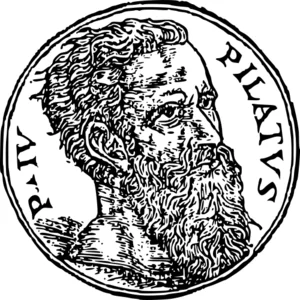

Pontius Pilate was a Roman prefect of Judaea from 26 to 36 AD. He is best known for ordering the crucifixion of Jesus of Nazareth. His governorship was marked by several conflicts with the Jewish population.
Pontius Pilate(11 av. J.-C. — ?)
Pontius Pilate
Rome antique
8 min read
Frequently asked questions
Key Facts
- Appointed prefect of Judaea around 26 AD by Emperor Tiberius
- Ordered the crucifixion of Jesus of Nazareth, according to the Gospels, around 30–33 AD
- Removed from office in 36 AD by the legate of Syria, Vitellius, following a violent crackdown on the Samaritans
- His exact title was 'praefectus', confirmed by the Caesarea inscription discovered in 1961
- His governorship was marked by several disputes with the Jews over Roman military standards and the Temple treasury
Works & Achievements
Pilate commissioned an aqueduct to bring water to Jerusalem, funding the project with money from the Temple treasury. Though technically beneficial, the project sparked serious riots due to the perceived sacrilege of using sacred funds.
Pilate had bronze coins struck bearing Roman symbols — the simpulum (a ritual ladle) and the lituus (an augur's staff) — whereas his predecessors had avoided such imagery out of respect for Jewish sensibilities. This deliberate act was interpreted as a religious provocation.
Pilate had golden shields bearing dedications to Emperor Tiberius placed in Herod's Palace in Jerusalem. This act of devotion to Rome met with such fierce resistance that Tiberius himself ordered their removal — a significant diplomatic humiliation for Pilate.
As prefect, Pilate spent ten years overseeing tax collection, maintaining order, and administering criminal justice in Judea. His tenure — one of the longest in the province — demonstrates Rome's ability to maintain authority over a notoriously difficult territory to govern, despite persistent tensions.
Anecdotes
Pontius Pilate had golden shields installed in Herod's palace in Jerusalem to honor Emperor Tiberius. The Jewish population protested vigorously, arguing that these Roman symbols desecrated the Holy City. The matter was escalated to Tiberius himself, who ordered Pilate to remove the shields — a stinging humiliation for the prefect.
Pilate reportedly drew from the Temple treasury in Jerusalem, known as the Korban, to fund the construction of an aqueduct to supply the city with water. Practical as it was for the population, this act was seen as a sacrilege. Riots broke out, and Pilate suppressed the protesters with a brutality that earned him a lasting reputation as a harsh and uncompromising governor.
During the trial of Jesus, according to the Gospels, Pilate performed a powerful symbolic gesture: he washed his hands before the crowd, declaring himself innocent of this man's blood. The gesture, borrowed from a Jewish purification custom, has become in Western culture an expression used to describe someone who refuses to accept responsibility for a decision.
In 36 AD, Pilate ordered a massacre of Samaritans who had gathered on Mount Gerizim, whom he suspected of plotting an uprising. This excessive violence was reported to the legate of Syria, Vitellius, who suspended him from his duties and sent him to Rome to account for his conduct before Emperor Tiberius. Tiberius died before Pilate could appear before him.
An inscription discovered in 1961 at Caesarea Maritima, known as the 'Pilate Stone,' explicitly mentions his name and his title of 'Praefectus Iudaeae.' It is the only direct archaeological evidence of the historical existence of Pontius Pilate, confirming that the figure is not merely a character in religious texts but a real Roman official.
Primary Sources
Pilate, the governor of Judea, sent images of Caesar called military standards into Jerusalem by night. This action aroused fierce indignation among the Jews, who flocked en masse to Caesarea to implore Pilate to have the standards removed.
Pilate, in order to build an aqueduct, spent the sacred treasury funds, appropriating for this purpose the revenues known as Korban. The people were enraged, and when Pilate came to Jerusalem, they surrounded him with loud cries.
Christus, from whom the name had its origin, suffered the extreme penalty during the reign of Tiberius at the hands of one of our procurators, Pontius Pilatus; and a most mischievous superstition, thus checked for the moment, again broke out not only in Judaea, the first source of the evil, but even in Rome.
Pilate was a man of inflexible disposition, a blend of stubbornness and harshness. He governed Judea with corruption, violence, plunder, abuse, repeated outrages, extra-judicial executions, and intolerable cruelty.
[Dis Augustis Tiberieum] / [Pon]tius Pilatus / [Praef]ectus Iuda[eae] / [fecit d]e[dicavit] — translation: Pontius Pilate, Prefect of Judaea, built and dedicated [this building] to the divine Augusti.
Key Places
The administrative capital of the province of Judea, Caesarea was the main residence of the Roman prefect. It was here that Pilate had his palace and offices, and where an inscription bearing his name was discovered in 1961.
During major Jewish festivals, particularly Passover (Pesach), Pilate would travel to Jerusalem and reside in the former palace of Herod the Great to maintain order. It was most likely in this location that the trial of Jesus took place.
The site of the execution of Jesus of Nazareth, ordered by Pilate. According to the Gospels, it was located outside the walls of Jerusalem; the current Church of the Holy Sepulchre is believed to mark this spot.
The sacred mountain of the Samaritans, scene of the massacre ordered by Pilate in AD 36 against Samaritan pilgrims. This episode of excessive violence was the cause of his removal from office.
The seat of imperial power where Tiberius resided. Pilate was directly answerable to the emperor, who had appointed him and could dismiss him; it was to Rome that he was summoned in AD 36–37 to answer for the massacre of the Samaritans.
Typical Objects

The Roman prefect drafted his orders, judgments, and official correspondence on wax tablets using a metal or bone stylus. Pilate used these instruments to record the judicial and administrative decisions of his government in Judea.

Lictors carrying the fasces — bundles of rods bound around an axe — preceded the prefect on his official movements, symbolizing his imperium, that is, his power to command and to punish. This emblem of Roman authority was particularly visible to the Judean population.

Every administrative or judicial act of the prefect was authenticated by his personal seal, engraved on a gold or bronze ring. This seal was used to validate death sentences, tax collection orders, and correspondence with Rome.

The distinctive garment of Roman magistrates, the toga praetexta was bordered with a purple stripe. Pilate wore it during official ceremonies and court sessions, visually asserting the power of Rome before the local population.

As holder of the right of the sword (ius gladii), Pilate alone had the authority to pronounce and carry out capital punishment in Judea. The gladius concretely symbolized this absolute power over the life and death of the province's inhabitants.

According to the Gospel account, Pilate had a bowl of water brought so he could wash his hands at the trial of Jesus, symbolically signifying that he was absolving himself of any responsibility for the condemnation. This gesture, borrowed from local cultural practices, illustrates Pilate's pragmatic adaptation to Judean customs.
School Curriculum
Vocabulary & Tags
Key Vocabulary
Daily Life
Morning
Pilate rose at dawn and, after a brief wash, received his secretaries and officers to review the night's reports — incidents, arrests, troop movements. He dictated his correspondence to Rome and to the legates of Syria, reporting on the province's political and religious tensions.
Afternoon
The afternoon was devoted to judicial hearings (the tribunal customarily sat in the morning by Roman practice) and to meetings with local dignitaries, high priests, and tax collectors. Pilate also oversaw the military garrisons stationed at Caesarea and at the Antonia Fortress in Jerusalem during the festivals.
Evening
In the evening, Pilate dined with his staff and Roman or local notables, following the conventions of the Roman banquet. Informants brought him word of rumors circulating in the markets and synagogues. He corresponded with his wife Claudia Procula, who is said to have accompanied him to Judea according to a tradition attested by Tacitus.
Food
Pilate followed the diet of a Roman aristocrat on provincial posting: wheat bread, olive oil, watered Judean wine, grilled meats, Mediterranean fish, legumes, and local fruits such as figs and dates. Official banquets might include delicacies imported from Italy to keep up the appearance of Roman refinement.
Clothing
In the exercise of his official duties, Pilate wore the toga praetexta edged with purple, the symbol of his magistracy. In daily life he wore a white linen tunic, better suited to the Judean heat, with leather sandals. On military campaigns or during troop inspections, he wore the cuirass and the paludamentum, the commander's military cloak.
Housing
In Caesarea Maritima, Pilate resided in the great palace built by Herod the Great — a lavish building with gardens, baths, and reception halls overlooking the Mediterranean. In Jerusalem, he occupied Herod's former palace in the upper city during his obligatory stays for the Jewish festivals, an imposing structure that symbolized Roman authority at the heart of the holy city.
Historical Timeline
Period Vocabulary
Visual Style
Style de fresque romano-pompéienne avec architecture hérodienne, lumière méditerranéenne intense sur l'ocre et la pierre calcaire, évoquant la tension entre domination impériale romaine et résistance judéenne.
Sound Ambience
Un mélange de sons méditerranéens — port animé de Césarée, marchés multilingues, soldats romains en patrouille — avec l'atmosphère tendue et bureaucratique d'un centre administratif colonial dominé par Rome.
Liens externes & ressources
Références
Œuvres
Construction de l'aqueduc de Jérusalem
vers 28-30 apr. J.-C.
Frappe de monnaies provinciales
29-31 apr. J.-C.
Installation des boucliers votifs dans le palais d'Hérode
32 apr. J.-C.
Administration judiciaire et fiscale de la Judée
26-36 apr. J.-C.
Rechercher
See also
Related Characters
Catiline
107 av. J.-C. — 61 av. J.-C.
Cato the Elder
233 av. J.-C. — 148 av. J.-C.
Claudius
9 av. J.-C. — 54
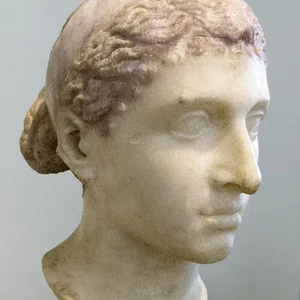
Cleopatra
68 av. J.-C. — 29 av. J.-C.
Cornelia
190 av. J.-C. — 100 av. J.-C.
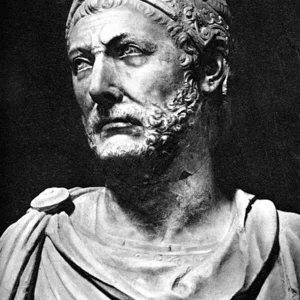
Hannibal Barca
246 av. J.-C. — 182 av. J.-C.