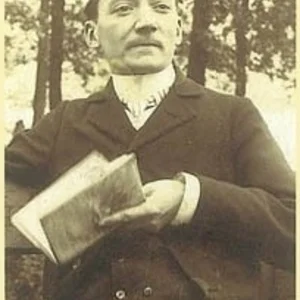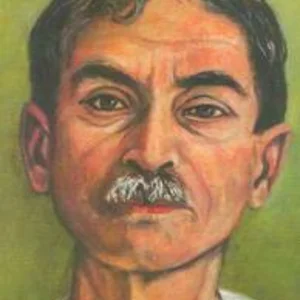

Premchand (1880-1936) is one of the greatest writers in the Hindi and Urdu languages. A novelist and short-story writer, he is regarded as the father of the modern social novel in Hindi, depicting the lives of peasants and the oppressed in colonial India.
Premchand(1880 — 1936)
Munshi Premchand
Raj britannique
6 min read
Frequently asked questions
Key Facts
- Born in 1880 near Benares (Varanasi) into a humble family, under British rule
- First wrote in Urdu under the pen name 'Nawab Rai' before adopting the name 'Premchand'
- His short-story collection 'Soz-e-Watan' (1908) was censored and burned by the colonial authorities for its patriotic content
- Published 'Godan' (The Gift of a Cow, 1936), his masterpiece on peasant poverty, the year of his death
- Died in 1936, leaving behind a body of work comprising a dozen novels and more than 300 short stories
Works & Achievements
A collection of patriotic short stories seized and burned by the British, which gave rise to his pen name.
The first major novel written in Hindi, devoted to the plight of women and the failings of society.
A celebrated short story about the decadence of the Awadh aristocracy, adapted for the screen by Satyajit Ray in 1977.
A sweeping novel whose hero is a blind beggar confronting industrialization and power.
A novel denouncing the dowry system and the ill-matched marriages forced upon young women.
A novel about the greed, corruption, and illusions of the Indian middle class.
His masterpiece: a poignant portrait of the exploitation of the peasant Hori in rural India.
One of his most famous and darkest short stories, about poverty and dignity.
Anecdotes
In 1908, the young writer published a collection of patriotic short stories, Soz-e-Watan, under the name "Nawab Rai." Alarmed by its nationalist tone, the British authorities summoned the author, seized nearly five hundred copies, and burned them. To keep writing without being harassed, he then adopted the pen name under which he would become famous: Premchand.
In 1921, Premchand held a safe, well-paid post as a deputy schools inspector. But after hearing Gandhi call on Indians to refuse cooperation with colonial rule, he resigned to follow his ideals, giving up his financial security. From then on he devoted his life to writing and teaching.
At a time when a widow could scarcely remarry, Premchand married Shivrani Devi, a young widow, defying the social conventions of his day. This act reflected the reformist ideas he championed in his novels, in which he denounced the oppression of women and the weight of tradition.
In 1934
drawn to the emerging film industry
Premchand went to work in Bombay and wrote the screenplay for the film Mazdoor (
The Labourer
)
which stood up for workers. The film so alarmed the authorities and factory owners that it was banned in several cities. Disappointed by the world of cinema
the writer returned to Benares after a year.
A few months before his death, in 1936, Premchand presided over the first conference of the Progressive Writers' Association in Lucknow. Weakened and in debt, he gave a famous speech there declaring that literature must defend the humble and the oppressed. He died on 8 October of that same year, shortly after completing his masterpiece, Godaan.
Primary Sources
A collection of short stories exalting love for India and sacrifice for the homeland, whose patriotic tone led the British to seize and burn it.
“We shall have to change our standard of beauty. The writer cannot remain indifferent to the fate of the humble and the oppressed: he is their advocate.”
“Hori had but one dream: to own a cow, a sign of prosperity and dignity in his village.” The novel follows this peasant crushed by debt and by the powerful.
“At the foot of the hut, beside a dying fire, the father and son sat, while inside the young woman lay dying in childbirth.”
Key Places
Village near Benares where Premchand was born in 1880 into a modest family of Kayasthas.
Sacred city on the Ganges where he lived, set up his printing press and died on 8 October 1936.
City where Premchand taught and worked in the school administration, and where he heard Gandhi's call.
City where he continued his studies and sat his university examinations despite poverty.
Cultural capital of Awadh where in 1936 he presided over the first conference of progressive writers.
Metropolis where Premchand worked in the film industry in 1934-1935 and wrote the screenplay for the film Mazdoor.
Typical Objects

A writing tool cut from a reed and dipped in ink, used to write in Urdu as well as Hindi.

A small container holding ink, into which the writer dipped his reed pen.

A notebook where Premchand wrote down his short stories and novels, reworking his drafts at length.

A wheel for spinning cotton that, under Gandhi's influence, became the symbol of Indian self-sufficiency and of the rejection of British textiles.

A piece of hand-spun cotton cloth, draped around the legs; a traditional garment that became a sign of nationalist commitment.

Premchand founded his own printing house in Benares to publish his magazines and books, despite severe financial difficulties.

A lamp used for writing at night in Indian villages, before the arrival of electricity.
School Curriculum
Vocabulary & Tags
Key Vocabulary
Daily Life
Morning
An early riser, Premchand readily devoted the start of the day to writing, his pen and inkwell set on a low table. During his years as a civil servant, he would set out to inspect the district's schools, sometimes traveling long distances.
Afternoon
His afternoons were split between his duties as a teacher or editor, reading, and correcting his manuscripts. He received fellow writers with whom he discussed literature and the political situation in India.
Evening
In the evening, by the glow of an oil lamp, he continued writing his novels and short stories, often late into the night. He enjoyed smoking the hookah and spending time with his family.
Food
His diet was simple and largely vegetarian, typical of North India: wheat flatbreads (roti), rice, lentils (dal), and vegetables. Tea punctuated his working days.
Clothing
He wore the modest dress of Indian scholars: a cotton dhoti, a long tunic (kurta), and sometimes a cap. Committed to the nationalist movement, he favored khadi, a hand-spun cloth.
Housing
He lived in a brick-and-earth village house in Lamhi, then in modest lodgings in Gorakhpur and Benares. His household was often burdened with debt, notably because of his printing press.
Historical Timeline
Period Vocabulary
Liens externes & ressources
Références
Œuvres
Soz-e-Watan (Lamentation pour la patrie)
1908
Sevasadan
1919
Rangbhoomi
1925
Gaban (Le Détournement)
1931
Godaan (Le Don d'une vache)
1936