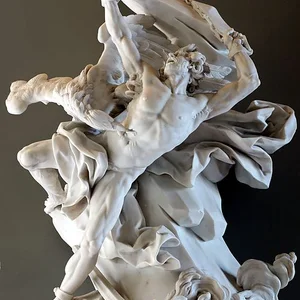

A Titan of Greek mythology, Prometheus is the symbol of human progress and rebellion against divine authority. He stole fire from the heavens to give it to humankind, transforming their condition and granting them access to civilization. Punished by Zeus for this act of defiance, he embodied the values of humanity and self-sacrifice.
Prometheus
Prometheus
8 min read
Frequently asked questions
Key Facts
- Theft of heavenly fire and its gift to mortals — the founding act of human civilization in Greek mythology
- Punishment ordered by Zeus: chained to a rock in the Caucasus, with an eagle devouring his liver each day
- Freed by Heracles (Hercules) according to some versions of the ancient myth
- Protagonist of Aeschylus's dramatic trilogy (5th century BC) 'Prometheus Bound'
- Literary and philosophical symbol of resistance, progress, and sacrifice for humanity
Works & Achievements
Prometheus stole fire from the heavens to give to humanity, granting them access to civilization, cooking, and technology. This act of defiance against Zeus symbolizes human progress and the spirit of sacrifice for the good of all.
According to some versions of the myth, Prometheus shaped humans from clay and water, giving them form and dignity. He thus became the protector and benefactor of the human race.
Chained to a rock in the Caucasus by Zeus, Prometheus endured the eternal torment of an eagle that devoured his liver each day, only for it to regenerate overnight. This punishment embodies the ultimate sacrifice for serving humanity against the will of the gods.
Prometheus taught humans a wide range of practical skills and arts, including metallurgy, architecture, and astronomy. This knowledge allowed humanity to advance and lay the foundations of civilization.
Prometheus demonstrated his cunning by deceiving Zeus at the sacrifice of Mecone, presenting him with the less desirable portions of the sacrificial animal. This ruse illustrates his clever, strategic opposition to divine authority.
Thanks to his Titan immortality, Prometheus was able to endure his eternal punishment without yielding, becoming a timeless symbol of revolt and perseverance in the face of tyrannical oppression.
Anecdotes
According to Hesiod in his Theogony, Prometheus tricked Zeus during a sacrifice at Mecone by offering him bones wrapped in fat while keeping the meat for humans. This famous ruse illustrates how the Titan sought to favor mortals, provoking the wrath of the king of the gods, who decided to withhold fire from them.
The legend of the theft of fire is recounted by several ancient Greek authors, most notably Aeschylus in his tragedy 'Prometheus Bound'. Prometheus is said to have stolen the divine spark hidden inside a fennel stalk and given it to humans, allowing them to cook food and develop the arts and civilization.
As punishment for his disobedience, Prometheus was chained to a rock in the Caucasus where an eagle came each day to devour his liver. According to ancient sources, this torment lasted for many generations until Heracles freed him — a stark illustration of the extreme consequences of divine vengeance in Greek mythology.
Prometheus is also credited in some myths with creating or fashioning humanity, in a version where he molded humans from clay. This role as creator and benefactor of humankind sets him apart from the other Titans and explains his deep commitment to the welfare of mortals throughout Greek legend.
The figure of Prometheus inspired numerous adaptations in antiquity: Aeschylus, Ovid, and other Greek and Roman authors all retold his story, making the Titan the universal symbol of human progress, rebellion against oppression, and self-sacrifice for the good of others.
Primary Sources
Prometheus of crafty counsel, who sat beside him, did not bow before the commands of Zeus. He dared to steal the eternal flame of fire and hid it in a hollow fennel stalk, to give it to mortal men.
Prometheus the Titan of wily thoughts was bound in chains because of the theft of fire. Zeus sent him an eagle, which each day would eat his liver, and each night the liver grew back anew to renew his torment the following day.
It is I who stole fire from the immortal gods and gave it to men. This is the crime I committed, and I must bear its punishment. These chains bind me to this rock in the Caucasus where the eagle comes each day to tear at my entrails.
Prometheus the Titan, having fashioned man in the image of the gods, dared to take fire from the heavens and bring it to mortals. For this act of defiance, he was bound to the Caucasus where a vulture fed daily on his immortal liver, tearing at it without end.
Key Places
Mountain range where Prometheus was chained by Zeus as punishment for stealing fire. This is the site of his eternal torment, where an eagle came each day to devour his liver.
Home of the Greek gods, from which Prometheus stole the sacred fire before giving it to humanity. It stands as a symbol of the divine power he dared to defy.
The recipient of the fire given by Prometheus, which allowed humans to access civilization, technology, and progress. Prometheus is thus the benefactor of all mankind.
Greek city where the cult of Prometheus was especially prominent. Festivals (the Prometheia) were held in his honor, celebrating him as an innovator and champion of human progress.
Island in the Aegean Sea where, according to some versions of the myth, Prometheus was cast down by Zeus after stealing fire, before being chained to the Caucasus.
Region in what is now southern Russia where, according to some mythological traditions, the torment of Prometheus took place, reinforcing the connection between the Titan and barbarian peoples.
Typical Objects

The central symbol of Prometheus, fire represents the transformative gift he stole from the gods to give to humanity. It is the essence of his act of rebellion and the foundation of human civilization.

The emblematic object used to carry divine fire from the heavens down to earth. The torch embodies Prometheus's role as a bearer of knowledge and progress to humankind.

Symbols of the punishment inflicted by Zeus, Prometheus was chained to a rock in the Caucasus. The chains represent the price of disobedience and the hero's sacrifice for his love of humanity.

The creature sent by Zeus to devour Prometheus's liver each day as punishment. This eagle symbolizes divine vengeance and the Titan's eternal torment.

A tool associated with Prometheus as a craftsman and creator Titan. The anvil represents work and creation — domains in which the Titan excelled before his condemnation.

A typical vessel of ancient Greece, it symbolizes the advances of human civilization made possible by fire: cooking, food preservation, and trade.

The mythical place of suffering where Prometheus was chained. This rock has become a timeless symbol of resistance and endurance in the face of divine oppression.
School Curriculum
Vocabulary & Tags
Key Vocabulary
Daily Life
Morning
As a Titan, Prometheus does not experience the biological rhythms of mortals. He spends his mornings on Olympus or among the heavens, contemplating the universe and reflecting on the human condition. His mind is constantly occupied by the desire to improve the lot of humanity.
Afternoon
In the afternoons, Prometheus watches over the mortal world, observing the struggles and suffering of humankind. He seeks ways to help and liberate them — a drive that gradually pushes him toward his revolutionary act of stealing the sacred fire.
Evening
Evenings find Prometheus meditating on the consequences of his actions and his identity as a rebel. After his punishment, he endures his nightly torments with dignity — his liver devoured by an eagle through the night — a symbol of his endless sacrifice for humanity.
Food
As an immortal Titan, Prometheus has no need for ordinary food as mortals do. He sustains himself on nectar and ambrosia, the divine nourishment of the Olympian gods. This sets him apart completely from the mortals whose fate he longs to improve.
Clothing
Prometheus is typically depicted as a powerful and majestic Titan, dressed in long flowing robes in the manner of Greek divinities. After his punishment, he bears the marks of his sentence — adamantine chains and the wounds of his torment — visually embodying both his defiance and his sacrifice.
Housing
Prometheus first dwells on Olympus alongside the other Titans and gods, in the magnificent divine palaces. After his condemnation by Zeus, he is chained to the Caucasus mountains — a harsh and inhospitable peak — where he endures his eternal punishment, his home transformed into a place of suffering and martyrdom.
Historical Timeline
Period Vocabulary
Visual Style
Un style classique inspiré de la céramique grecque antique fusionné avec la maîtrise anatomique Renaissance, utilisant un contraste dramatique entre la lumière dorée du feu divin et les ombres profondes. L'ambiance évoque à la fois l'héroïsme antique et la rébellion romantique, avec des teintes chaudes dominant une composition dynamique et mouvementée.
Sound Ambience
Une ambiance sonore épique mêlant le crépitement du feu volé, les grondements divins de Zeus et les chaînes d'un châtiment éternel, exprimant le sacrifice héroïque et la révolte contre l'oppression cosmique.
Liens externes & ressources
Références
Œuvres
Le Vol du feu divin
inconnue
La création de l'humanité
inconnue
Le Châtiment au Caucase
inconnue
L'enseignement des arts et techniques
inconnue
La ruse contre Zeus
inconnue
L'immortalité de la résistance
inconnue