
Pulcheria (399-453) was an Eastern Roman (Byzantine) empress, daughter of Emperor Arcadius. As regent for her brother Theodosius II during his minority, she wielded major influence over the politics and religious affairs of the Empire for nearly half a century.
Pulcheria(399 — 453)
Pulcheria
Empire byzantin
5 min read
Frequently asked questions
Key Facts
- Born in 399 in Constantinople, daughter of Emperor Arcadius
- Proclaimed Augusta in 414 and took on the regency of her young brother Theodosius II, who had come to the throne at age 7 in 408
- Played a key role in the religious life of the Empire, notably at the Council of Ephesus (431)
- Married the general Marcian in 450, who became emperor, while keeping her vow of virginity
- Supported the convening of the Council of Chalcedon (451), which defined Christological doctrine; she died in 453 and is venerated as a saint
Works & Achievements
By acting as regent for Theodosius II, Pulcheria stabilized the Empire and wielded political authority rare for a woman in Antiquity.
She organized the moral, religious, and political training of her brother, lastingly shaping the sovereign and his reign.
Her backing helped bring about the proclamation of Mary as “Mother of God,” a major decision in Christian doctrine.
This union ensured a peaceful transition of power and the legitimacy of the new emperor after the death of Theodosius II.
She played a key role in holding this foundational council, which defined the two natures of Christ and remains a reference today.
Pulcheria had several sanctuaries dedicated to the Virgin built or endowed in Constantinople, anchoring the cult of Mary in the capital.
Anecdotes
At just fifteen years old, in 414, Pulcheria became regent of the Eastern Roman Empire on behalf of her young brother Theodosius II. To establish her moral authority, she publicly took a vow of perpetual virginity and drew her two sisters into the same promise, turning the imperial palace into a kind of monastery.
It is said that Pulcheria personally oversaw the education of her younger brother Theodosius II, teaching him to carry himself with dignity, to master his emotions, and even to wear the imperial purple correctly. Many historians believe she was the true ruler of the Empire for decades.
According to a famous anecdote, Pulcheria once had her brother sign an important document without reading it: it was an order condemning his own wife Eudocia to slavery, meant to show him that he signed things without checking. True or exaggerated, this story illustrates the rivalry for influence at court.
In 450, upon the death of Theodosius II, Pulcheria, then fifty years old, married the general Marcian to ensure the stability of the Empire — while insisting that her vow of chastity be respected. This purely political marriage legitimized the new emperor.
Pulcheria played a decisive role in convening the Council of Chalcedon in 451, one of the most important in Christian history. For her religious devotion, both the Orthodox Church and the Catholic Church venerate her as a saint.
Primary Sources
Pulcheria, although very young, displayed admirable wisdom and piety; she consecrated her virginity to God and persuaded her sisters to do the same.
We know with what zeal for the Catholic faith Your Clemency strives to defend the truth against errors.
The Augusta Pulcheria and the Emperor Marcian presided in person over the sessions, overseeing the definition of the faith concerning the two natures of Christ.
Pulcheria Augusta, sister of Theodosius, governed the State with great wisdom and founded many churches in honor of the Virgin.
Key Places
Capital of the Eastern Roman Empire and imperial residence where Pulcheria was born, grew up, and governed. There she transformed the palace into a place of pious living.
Great church of Constantinople, heart of imperial religious life where the major ceremonies took place. There Pulcheria asserted her role as protector of the faith.
Marian shrine of Constantinople associated with the cult of the Virgin that Pulcheria helped to promote. It became a major center of Byzantine piety.
City located across from Constantinople, on the Asian shore of the Bosphorus, where the great council presided over by Pulcheria and Marcian was held in 451.
City of Asia Minor where the councils of 431 and 449 were held, centered on the debates over the nature of Christ that Pulcheria followed closely.
Typical Objects

A headband adorned with pearls and precious stones worn by the Byzantine augustae. It signaled imperial rank and the sovereign power of Pulcheria.

A long cloak dyed purple, a color reserved for the imperial family. Pulcheria made sure her brother wore it with dignity.

A precious cross offered to churches by the empress as a sign of piety. Pulcheria dedicated several of them to the sanctuaries of Constantinople.

An official act drawn up in the emperor's name and validated by a lead or wax seal. Pulcheria dictated many of them on behalf of Theodosius II.

A holy image of Mary Mother of God, whose cult Pulcheria promoted. She is said to have had churches built to house such icons.

The standard Byzantine gold coin, struck with the likeness of the sovereigns. Some pieces bear the portrait of Pulcheria as Augusta.
School Curriculum
Vocabulary & Tags
Key Vocabulary
Tags
Daily Life
Morning
Pulcheria began her day with prayer and the reading of Scripture, faithful to her vow of a pious life. She then received counselors and officials to handle the affairs of the Empire.
Afternoon
The afternoon was devoted to governing: audiences, reading reports, drafting decrees in the emperor's name. She also oversaw religious matters and the correspondence with the bishops.
Evening
In the evening, she withdrew to her apartments for devotions, needlework, and conversations with her sisters. The court she led avoided pomp and amusements deemed frivolous.
Food
As a member of the imperial family, she had access to refined food — bread, fish, fruit, wine cut with water. Out of piety, Pulcheria is said to have practiced fasting and led a sober dietary life.
Clothing
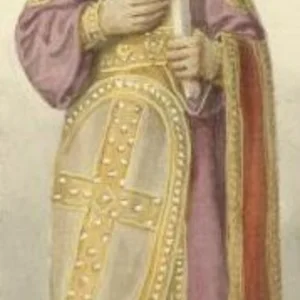
She wore the garments of an augusta: silk gowns, a purple mantle, and a pearl-adorned diadem during ceremonies. In private, she favored more austere attire in keeping with her devotion.
Housing
Pulcheria resided in the Great Palace of Constantinople, a vast complex of halls, chapels, and gardens on the shore of the Bosphorus. There she had established an atmosphere close to that of a convent.
Historical Timeline
Period Vocabulary
Liens externes & ressources
Références
Œuvres
Régence de l'Empire d'Orient
414-416 et au-delà
Éducation de Théodose II
à partir de 414
Soutien au concile d'Éphèse (Theotokos)
431
Mariage politique avec Marcien
450
Convocation du concile de Chalcédoine
451
Fondation d'églises mariales
Ve siècle