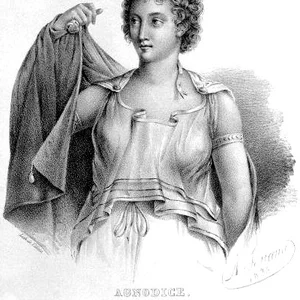

Greek biologist and embryologist of the 4th century BC, wife of Aristotle. She is believed to have actively participated in the philosopher's natural research, particularly in embryology and marine biology. A rare female figure in ancient science.
Pythias(361 av. J.-C. — 400 av. J.-C.)
Pythias
8 min read
Frequently asked questions
Key Facts
- Around 370 BC: born in Assos, in Mysia (present-day Turkey)
- Wife of Aristotle, with whom she is believed to have collaborated on biological observations
- Associated with the Lyceum's work in embryology and marine biology
- Mother of a daughter also named Pythias
- Died before 322 BC, the year of Aristotle's death
Works & Achievements
Pythias took part in the naturalist observations conducted in the Pyrrha lagoon on Lesbos. This collective work fed directly into Aristotle's major biological treatises (*Historia Animalium*, *De Partibus Animalium*), regarded as the founding works of ancient zoology and biology.
The pioneering studies on the embryonic development of selachians, cephalopods, and birds, recorded in the *De Generatione Animalium*, are attributed by some historians of science to observations shared with Pythias. This work established embryology as a scientific discipline for nearly twenty centuries.
Coming from a cultivated and philosophical milieu that was exceptional for a woman of her time, Pythias helped transmit the naturalist and medical knowledge circulating at the court of Hermias — knowledge enriched by contact with the Platonic tradition and the empirical learning of Asia Minor.
Anecdotes
Pythias accompanied Aristotle to the island of Lesbos around 345–343 BC, where the philosopher undertook his celebrated marine observations in the lagoon of Pyrrha. According to historians of science, she actively participated in collecting marine specimens and observing the embryos of fish and cephalopods, directly contributing to the work that would become Aristotle's landmark biological writings.
In his will, preserved by Diogenes Laërtius, Aristotle expressed the explicit wish to be buried alongside Pythias: he asked that their bones be laid together, in accordance with a wish she herself had made during her lifetime. This gesture reflects a deep affection and an intellectual and personal bond that was exceptional for the era.
Pythias was the adoptive niece of Hermias of Atarneus, a former slave who had risen to become ruler of the cities of Atarneus and Assos in Asia Minor, and was himself a philosopher and disciple of Plato. Aristotle had joined his court around 347 BC before marrying Pythias, forging a remarkable alliance between philosophy, politics, and science.
Pythias and Aristotle had a daughter also named Pythias, reflecting the deep respect Aristotle held for his wife. The younger Pythias later married Nicanor, Aristotle's nephew, perpetuating the philosopher's family ties.
After Pythias's death, Aristotle is said by some sources to have composed a funeral epitaph in her honor — a rare and touching gesture in a society where women were seldom publicly honored in such a way. This testament illustrates the exceptional place Pythias held in both the intellectual and personal life of the philosopher.
Primary Sources
Aristotle left a will in which he requested that the bones of Pythias, his deceased wife, be joined with his own, as she had wished. He named his daughter Pythias as heir and entrusted her guardianship to Nicanor.
The numerous observations on shark embryos, cephalopod reproduction, and chick development bear witness to a systematic inquiry conducted on Lesbos, a period associated with the presence and participation of Pythias.
This treatise on animal generation, arising from research conducted on Lesbos, contains the first systematic descriptions of animal embryology. Some historians of science attribute a share of the direct observation to Pythias's collaboration.
Aristotle composed a hymn in honor of Hermias of Atarneus, Pythias's adoptive uncle, celebrating his virtue and courage in the face of death. This text, partially preserved by Athenaeus, illustrates the deep bonds between Aristotle and Pythias's family.
Key Places
City in Asia Minor ruled by Hermias, Pythias's adoptive uncle. It was here that Aristotle joined Hermias's philosophical court around 347 BC and met Pythias, whom he would go on to marry. Assos formed the cultural and family environment in which Pythias had grown up.
Island in the Aegean Sea where Aristotle and Pythias stayed from around 345 to 343 BC. There they conducted their groundbreaking research in marine biology and embryology, particularly in the Pyrrha lagoon (present-day Lake Kalloni), which was rich in aquatic life.
Institution founded by Aristotle in 335 BC in the gardens dedicated to Apollo Lykeios. Although Pythias had most likely already died by the time it was founded, the observations she had conducted with Aristotle on Lesbos formed its enduring scientific foundation.
Aristotle's native city on the Chalcidice peninsula. Aristotle maintained family ties there, and it is possible that Pythias spent time there during certain periods of their life together, before the great years of research on Lesbos.
Typical Objects

A common writing medium in ancient Greece, wax-coated tablets were used to take notes during naturalist observations. Pythias and Aristotle likely used them to record their embryology and marine biology findings on the shores of the Pyrrha lagoon on Lesbos.

Essential instruments for capturing the marine specimens studied in the Pyrrha lagoon. The biological research conducted by Aristotle and Pythias on Lesbos depended on these tools to observe octopuses, cuttlefish, fish, and crustaceans in their living state.

A writing medium used for longer texts, imported from Egypt. The biological works developed from the joint research of Aristotle and Pythias were written on papyrus scrolls kept at the Lyceum in Athens.

A characteristic vessel of the Greek meal, with a wide rim and tall foot. As the wife of a renowned philosopher at the court of Hermias and later within Greek intellectual circles, Pythias would have used this type of vessel at meals and household gatherings.

Tools of wool spinning, a fundamental activity for Greek women of all social ranks. Even an educated woman like Pythias oversaw the textile production of the oikos; these objects symbolized the feminine domestic virtue prized in Greek society.

The main light source in ancient Greek interiors, fueled by olive oil. Pythias and Aristotle used it to continue reading, writing, and scientific discussions after sunset, especially during the long winter evenings on Lesbos.
School Curriculum
Vocabulary & Tags
Key Vocabulary
Daily Life
Morning
Pythias rose at dawn with the rest of the household. She oversaw the oikos (domestic hearth) and ensured the smooth running of daily tasks. During research stays in Lesbos, she may have accompanied Aristotle to the edge of the Pyrrha lagoon in the early morning, taking advantage of the light to observe aquatic specimens caught by local fishermen.
Afternoon
In the afternoon, Pythias devoted time to writing, recording naturalist observations, and educating her daughter. As an educated woman from the court of Hermias — a rare philosophical circle that made room for learned women — she could take part in the intellectual discussions of Aristotle's circle and work on descriptions of the animals being studied.
Evening
The evening brought the family together for the deipnon, the main meal of the Greek day. In the intellectual circle in which Pythias moved, evenings could be occasions for philosophical and scientific exchanges. Aristotle held her in great respect, and these shared discussions likely occupied a central place in their life together.
Food
Pythias's diet was that of a prosperous Greek household: wheat or barley bread, vegetables (lentils, chickpeas, broad beans), olives and olive oil, goat's or sheep's cheese, figs and dried grapes. Fish was particularly abundant in Lesbos: sardines, tuna, octopus, and sea urchins likely made up a large part of their daily diet during their stays on the island. Wine, always diluted with water, accompanied meals.
Clothing
Pythias wore the chiton (a long tunic of linen or light wool) and the peplos (a large draped woolen cloth, pinned at the shoulders) characteristic of Greek women of her era. As a woman of high standing, she had access to quality fabrics, sometimes dyed blue, red, or saffron. She wore her hair up and pinned, adorned with bands or bronze pins for everyday wear, and gold for official occasions.
Housing
In Assos, Pythias lived in Hermias's palace, a residence with inner courtyards, banquet halls, and gardens. In Lesbos, the couple likely occupied a manor house close to the Pyrrha lagoon. Elite Greek homes were organized around a central courtyard with a well and domestic altar, and included a gynaikeion (women's quarters), reception rooms (andron), and upstairs bedrooms, providing a separation between the male public space and the female private space.
Historical Timeline
Period Vocabulary
Liens externes & ressources
Références
Œuvres
Contributions aux recherches biologiques de Lesbos
Vers 345-343 av. J.-C.
Participation aux recherches en embryologie animale
Vers 344-342 av. J.-C.
Rôle dans la transmission du savoir naturel du cercle d'Hermias
Vers 347-341 av. J.-C.