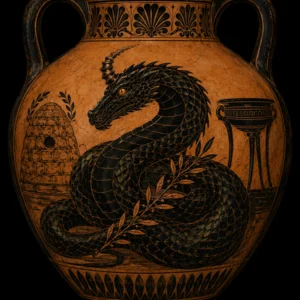

A massive serpent-dragon of Greek mythology, guardian of the sanctuary of Delphi. Slain by the god Apollo, who seized the site and established the famous oracle there. Its name was given to the Pythia, the prophetic priestess of Apollo.
Frequently asked questions
Key Facts
- Python guarded the sanctuary of Delphi, a sacred site considered the center of the Greek world
- According to some versions of the myth, it was born from the mud left behind by the Great Flood
- Apollo slew it with his silver arrows in order to claim the oracular site
- The Pythian Games were established in commemoration of Apollo's victory
- The name 'Pythia' given to the priestess of Delphi and the word 'python' (the snake) both derive directly from its name
Works & Achievements
A foundational text that narrates in detail Apollo's slaying of Python and the founding of the oracle at Delphi. It is the most complete archaic Greek source on this myth.
Lyric odes composed for the Pythian Games at Delphi, which regularly invoke the founding myth of Python. They attest to the importance of this narrative in Greek civic culture.
Ovid offers the most developed Latin version of the myth: Python is born from the mud left by the Great Flood and is slain by a youthful, triumphant Apollo. This text ensured the myth's transmission through the Renaissance.
A Greek mythographic compilation presenting the version in which Hera sends Python to pursue Leto. This text is an essential source for the various traditions surrounding the myth.
A collection of Latin myths that introduces oracular motivations for Python: the serpent knew of the prophecy foretelling its death and sought to escape it. These variants enrich the interpretation of the myth.
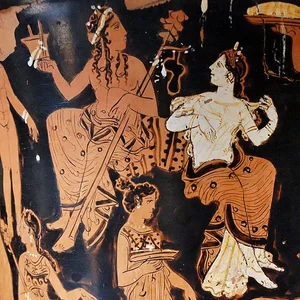
Numerous depictions on Attic ceramics showing Apollo armed with his bow facing the serpent. These works attest to the myth's popularity in classical Greek art.
Anecdotes
Python is said to have been born from the slime and mud left on earth after the Great Flood sent by Zeus. This chthonic origin, tied to the depths of the earth, explains why the Greeks regarded it as a primordial creature, older than the Olympian gods themselves.
According to some versions of the myth, Python had been tasked by Hera with pursuing Leto, the mother of Apollo and Artemis, to prevent her from giving birth. In this version, Python is not merely a monster, but an instrument of divine jealousy.
Apollo, still very young according to the myth, slew Python with golden arrows when he was only four days old. The ancients saw in this story the triumph of light, reason, and orderly prophecy over the dark and chaotic forces of the earth.
Python's remains were buried beneath the omphalos, the sacred stone symbolizing the center of the world at Delphi. To atone for killing a creature connected to Gaia, Apollo had to undergo purification, and funeral games were established in the serpent's honor: the Pythian Games, held every four years.
The Greek word 'python' originally referred to a large snake capable of crushing its prey. It was not until much later, in the modern era, that zoologists gave the same name to the family of large constrictor snakes, in direct homage to the mythological monster.
Primary Sources
There you slew with your mighty arrows the fierce dragon, great and fat, who ravaged the flocks of men on those sacred mountains. Having slain it, Phoebus Apollo boasted, saying: 'Now rot upon the earth that nourishes men.'
Apollo slew the fearsome dragon Python with his golden arrows and seized the prophetic cave of Delphi, thus founding the most celebrated sanctuary in the Greek world.
Python, that great new serpent, held the slopes of Mount Parnassus and spread terror among the peoples. Apollo struck it down with his arrows — a weapon unknown to him until then — and emptied nearly his entire quiver.
Hera sent Python to pursue the pregnant Leto across the whole world. When Apollo was born, he avenged his mother by killing Python at Delphi, on Mount Parnassus.
Python the serpent had received an oracle from Themis foretelling that he would perish at the hands of Leto's children. For this reason he persecuted the goddess. But Apollo slew him.
Key Places
The central site of the myth: Python was its guardian before Apollo slew it and founded what became the most famous oracle in the Greek world. The site is now a UNESCO World Heritage Site.
The mountain range towering above Delphi, on whose slopes Python was said to dwell according to myth. Parnassus was considered a sacred place of Apollo and the Muses.
A spring rising at the foot of Parnassus, used by pilgrims to purify themselves before consulting the oracle. It was associated both with the Muses and with the sacred precinct of Apollo.
The deep valley at the foot of Delphi where, according to some local traditions, Python roamed the territory it had been charged with guarding on behalf of the goddess Gaia.
The island where Leto, mother of Apollo, is said to have finally given birth after fleeing the persecution of Python, sent by Hera. It is the mythical birthplace of Apollo.
Typical Objects

A sacred conical stone symbolizing the navel of the world, placed at Delphi on the very spot where Python was slain and buried. It embodied the prophetic power of the site that Apollo had conquered.

The weapons with which Apollo killed Python. In artistic depictions, the golden arrows symbolize solar light triumphing over the chthonic darkness embodied by the serpent.

A three-legged bronze seat on which the priestess of Delphi sat to deliver her oracles. Its form is a reminder that the Pythia takes her name from the serpent Python, slain by Apollo.

A bronze vessel used in purification rituals at Delphi. After killing Python, Apollo was required to purify himself, establishing the rite of catharsis that would become fundamental to Greek religion.

Laurel branches carried by Apollo after his victory over Python. According to legend, the god crowned the Pythia with laurel, a plant thenceforth associated with divination and poetic glory.

In certain cultic representations, Python's skin symbolized a power that had been defeated yet absorbed into the sanctuary. The serpent's remains served as a reminder of the founding sacrifice upon which the oracle was built.
School Curriculum
Vocabulary & Tags
Key Vocabulary
Daily Life
Morning
Python begins his day roaming the slopes of Mount Parnassus, patrolling the vast territory he guards on behalf of the goddess Gaia. In the morning, he watches over the entrance to the oracular sanctuary, ensuring that no unpurified mortal approaches the sacred site.
Afternoon
At midday, Python settles near the telluric fissure of the sanctuary, from which prophetic vapors rise. His presence is that of a cosmic guardian: he embodies the ancient knowledge of Mother Earth, conveyed to humans through oracles. Any flocks that wander too close are devoured.
Evening
At dusk, Python retreats into his underground caves beneath Parnassus. He is a creature of the depths, bound to the underworld and to the primordial forces that predate the Olympian gods. His power is at its greatest in darkness, far from the light of Apollo.
Food
Python feeds on entire flocks, crushing them in his coils before swallowing them whole. Greek myths also describe his ability to devour humans who dared approach the sanctuary. As a purely chthonic being, he also draws energy from the emanations of the earth itself.
Clothing
Python wears no clothing, being a creature that is part serpent, part dragon. His body is covered in scales described as enormous, gleaming, and hard as metal. Some artistic depictions give him greenish or golden hues, symbolizing his nature as both an earthly and divine being.
Housing
Python dwells in the caves and underground fissures of Mount Parnassus, near Delphi. His lair is described as a dark place from which sulfurous vapors rise — the very same vapors that inspire the prophecies of the Pythia. It exists on the boundary between the world of the living and the realm of the dead.
Historical Timeline
Period Vocabulary
Visual Style
Style visuel s'inspirant de la céramique grecque archaïque à figures noires et rouges : formes serpentines stylisées sur fond ocre et terracotta, contrastes dramatiques entre ombre chtonienne et lumière solaire apollinienne.
Sound Ambience
Ambiance sonore du sanctuaire archaïque de Delphes dominé par Python : souffle profond du serpent-dragon dans les gorges rocheuses du Parnasse, eaux sacrées et vent dans les lauriers.
Liens externes & ressources
Références
Œuvres
Hymne homérique à Apollon Pythien
VIIe-VIe siècle av. J.-C.
Odes Pythiques de Pindare
~498-446 av. J.-C.
Métamorphoses d'Ovide (Livre I)
8 après J.-C.
Bibliothèque d'Apollodore
IIe siècle apr. J.-C.
Fables d'Hygin (Fabula 53 et 140)
Ier-IIe siècle apr. J.-C.
Apollon et Python (peintures de vases à figures noires)
VIe-Ve siècle av. J.-C.