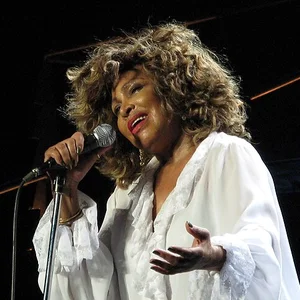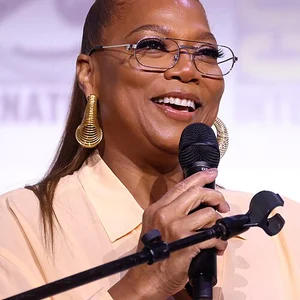

A pioneer of American female hip-hop, Queen Latifah made her mark from the late 1980s with politically engaged and feminist rap. She went on to build a dual career as a singer and actress, becoming one of the most influential women in the entertainment industry.
Queen Latifah(1970 — ?)
Queen Latifah
États-Unis
8 min read
Frequently asked questions
Famous Quotes
« Ladies First.»
Key Facts
- Born March 18, 1970 in Newark, New Jersey, under the name Dana Elaine Owens
- Launched her rap career in 1988 with the single “Wrath of My Madness”
- Her album “All Hail the Queen” (1989) laid the foundations for an assertive, feminist hip-hop
- Nominated for an Academy Award for her role in Chicago (2002), Grammy Award in 2004
- First rapper to receive a star on the Hollywood Walk of Fame (2006)
Works & Achievements
Queen Latifah's debut album, released on Tommy Boy Records, featuring the feminist anthem 'Ladies First'. It laid the groundwork for politically engaged female rap, a voice that was virtually absent from the American music industry before her.
An album dedicated to her brother Lance, who had died the previous year. It includes 'U.N.I.T.Y.', a direct indictment of sexual harassment that won the Grammy Award in 1995 — her most personal and politically powerful work.
A series in which Queen Latifah plays Khadijah James, the editor of an independent magazine. It preceded *Friends* by a year and brought images of autonomous, ambitious Black women to American television.
A heist film in which Queen Latifah plays Cleo, one of four protagonists. Her performance confirmed her ability to carry complex roles on the big screen, well beyond her identity as a rapper.
In this Oscar-winning musical, she plays Mama Morton with a commanding stage presence that drew widespread critical praise. Her Academy Award nomination for Best Supporting Actress cemented her successful transition to major cinema.
A personal account in which she recounts her childhood in Newark, the death of her brother, and her journey as an artist. An essential source for understanding the forging of a Black female identity in 1980s–1990s America.
Anecdotes
At age 8, Dana Owens chose the name “Latifah” for herself while browsing a dictionary of Arabic names, drawn to its meaning of “delicate and kind.” This early act of self-definition set the tone for an entire career: defining herself on her own terms, refusing labels imposed from outside.
In 1989, her track “Ladies First” — recorded with British rapper Monie Love — was one of hip-hop’s first feminist anthems. The music video blended images of civil rights activists and African female figures, asserting that women had always been at the heart of the struggle for freedom, long before rap acknowledged it.
On April 23, 1992, her brother Lance — to whom she had given a motorcycle — died in a road accident. Queen Latifah wore the key to that motorcycle around her neck for many years after his death. This tragedy inspired the album 'Black Reign' (1993), dedicated entirely to Lance, which would become her most personal work.
In 1993, her track “U.N.I.T.Y.” directly confronted men who harass women on the street, featuring the now-iconic line: 'Who you callin’ a bitch?' It won the 1995 Grammy Award for Best Rap Solo Performance — a first for a female artist explicitly addressing gender-based violence in the genre.
When she received an Oscar nomination in 2003 for her role as Mama Morton in 'Chicago', Queen Latifah became one of the rare hip-hop artists to earn such recognition from Hollywood. That journey — from the underprivileged neighborhoods of Newark to the Academy Awards — symbolized rap’s breakthrough into global popular culture.
Primary Sources
I knew from the start that no one but me was going to write my story. Growing up in Newark taught me that if you don't occupy the space yourself, someone else will do it for you — and not necessarily in your favor.
A lesson is to be learned from this, listen / Ladies first, ladies first / Believe me when I say being a woman is great.
Who you callin' a bitch? Unity, peace and having fun again / I don't think the brothers understand.
I dedicate this Grammy to all the women who endured harassment in silence. This award says that your voice matters — and that someone heard it.
Hip-hop is the voice of my community, my neighborhood, of everyone who never gets heard. I refuse to use it to put women down — that's exactly the opposite of what it was created for.
Key Places
Queen Latifah's hometown, Newark is an African-American city marked by deep social inequalities and the riots of 1967. It is in this context that Dana Owens forges the political consciousness that runs through all her lyrics.
The neighboring city of Newark where Queen Latifah grew up with her schoolteacher mother and her brother Lance. The streets of Irvington shaped her awareness of racial and social inequality, which would fuel her writing.
The birthplace of hip-hop, dating back to DJ Kool Herc's legendary party at 1520 Sedgwick Avenue in 1973. It is in this working-class borough that the cultural movement was born that would bring Queen Latifah worldwide fame.
The world capital of entertainment, where Queen Latifah established herself as an actress during the 1990s and 2000s, most notably through *Chicago* and numerous other film productions.
Queen Latifah received her star here on **November 4, 2006**, cementing her dual career as a rapper and actress — among the first artists from hip-hop to join this iconic symbol of American popular culture.