
Quetzalcoatl, the "Feathered Serpent," is one of the most important deities in Mesoamerica. Venerated by the Aztecs and the Toltecs, he is the god of wind, wisdom, and creation. His figure spans several pre-Hispanic civilizations across more than two millennia.
Quetzalcoatl
Quetzalcoatl
9 min read
Frequently asked questions
Key Facts
- Venerated from around 900 BCE by the Toltecs at Tula
- Associated with the planet Venus, the wind (Ehecatl), and wisdom
- According to myth, he promised to return — a belief that may have influenced the reception of Cortés in 1519
- His cult is attested at Teotihuacan, Chichén Itzá, Tula, and Tenochtitlan
- Depicted as a serpent covered in quetzal feathers
Works & Achievements
Quetzalcoatl descended into Mictlan, the kingdom of the dead, to gather the bones of previous generations and sprinkle them with his own blood. This creative sacrifice gave birth to the human beings of the present world.
Transformed into an ant, Quetzalcoatl slipped into the mountain Tonacatépetl to retrieve the corn kernels hidden by the gods. This fundamental gift allowed humans to feed themselves and build their civilization.
Quetzalcoatl is credited with revealing to humankind the sacred 260-day calendar, a fundamental tool of divination, medicine, and the organization of religious ceremonies throughout Mesoamerica.
As the priest-king Ce Acatl Topiltzin, Quetzalcoatl is said to have founded or restored the great city of Tula, establishing a reign of prosperity, justice, and artistic excellence that the Aztecs still claimed as their heritage six centuries later.
Quetzalcoatl is said to have given humanity the cacao tree, stolen from the gods, as well as the arts and crafts: goldsmithing, featherwork, painting, and knowledge of the stars. He is the mythological patron of all Mesoamerican artisans.
Anecdotes
According to Nahuatl myth, Quetzalcoatl created the human beings of the current world by descending into the Underworld (Mictlan) to steal the bones of the dead from previous eras. He wounded himself and sprinkled the bones with his own divine blood, thus giving birth to humanity. This willing sacrifice makes him one of the most altruistic creator gods in the Mesoamerican pantheon.
Toltec tradition tells of a priest-king named Ce Acatl Topiltzin Quetzalcoatl who ruled over the city of Tula, capital of a golden age. His rival Tezcatlipoca, god of the smoking mirror, trapped him by making him drink pulque (agave alcohol) and pushing him to commit shameful acts. Overcome with shame, the king went into exile toward the east and threw himself into the flames, transforming into the morning star — the planet Venus.
The Aztecs believed that Quetzalcoatl had brought humans cacao, maize, and the knowledge necessary for civilization: agriculture, crafts, the arts, and writing. He was also the inventor of the 260-day ritual calendar (the tonalpohualli), the foundation of all divination and the organization of sacred time in Mesoamerica.
An Aztec prophecy foretold the return of Quetzalcoatl from the east, during a year “One Reed” (Ce Acatl). In 1519, Hernán Cortés landed precisely during such a year. Some Spanish chroniclers reported that Moctezuma II may have hesitated to oppose the conquistadors, believing he recognized the returning god — though modern historians strongly qualify this interpretation.
At Chichén Itzá, in the Maya world, Quetzalcoatl is venerated under the name Kukulkán. The great pyramid known as “El Castillo” is designed so that, during the spring and autumn equinoxes, the shadow cast on its staircases forms the undulating body of a feathered serpent descending toward the earth — an astronomical and architectural feat that testifies to the central role of this god throughout the Mesoamerican world.
Primary Sources
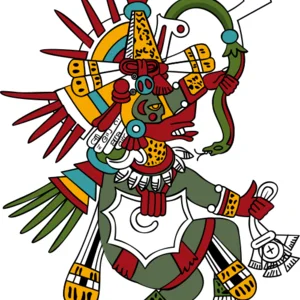
The manuscript depicts Quetzalcoatl in his form as the wind god Ehecatl, wearing a bird-beak mask and the spiral shell ornament that symbolizes breath and creation.
"Quetzalcoatl was regarded as a god; he was once worshipped at Tula. His temple had many very tall columns made in the form of serpents."
"In the year One Reed, Quetzalcoatl was born — he who is also called Topiltzin, priest of Our Lord Quetzalcoatl. It is said that he ruled and dwelt in Tula."
The text recounts how Quetzalcoatl and Tezcatlipoca worked together to create the sun and moon of the present world — the fifth sun — by sacrificing themselves so that light could exist.
"Goldsmiths, featherworkers, painters — all craftsmen regarded Quetzalcoatl as their patron and master, for it was he who invented all the arts."
Key Places
The mythical and historical capital of the Toltecs, where Quetzalcoatl is said to have reigned as priest-king under the name Ce Acatl Topiltzin. Its ruins preserve Atlantean columns and feathered serpent reliefs that bear witness to this cult.
A pyramid built around 200 CE, entirely covered in sculptures alternating feathered serpent heads with deity masks. It is one of the earliest monumental representations of Quetzalcoatl in Mesoamerica.
A Maya pyramid dedicated to Kukulkán, the Maya equivalent of Quetzalcoatl. Designed so that the shadow cast at the equinoxes traces a serpent descending its staircase, it stands as testament to the pan-Mesoamerican spread of the cult.
An archaeological site housing the Temple of the Feathered Serpents, covered in bas-reliefs depicting Quetzalcoatl and calendar glyphs. This 8th-century cultural crossroads was an important center for the spread of the cult.
The mythical site of Quetzalcoatl's exile and departure according to Toltec tradition: the god-king is said to have set sail eastward on a raft of intertwined serpents, promising one day to return from the sea's horizon.
Typical Objects

A spiral pendant carved from a conch shell, the distinctive attribute of Quetzalcoatl in his form as Ehecatl, god of wind. It symbolizes the vital breath and the circular movement of the wind that precedes the fertilizing rains.

When manifesting as Ehecatl, Quetzalcoatl wears a mask shaped like a bird's or duck's beak, through which the cosmic wind blows. This mask appears in numerous codex illustrations and sculptural representations.

The long, iridescent emerald-green feathers of the quetzal (the sacred bird of Central America) adorn the deity's headdress and body. Extremely precious, they symbolized royalty, fertility, and the link between sky and earth.

A ritual scepter in the shape of a feathered serpent, an attribute of Quetzalcoatl in ceremonies tied to the creation and renewal of the world. Priests who officiated in his name would brandish it during major rituals.

Quetzalcoatl is credited with bringing cacao to humanity by stealing the plant from the other gods. Cacao beans served both as a ritual drink reserved for the elite and as currency throughout the Mesoamerican world.

Although more closely associated with his rival Tezcatlipoca, the smoking black obsidian mirror appears in myths depicting the confrontation between the two gods. It symbolizes divination, illusion, and the darkness that stands in opposition to Quetzalcoatl's light.

Accordion-folded amate paper books on which the 260-day ritual calendar attributed to Quetzalcoatl was recorded. Used by priest-diviners to interpret destinies and organize sacred ceremonies.
School Curriculum
Vocabulary & Tags
Key Vocabulary
Tags
Daily Life
Morning
At dawn, the priests of Quetzalcoatl performed rites of penance in his name: self-flagellation, blood offerings drawn from their earlobes or tongue, and the burning of copal (resin incense). These practices imitated the god's original sacrifice and maintained the cosmic balance that allowed the sun to rise each day.
Afternoon
The round temples dedicated to Ehecatl-Quetzalcoatl, god of the wind, were designed without corners so as not to obstruct the flow of air. In the afternoon, priests observed the winds and clouds, for Quetzalcoatl was believed to send life-giving rains heralded by his breath. They consulted the tonalpohualli tablets to interpret the omens of the day.
Evening
At dusk, when Venus appeared as the evening star, priests paid it special veneration, for the planet was identified with Quetzalcoatl in his cyclical death and rebirth. Hymns and offerings of flowers, incense, and sometimes sacrificed quails accompanied this celestial appearance.
Food
The god himself, in his mythological incarnations, was associated with pure, plant-based nourishment: corn, cacao, beans, flowers, and fruits placed upon the altars. The priests of Quetzalcoatl observed strict fasts and abstained from animal flesh during ritual periods, in homage to the civilizing, non-warlike nature of their deity.
Clothing
Depictions of Quetzalcoatl show him adorned with emerald-green quetzal feathers, wearing a spiral shell pectoral, a black bird-beak mask, and an elaborate plumed headdress. His priests blackened their faces, wore black robes, and donned ornaments imitating these divine attributes during major ceremonies.
Housing
The temples of Quetzalcoatl, especially in his Ehecatl form, had the distinctive architectural feature of being circular or semi-circular — a rare form in the otherwise angular world of Mesoamerica — so that the wind could flow freely around them. At Tula, the mythical priest-king was said to dwell in palaces whose columns were sculpted in the shape of feathered serpents rising toward the sky.
Historical Timeline
Period Vocabulary
Liens externes & ressources
Références
Œuvres
Création de l'humanité du Cinquième Soleil
Temps mythique
Don du maïs à l'humanité
Temps mythique
Invention du calendrier rituel (tonalpohualli)
Attribué à l'époque toltèque, vers 900-1100
Fondation et âge d'or de Tula
Vers 900-1000 apr. J.-C.
Création du cacao et des arts
Temps mythique