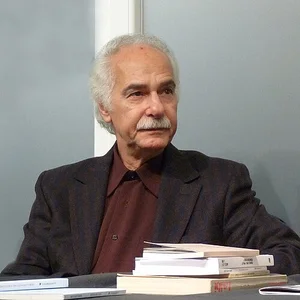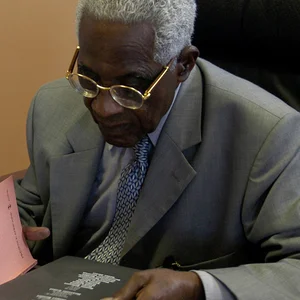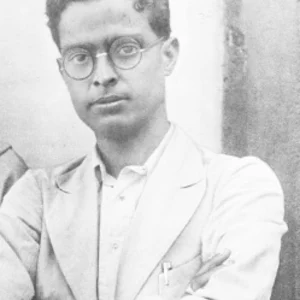

Indian novelist writing in English, one of the greatest writers of twentieth-century India. He created the imaginary town of Malgudi, the setting for most of his works, where he portrays the everyday life of South India with tenderness and irony.
R. K. Narayan(1906 — 2001)
R. K. Narayan
Inde, Raj britannique
6 min read
Frequently asked questions
Key Facts
- Born in 1906 in Madras (now Chennai), in southern India
- Published his first novel, Swami and Friends, in 1935, launching the Malgudi cycle
- Won the Sahitya Akademi Award in 1958 for The Guide
- Encouraged early in his career by the British writer Graham Greene, who helped him get published
- Died in 2001 in Chennai, after a major body of novels and short stories
Works & Achievements
Narayan's first novel: through the young schoolboy Swami, he invents the town of Malgudi, which would become the setting for all his work.
A coming-of-age novel following a young man through his studies, love, and spiritual quest in South India.
A largely autobiographical novel marked by the death of his wife; one of his most moving books.
A collection of short stories depicting the everyday life and ordinary people of Malgudi, later adapted for Indian television.
A bittersweet satire of the rise and fall of a Malgudi moneylender.
His most famous novel, awarded the Sahitya Akademi prize and adapted for film: the story of a tour guide who reluctantly becomes a holy man.
A condensed and accessible version of the great Indian epic, through which Narayan passes on India's mythological heritage.
A memoir in which he recounts his life, the birth of Malgudi, and his beginnings as a writer.
Anecdotes
When R. K. Narayan, a young unknown, sent the manuscript of his first novel to England, it happened to land in the hands of the famous writer Graham Greene. Enthusiastic, Greene recommended it to a publisher and advised the author to shorten his very long name, Rasipuram Krishnaswami Narayanaswami, to “R. K. Narayan,” easier for English readers to remember.
Narayan used to say that the town of Malgudi had “appeared” to him all at once. One day in September 1930, chosen as an auspicious day by his grandmother, he bought a notebook and, as he was wondering what to write, he saw a little railway station with its banyan tree and its stationmaster spring up in his imagination: Malgudi was born, and it would serve as the setting for almost all of his work.
The death of his young wife Rajam, taken by typhoid in 1939, deeply shattered him. He turned this grief into literature in *The English Teacher*, a largely autobiographical novel, and recounted in his memoirs his attempts to “communicate” with her, a sign of the sorrow that haunted him for a long time.
His younger brother, R. K. Laxman, became the most famous newspaper cartoonist in India, creator of the character of the “Common Man.” The two brothers collaborated: Laxman illustrated several of Narayan's short stories, blending the humor of the pencil with that of the pen.
His best-known novel, *The Guide* (1958), was an immense success: awarded the prestigious Sahitya Akademi Prize, it was adapted into a hit film in Hindi and even staged on Broadway. Narayan was considered several times for the Nobel Prize and was appointed in 1989 to the upper house of the Indian Parliament.
Primary Sources
While I was wondering what to write, Malgudi, with its small railway station, sprang into my mind.
It was Monday morning. Swaminathan was reluctant to open his eyes. He considered Monday specially unpleasant in the calendar.
Without him I could never have known what it is like to be Indian.
Raju welcomed the intrusion — something to relieve the loneliness of the place.
Key Places
City in southern India where Narayan was born in 1906 and where he died in 2001. He spent part of his childhood there at his grandmother's home.
City where Narayan lived most of his adult life and wrote the majority of his novels. Its streets and inhabitants were a major inspiration for the imaginary Malgudi.
Institution where Narayan continued his studies and earned his university degree. His father ran the attached secondary school there.
Thanks to a Rockefeller Foundation grant, Narayan traveled across the United States in 1956, a stay that fed into his travel journal *My Dateless Diary*.
Typical Objects

Narayan wrote his novels by hand, page after page, in the days before computers. The fountain pen was the everyday tool of his writing craft.

It was in a plain notebook bought on an auspicious day that he wrote the first line of his first novel. The notebook stands for the starting point of his entire body of work.

An iconic South Indian drink, brewed drop by drop in a metal filter and served in a rimmed tumbler. It set the rhythm of daily life and of the Mysore conversations Narayan loved to observe.

A long piece of cloth draped around the legs, the traditional garment of men in southern India. Narayan, a Tamil Brahmin, wore it every day.

The glasses were part of the familiar image of the elderly writer, a tireless reader. They evoke the man of letters alert to the smallest detail of everyday life.

A major English-language daily of southern India, in which Narayan published many short stories and columns. The press was for him a regular writing workshop.
School Curriculum
Vocabulary & Tags
Key Vocabulary
Daily Life
Morning
In the morning, Narayan devoted himself to writing, filling his pages by hand with discipline and regularity. It was his most precious working time, often accompanied by a South Indian filter coffee.
Afternoon
In the afternoon, he liked to wander through the streets of **Mysore**, sit by a pond, or chat with shopkeepers and passers-by. These walks were a wealth of observations for him: many of his characters were born from such encounters.
Evening
The evening was devoted to reading, to conversations with friends and family, and to reflecting on his stories. Curious about everything, he listened closely to the conversations and tales of ordinary people.
Food
A Tamil Brahmin, Narayan followed a vegetarian diet typical of South India: rice, *sambar*, *rasam*, *idli*, and *dosa*. Filter coffee, served piping hot, accompanied nearly every day.
Clothing
On a daily basis he wore traditional South Indian dress: the draped *dhoti* and a shirt or a shawl. His round glasses completed the writer's familiar silhouette.
Housing
In the 1950s, Narayan had a house built in the **Yadavagiri** district of **Mysore**, famous for its bay window from which he could watch the street. This light-filled home reflected his love of light and his observation of everyday life.
Historical Timeline
Period Vocabulary
Liens externes & ressources
Références
Œuvres
Swami and Friends
1935
The Bachelor of Arts
1937
The English Teacher
1945
Malgudi Days
1943
The Financial Expert
1952
The Ramayana (réécriture)
1972