 flip
flipConical Emmer Wheat Loaves for the Altar
Conical Emmer Wheat Loaves for the Altar
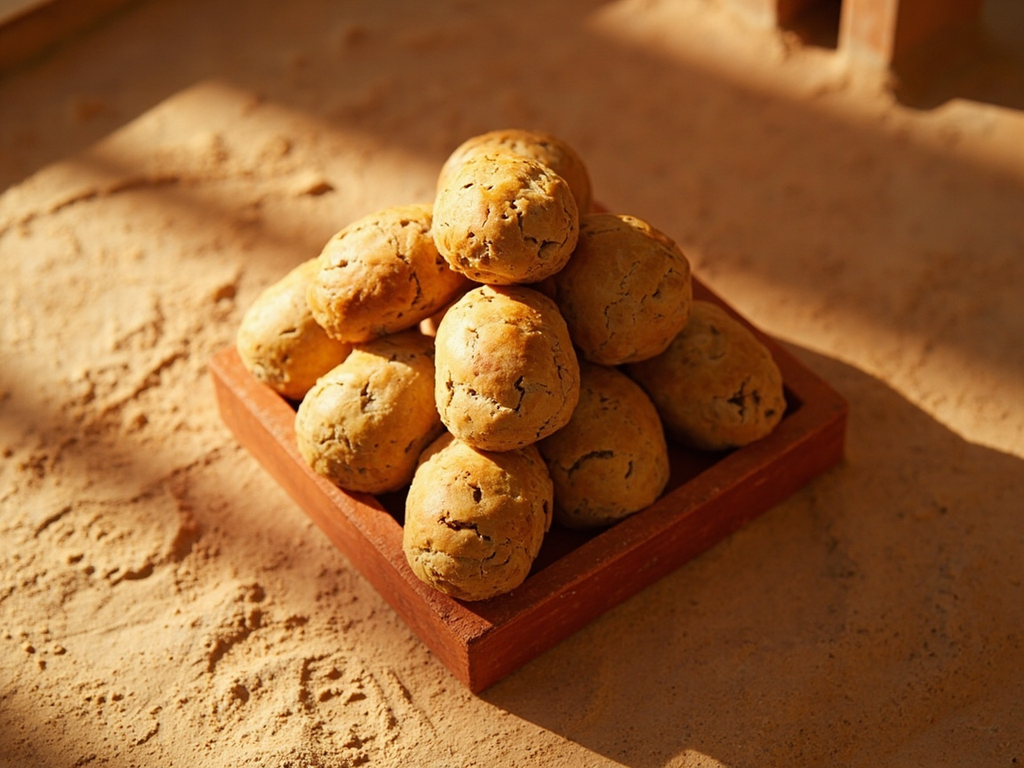
Why this dish? The conical loaf is the solar offering par excellence: stacked in a pyramid before the statue of Ra at Heliopolis and Karnak, its pointed shape evokes the sun's ray and the benben stone upon which, according to the Heliopolitan myth, the creator god stood on the first morning of the world.
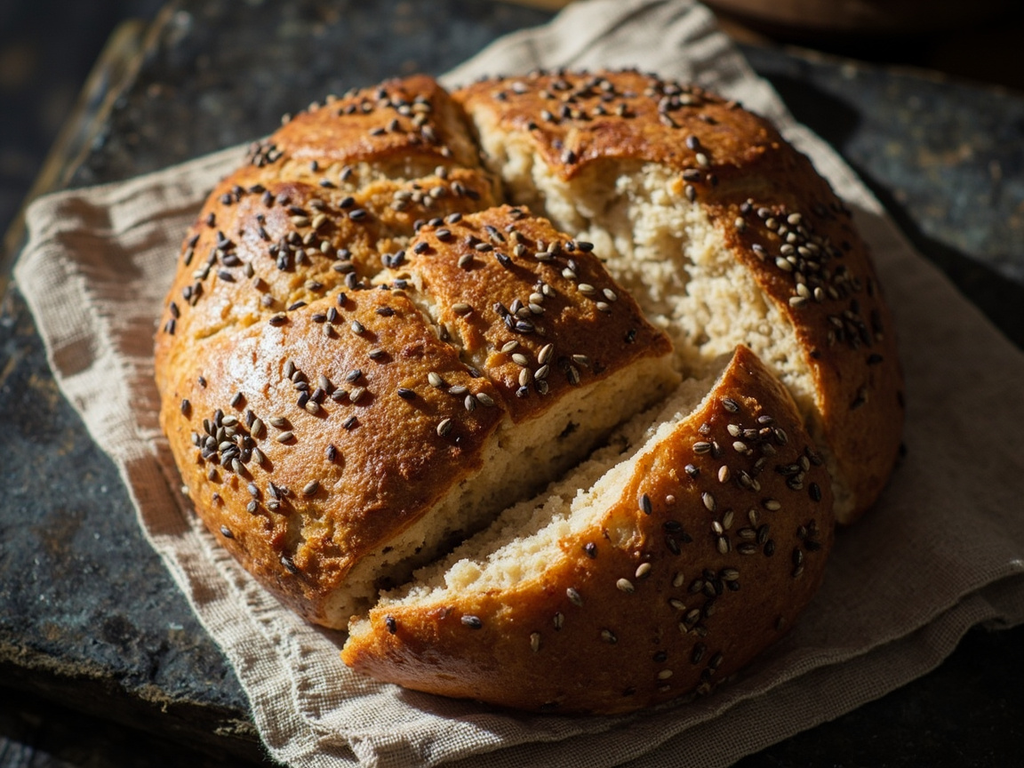
Small dense cone-shaped loaves with a tight crumb and golden crust, shaped in terracotta molds heated over fire. This is the simplest and most sacred bread, deposited by the dozens on the temple offering tables.
I am Ra, who rises in the east and shapes the day with my own light. See these loaves pointed toward me: they imitate the first stone upon which I stood when nothing else existed. My priests knead the emmer before dawn, fill the clay molds and bury them in the embers, so that the crust is golden like my disk at noon. Eat this bread after I have taken its breath, and you will nourish yourself with what I give to the entire Valley.
- •Emmer flour ground on a millstone — one basket (base grain)
- •Nile water — to consistency (binding)
- •Sourdough starter from the day before (soured dough) — a handful (fermentation)
- •Desert salt — a pinch (seasoning)
Conical Emmer Wheat Loaves for the Altar
Small dense cone-shaped loaves with a tight crumb and golden crust, shaped in terracotta molds heated over fire. This is the simplest and most sacred bread, deposited by the dozens on the temple offering tables.
Why this dish? The conical loaf is the solar offering par excellence: stacked in a pyramid before the statue of Ra at Heliopolis and Karnak, its pointed shape evokes the sun's ray and the benben stone upon which, according to the Heliopolitan myth, the creator god stood on the first morning of the world.
I am Ra, who rises in the east and shapes the day with my own light. See these loaves pointed toward me: they imitate the first stone upon which I stood when nothing else existed. My priests knead the emmer before dawn, fill the clay molds and bury them in the embers, so that the crust is golden like my disk at noon. Eat this bread after I have taken its breath, and you will nourish yourself with what I give to the entire Valley.
Ingredients (period version)
- Emmer flour ground on a millstone — one basket (base grain)
- Nile water — to consistency (binding)
- Sourdough starter from the day before (soured dough) — a handful (fermentation)
- Desert salt — a pinch (seasoning)
Ingredients
- Small spelt flour (or whole spelt) — 500 g (replaces emmer)
- Warm water — 300 ml (hydration)
- Active natural sourdough starter (or 5 g baker's yeast) — 100 g (fermentation)
- Fine salt — 8 g (seasoning)
Method
- Mix the flour, salt, starter, and water until you get a firm, slightly sticky dough.
- Knead for 10 minutes, cover, and let rise for 3 to 4 hours (or until doubled).
- Divide into balls, then shape each into a thick cone (wide base, pointed top).
- Place on a baking sheet and let rest for 30 minutes.
- Bake in a hot oven (230 °C) for 25 to 30 minutes, until the crust is well golden.
- Let cool slightly and stack in a pyramid to serve.
How it was made : Egyptian bakers baked bread in conical terracotta molds (bedja) preheated in the ashes, a technique attested by funerary models and remains of ovens at Heliopolis and Deir el-Medina. Emmer, more rustic than our soft wheat, produced a compact crumb. Desert sand sometimes ended up in the flour: mummies show very worn teeth.
The contemporary twist : Serve them upright on a slate board, tips pointing skyward, with a toasted sesame butter — a 'pyramid of Ra' to share.
Sources : Delwen Samuel, "Bread Making and Social Interactions at the Amarna Workmen's Village", World Archaeology, 1999 · Pierre Tallet, La cuisine des pharaons, Actes Sud, 2003
Ra · Charactorium