 flip
flipKlepon
Klepon
Why this dish? Klepon are an omnipresent sweet on Javanese markets and in homes. In the aristocratic life of Jepara, these little green bites were served with afternoon tea. Kartini, who describes in her letters the small pleasures of daily Javanese life and who organized tea parties for her students at the school she founded in Jepara, would certainly have offered these jajan to her young protégées.
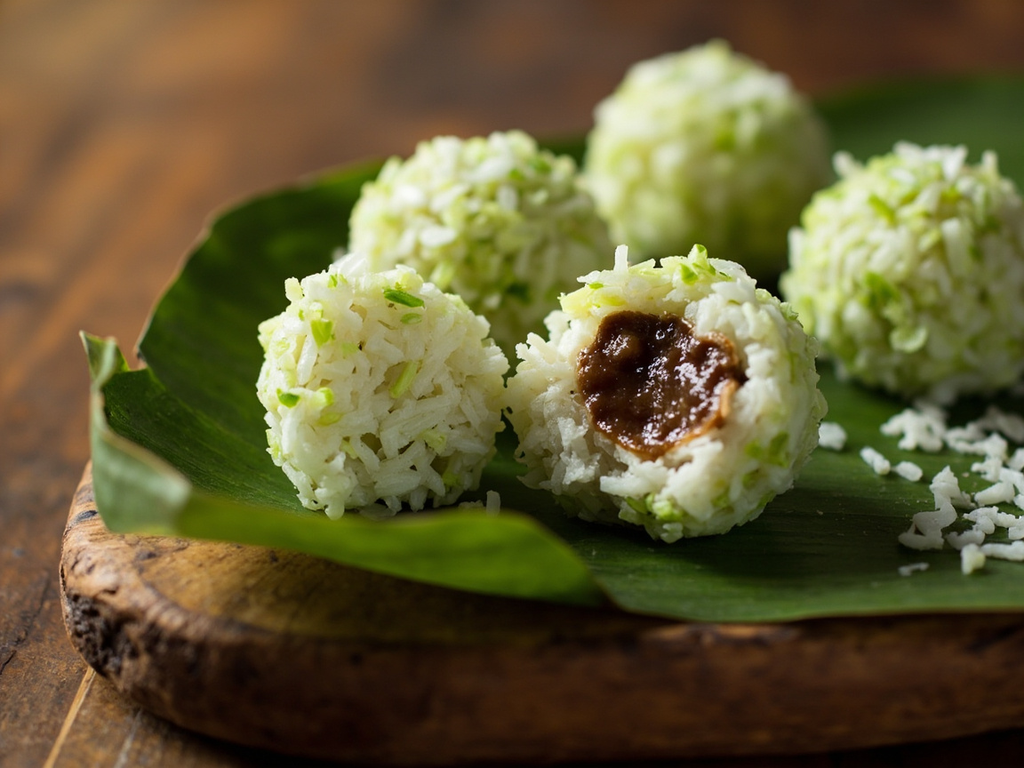
Small glutinous rice flour balls, colored with pandan juice, filled with a heart of grated palm sugar that melts during cooking. Rolled in fresh grated coconut, they burst in the mouth releasing a hot, fragrant syrup. A surprise bite that delights both children and adults.
If you asked me which sweet best sums up the spirit of Java, I would answer without hesitation: the klepon. This little green ball hides a secret in its heart — a brown sugar that bursts when you bite into it, a sweet surprise that makes children laugh. When I opened my school for the girls of Jepara, I offered them these klepon after lessons. See how such a modest thing can gladden a heart and gather souls around a common mat.
- •Glutinous rice flour (tepung ketan) — one portion (dough)
- •Pandan leaves — a few leaves, pounded and strained (color and fragrance)
- •Palm sugar (gula Jawa) — one block, finely grated (filling)
- •Fresh grated coconut — half a coconut (coating)
- •Salt — a pinch (enhances coconut)
- •Water — as needed (binder)
Klepon
Small glutinous rice flour balls, colored with pandan juice, filled with a heart of grated palm sugar that melts during cooking. Rolled in fresh grated coconut, they burst in the mouth releasing a hot, fragrant syrup. A surprise bite that delights both children and adults.
Why this dish? Klepon are an omnipresent sweet on Javanese markets and in homes. In the aristocratic life of Jepara, these little green bites were served with afternoon tea. Kartini, who describes in her letters the small pleasures of daily Javanese life and who organized tea parties for her students at the school she founded in Jepara, would certainly have offered these jajan to her young protégées.
If you asked me which sweet best sums up the spirit of Java, I would answer without hesitation: the klepon. This little green ball hides a secret in its heart — a brown sugar that bursts when you bite into it, a sweet surprise that makes children laugh. When I opened my school for the girls of Jepara, I offered them these klepon after lessons. See how such a modest thing can gladden a heart and gather souls around a common mat.
Ingredients (period version)
- Glutinous rice flour (tepung ketan) — one portion (dough)
- Pandan leaves — a few leaves, pounded and strained (color and fragrance)
- Palm sugar (gula Jawa) — one block, finely grated (filling)
- Fresh grated coconut — half a coconut (coating)
- Salt — a pinch (enhances coconut)
- Water — as needed (binder)
Ingredients
- Glutinous rice flour — 200 g (dough)
- Pandan extract (or 5 fresh leaves blended and strained) — 1 tsp (or the strained juice) (color and fragrance)
- Palm sugar (gula Jawa) or muscovado sugar — 100 g, finely grated or chopped (filling)
- Grated coconut (fresh or frozen) — 150 g (coating)
- Fine salt — 1/2 tsp (enhances coconut)
- Warm water — about 150 ml (binder)
Method
- If using fresh pandan leaves, blend them with a little water then strain to obtain an intense green juice.
- Mix the grated coconut with a pinch of salt. If frozen, steam for 2 minutes to refresh.
- In a bowl, place the glutinous rice flour. Gradually add the warm water mixed with the pandan juice (or extract). Knead until you get a soft, non-sticky dough, like playdough.
- Take a small ball of dough (walnut-sized). Flatten it in your palm, place about 1 tsp of grated palm sugar in the center, then close by rolling between your palms to form a smooth, crack-free ball.
- Bring a large pot of water to a boil. Drop the klepon in small batches. They are ready when they float to the surface (about 3 minutes). Remove with a slotted spoon.
- Immediately roll each klepon in the salted grated coconut, pressing lightly so the coconut sticks.
- Arrange on a tray lined with banana leaves (or parchment paper). Serve warm to enjoy the molten center.
How it was made : Klepon belong to the large family of jajan pasar (literally "market snacks"), sweets that women prepared at home or bought at the village pasar (market). The green color came exclusively from the juice of pandan leaves pounded in a cobek. Palm sugar, harvested and molded locally into conical blocks (gula Jawa), was grated by hand. Klepon were traditionally presented on banana leaves.
The contemporary twist : You can vary the colors using beet juice (pink) or papaya juice (orange) for a multicolored platter, while keeping the classic palm sugar filling.
Sources : Sri Owen, The Food of Indonesia, 1999 · Suryatini N. Ganie, Kumpulan Resep Jajan Pasar, 2000
Raden Ajeng Kartini · Charactorium