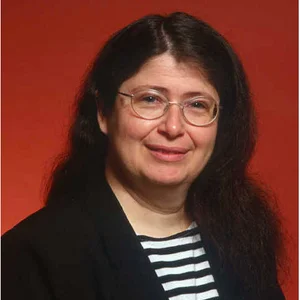

Radia Perlman is an American engineer and computer scientist born in 1951, nicknamed the "Mother of the Internet." In 1985, she invented the Spanning Tree Protocol (STP), which makes computer networks stable and reliable. Her work on network security and routing protocols remains foundational to the architecture of the Internet.
Radia Perlman(1951 — ?)
Radia Perlman
États-Unis
7 min read
Frequently asked questions
Key Facts
- Born in 1951 in Portsmouth, Virginia; earned her PhD from MIT in 1988
- Invented the Spanning Tree Protocol (STP) in 1985, which prevents loops in Ethernet networks and stabilizes communications
- Holds more than 100 patents in the fields of networking and computer security
- Author of the reference textbooks Interconnections (1992) and Network Security (2002), used in universities worldwide
- Recipient of numerous honors, including induction into the Internet Society's Hall of Fame (2014)
Works & Achievements
Radia Perlman's landmark invention, this algorithm allows computer networks to operate without creating infinite loops while maintaining redundant paths for reliability. It is still used today in millions of switches worldwide.
An essential reference manual on network protocols, widely adopted as a course textbook at universities around the world. It remains a foundational resource for understanding how modern networks function.
Co-authored with Charlie Kaufman and Mike Speciner, this authoritative book on network security covers cryptography, secure protocols, and digital identity management.
Designed to replace STP in large data centers, TRILL enables more efficient multipath routing and eliminates some of the limitations of Spanning Tree. It is Perlman's most significant contribution of the 21st century.
A routing protocol for OSI networks developed by Radia Perlman at DEC, demonstrating the breadth of her contributions to network communications standards well beyond STP alone.
Anecdotes
Radia Perlman invented the Spanning Tree Protocol (STP) in 1985 in just a few weeks, solving a problem that had been crippling computer networks for years. This protocol prevents infinite data loops in networks, allowing the Internet to function reliably at scale.
Although she is sometimes nicknamed the 'mother of the Internet', Radia Perlman rejects the title with good humor, arguing that the Internet is the result of the collective work of thousands of engineers. She prefers recognition for her specific technical contributions rather than a grandiose and inaccurate title.
During her studies at MIT in the 1970s, Radia Perlman taught very young children to program in LOGO, a graphical programming language. She designed a subset of LOGO usable by kindergartners, demonstrating her talent for making computing accessible from an early age.
Radia Perlman wrote a poem called 'Algorhyme' to explain how the Spanning Tree Protocol works in a playful way. The poem, which begins with 'I think that I shall never see a graph more lovely than a tree', has become famous in the network engineering community.
Holder of more than 100 patents, Radia Perlman has also contributed to fields as varied as network security and the TRILL protocol, designed to replace STP and further improve the robustness of modern networks. She continues to work actively in computer science research.
Primary Sources
The spanning tree algorithm allows a network with redundant paths to function by logically removing redundant links while maintaining a fully connected topology. This prevents broadcast storms and ensures network stability.
Security in networks requires careful consideration of trust relationships, key distribution, and protocol design. No single mechanism can address all threats; layered security remains essential.
RBridges combine the advantages of bridges and routers. They provide optimal pair-wise forwarding paths, support multipathing of both unicast and multi-destination traffic, and are compatible with IEEE 802.1 customer bridges.
I think that I shall never see / A graph more lovely than a tree. / A tree whose crucial property / Is loop-free connectivity.
Key Places
Radia Perlman studied and conducted her early research here, including teaching programming to children. MIT remains one of the world's leading centers of computer science innovation.
It was at DEC that Radia Perlman invented the Spanning Tree Protocol in 1985, responding to an internal request to solve the problem of loops in bridged networks.
Radia Perlman joined Sun Microsystems and later Oracle, where she continued her research on network security and developed the TRILL protocol, the successor to STP.
Radia Perlman's hometown, where she grew up in a family of engineers — both her father and mother worked in technical roles for the U.S. government.
Typical Objects

In the 1970s–1980s, Radia Perlman worked on text terminals connected to mainframes, typing lines of code and algorithms to design the foundational protocols of computer networks.

An essential tool for network engineers, the whiteboard allowed Radia Perlman to sketch network topologies, tree graphs, and algorithmic diagrams that sat at the heart of her inventions.

The network switch is the physical device that implements the STP protocol invented by Radia Perlman. Without her algorithm, these devices — which interconnect millions of machines — would create catastrophic routing loops.

The Ethernet cable is the physical medium of local area networks where the Spanning Tree Protocol operates. Radia Perlman designed her algorithm specifically to allow cable redundancy without causing network failures.

RFCs are the official technical documents that define Internet standards. Radia Perlman is the author or co-author of several RFCs, including RFC 6325, which defines the TRILL protocol.

The rise of PCs in the 1980s made Perlman's STP protocol indispensable, as thousands of machines needed to be interconnected in reliable, redundant local area networks.
School Curriculum
Vocabulary & Tags
Key Vocabulary
Tags
Daily Life
Morning
Radia Perlman starts her day early, often reviewing technical notes or algorithm drafts written the night before. She arrives at the DEC or MIT lab in the morning, grabs a coffee, and checks her emails and ongoing discussions about network protocols under standardization.
Afternoon
Afternoons are devoted to programming and technical meetings with fellow engineers. Radia Perlman spends long hours at her terminal coding and testing algorithms, regularly sketching network topologies on whiteboards to explain her ideas or work through problems with her team.
Evening
In the evenings, Radia Perlman writes technical documentation, papers, or chapters for her reference books. She sometimes attends academic conferences or prepares lectures, maintaining an intense intellectual life outside of office hours.
Food
Like many engineers of her generation working in American research labs, Radia Perlman favors practical, no-fuss eating — sandwiches, corporate or university cafeteria meals — keeping things simple so as not to interrupt her creative work.
Clothing
Radia Perlman dresses in the casual style typical of computer engineers: jeans, sweaters or relaxed shirts, comfortable shoes. In the 1980s, she stood out from the suited executives of the industry, embracing the informal technical culture inherited from MIT's academic world.
Housing
Radia Perlman lives in the suburbs of Boston and later in California, in functional middle-class homes. Her domestic environment reflects her intellectual interests: shelves filled with technical manuals, a personal computer for working from home, and a simple setting conducive to deep thinking.
Historical Timeline
Period Vocabulary
Visual Style
Le style visuel évoque les laboratoires informatiques des années 1980 : écrans phosphorescents verts, tableaux couverts de graphes réseau, et l'esthétique fonctionnelle et technique du MIT et de DEC.
Sound Ambience
L'environnement sonore de Radia Perlman est celui des laboratoires informatiques des années 1980 : bourdonnement des ordinateurs, cliquetis des claviers mécaniques et discussions techniques entre ingénieurs.
Liens externes & ressources
Références
Œuvres
Protocole Spanning Tree (STP) — IEEE 802.1D
1985
Interconnections: Bridges, Routers, Switches, and Internetworking Protocols
1992
Network Security: Private Communication in a Public World
1999
Protocole TRILL (Transparent Interconnection of Lots of Links) — RFC 6325
2011
NESAP (Network Entity State Advertisement Protocol)
1988