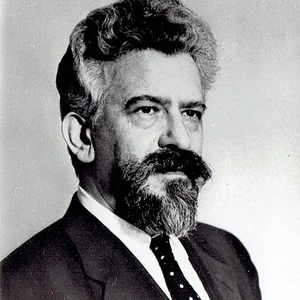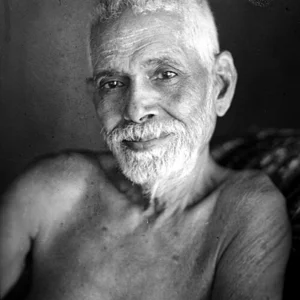

Indian sage and spiritual master, a major figure of the Advaita Vedānta (non-duality) tradition. Settled in Tiruvannamalai at the foot of the sacred mountain Arunachala, he taught the path of self-inquiry through the question “Who am I?”.
Ramana Maharshi(1879 — 1950)
Ramana Maharshi
Inde, Raj britannique, Union indienne
6 min read
Frequently asked questions
Famous Quotes
« Who am I?»
« Happiness is your very nature. It is not wrong to desire it. What is wrong is seeking it outside when it lies within.»
Key Facts
- Born in 1879 in Tiruchuzhi, in southern India (Tamil Nadu)
- In 1896, at the age of 16, undergoes an experience of “awakening” by confronting the fear of death
- Settles at the foot of the sacred mountain Arunachala in Tiruvannamalai, where he remains until his death
- Develops the teaching of self-inquiry (atma-vichara) centered on the question “Who am I?”
- Dies in 1950; his ashram (Sri Ramanasramam) becomes a radiant spiritual center in India and the West
Works & Achievements
Foundational text in question-and-answer form that sets out the method of Self-inquiry (“Who am I?”).
Long devotional poem in Tamil addressed to the mountain Arunachala, still sung at the ashram today.
Thirty concise verses summing up the paths of action, devotion, and knowledge that lead to realization of the Self.
Major philosophical work setting out the nature of reality and of the Self from the perspective of Advaita Vedānta.
A set of devotional poems expressing his love for the sacred mountain, blending non-duality and bhakti.
A collection of conversations recorded by devotees, which became a major reference for transmitting his oral teaching.
Anecdotes
At the age of 16, the young Venkataraman was gripped by a sudden and intense fear of death. Instead of fleeing, he lay down, simulated his own death, and observed what within him remained alive. This awakening experience overturned his life and led him to leave his family.
In 1896, he secretly boarded a train to Tiruvannamalai, drawn by the sacred mountain Arunachala. Upon arriving, he threw away the rest of his money and had his head shaved, permanently abandoning his life as a schoolboy for that of an ascetic.
During his early years in Tiruvannamalai, he remained immersed in a silence and stillness so deep that insects and vermin attacked his legs without him paying any attention. Devotees had to feed him and move him.
His mother, who came to beg him to return home, eventually settled near him and herself became a disciple. At her death in 1922, Ramana claimed to have guided her toward liberation by placing his hand on her chest and her head.
Ramana refused privileges: he insisted that all food offered to the ashram be shared equally among everyone, including the animals. He was often seen personally caring for the cow Lakshmi, who was deeply attached to him.
Primary Sources
Of all thoughts, the thought “I” is the root. If one inquires where this thought “I” arises from, it will vanish. This is the inquiry into the Self.
To seek where the “I” arises—this is the path of knowledge. Where the “I” dissolves, the one Self appears as “I-I.”
Your duty is to be, and not to be this or that. “I am that I am” sums up the whole truth. The method is summed up in these words: “Be still.”
O Arunachala! You have uprooted the “I” and established me in silence. Like a mother, take care of me.
Key Places
Village in Tamil Nadu where Venkataraman was born in 1879, near a temple dedicated to Shiva.
City where the young Venkataraman lived with his uncle and where, around the age of 16, he had his decisive awakening experience in the face of death.
Sacred hill dedicated to Shiva, regarded by Ramana as his master and the center of his existence; he would climb its paths.
Cave on the slope of Arunachala where Ramana spent much of his early years of asceticism, in silence.
Ashram founded at the foot of the mountain, around his mother's tomb; he lived, taught, and died there in 1950.
Typical Objects

Simple strip of cloth tied at the waist, the only garment Ramana wore, a symbol of his total renunciation of material possessions.

Traditional vessel of Indian renunciants, used to carry water. It evokes the wandering, frugal life of the sannyasin.

Walking stick that Ramana used to climb the trails of Mount Arunachala during his walks.

Instruments with which Ramana inscribed his rare writings and devotional poems in the Tamil manuscript tradition.

Couch on which Ramana sat in the hall to receive visitors in silence for hours, the heart of life at the ashram.

Metal bowl used for meals; Ramana insisted on a strictly equal sharing of all food among the humans and animals of the ashram.
School Curriculum
Vocabulary & Tags
Key Vocabulary
Daily Life
Morning
Ramana rose early and took part in the ashram's chores, especially in the kitchen where he helped prepare the meals. The morning often included the reading of sacred texts and the singing of hymns.
Afternoon
Seated on his sofa in the hall, he silently received a continuous stream of visitors who came from all over India and beyond. His mere silent presence was regarded as his principal teaching.
Evening
In the evening, he sometimes walked around the mountain or strolled along its slopes. Devotional hymns were sung, and he answered the questions of spiritual seekers.
Food
His diet was strictly vegetarian, simple and frugal, based on rice, vegetables, and South Indian porridges. He insisted that his portion be identical to that of the humblest.
Clothing
He wore only a simple loincloth (*kaupina*) of white cotton, a symbol of his total renunciation. On more formal occasions, a cloth was sometimes draped over his shoulders.
Housing
After years spent in the caves of Mount Arunachala, he lived in the modest buildings of the ashram, sleeping and receiving visitors in an open, bare hall.
Historical Timeline
Period Vocabulary
Liens externes & ressources
Références
Œuvres
Nan Yar ? (Qui suis-je ?)
vers 1902
Aksharamanamalai (La Guirlande nuptiale des lettres)
vers 1914
Upadesa Saram (L'Essence de l'enseignement)
1927
Ulladu Narpadu (Quarante versets sur la Réalité)
1928
Cinq hymnes à Arunachala
vers 1914-1917
Talks with Sri Ramana Maharshi (Entretiens)
1935-1939