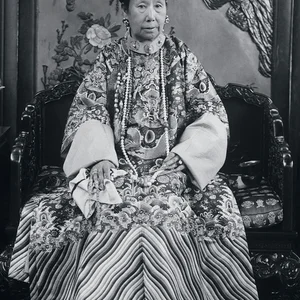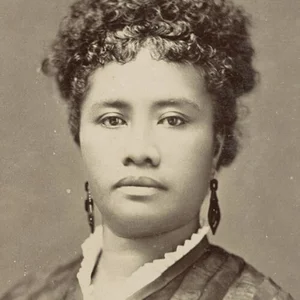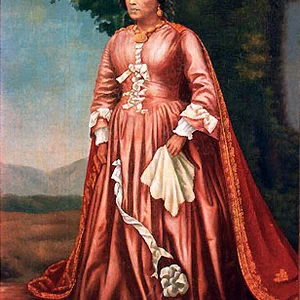

Queen of Madagascar from 1828 to 1861, Ranavalona I belonged to the Merina people of the Malagasy Highlands. She firmly resisted European encroachment — both British and French — by expelling missionaries and banning Christianity. Her sovereigntist policies preserved the kingdom's independence for more than thirty years.
Ranavalona I(1788 — 1861)
Ranavalona I
Royaume merina
8 min read
Frequently asked questions
Famous Quotes
« "I shall govern here according to the laws and customs of my ancestors." (saying attributed by Malagasy tradition at her accession to the throne, not verified in writing)»
Key Facts
- 1828: ascends the throne following the death of her husband Radama I, becoming the third sovereign of the Kingdom of Madagascar
- 1835: bans Christianity and expels European missionaries to protect ancestral Malagasy traditions
- 1845: militarily repels a Franco-British naval expedition attempting to force the country open
- Throughout her reign (1828–1861): maintains Madagascar's independence against French and British colonial pressure
- 1861: dies after 33 years of rule; Madagascar would not be colonized by France until 1896, long after her death
Works & Achievements
A royal decree proclaiming the prohibition of Christian practice and the expulsion of European missionaries. This major political act defined Ranavalona's sovereigntist policy for the following twenty-six years.
Upon her accession to the throne, Ranavalona renegotiated or annulled the treaties signed by her predecessor that granted privileges to the British. This founding act reflects her vision of a fully sovereign Madagascar.
In collaboration with Jean Laborde, Ranavalona had a large local industrial complex built, producing weapons, textiles, and porcelain. This project aimed to make Madagascar self-sufficient and independent from European imports.
The queen had the royal palace rebuilt in wood using exclusively Malagasy craftsmen and techniques, rejecting imported materials. The building became the architectural symbol of Malagasy cultural resistance.
Ranavalona upheld and institutionalized ancestral judicial practices, including the tangena ordeal, in direct opposition to the European legal norms that missionaries sought to introduce.
Following the bombardment of 1845, the queen reinforced the fortifications of Malagasy ports and developed a local artillery force. This defensive strategy allowed Madagascar to remain independent until 1896.
Anecdotes
When her husband, King Radama I, died in 1828, Ranavalona I seized power through a palace coup she had skillfully orchestrated with her Merina allies. She had her reign proclaimed immediately from the Manjakamiadana palace in Antananarivo, outmaneuvering the plots of several rival claimants to the throne.
In 1845, a Franco-British fleet bombarded Tamatave (present-day Toamasina) to pressure the queen into reopening Madagascar to European trade. Ranavalona flatly refused to yield and responded by reinforcing coastal defenses, sending a clear message: Madagascar would remain master of its own destiny.
The queen imposed the 'tangena,' a traditional Malagasy ordeal, as a method of judgment for those accused of treason or witchcraft. The tanghin nut, highly toxic, was administered to the accused; survival or death determined innocence. This practice, which claimed many lives, represented in Ranavalona's eyes a rejection of European modes of justice.
In 1861, shortly before her death, Ranavalona I received a delegation of nobles at her palace who asked her to lift the ban on Christianity. She refused until her last breath. It was her son Radama II who, upon succeeding her, immediately authorized the return of missionaries — illustrating the depth of the political divide running through the royal court.
In 1839, Ranavalona I had a European-style wooden palace built, the Manjakamiadana, atop the hill of Antananarivo — but using exclusively Malagasy craftsmen and locally adapted techniques. This choice perfectly embodied her policy: adopt what was useful from the outside world, while never surrendering cultural sovereignty.
Primary Sources
The mpikabary of the court of Antananarivo preserved the royal speeches (kabary) of Ranavalona, including her proclamations against foreigners: 'This island belongs to me, inherited from my ancestors; I will not share it with strangers.'
The French admiral reports that the queen refused all negotiation following the 1845 bombardment and ordered the dismantling of European trading posts, commanding the immediate expulsion of remaining foreign residents.
Ellis describes Ranavalona's firmness toward Anglican missionaries: 'The queen declared that the religion of her ancestors was sufficient for her people and that no foreign faith would be tolerated on her lands.'
The hainteny composed during her reign evoke the queen as 'Iaboriborivola', she who protects the land as a mother protects her children, standing firm against the winds coming from the sea.
A dispatch from 1836 states that the queen issued an edict formally forbidding any Malagasy person from converting to Christianity on pain of death, rendering all European missionary activity impossible.
Key Places
The queen's official residence atop the royal hill of Antananarivo, this palace was rebuilt in wood by Malagasy craftsmen in 1839. It was from this palace that Ranavalona governed Madagascar for more than thirty years.
Madagascar's main port on the east coast, Tamatave was the site of the Franco-British bombardment of 1845. The defense of this port symbolizes Ranavalona's refusal to tolerate any foreign interference by sea.
An industrial town founded during Ranavalona's reign by French engineer Jean Laborde, where forges, a gunpowder factory, and manufacturing workshops were built. This site illustrates Ranavalona's policy: acquiring European technology without surrendering sovereignty.
The central region of Madagascar, homeland of the Merina people and heartland of Ranavalona's kingdom. It was here that the queen found her strongest popular support and where oral traditions celebrating her reign continued to be passed down.
A sacred hill and former spiritual capital of the Merina kingdom, listed as a UNESCO World Heritage Site. Ranavalona strengthened the cult of the royal ancestors there to legitimize her authority in the face of foreign influences.