
Rangda is the demon queen of Balinese mythology, embodiment of evil and the dark forces. She leads an army of witches called Leyaks and is locked in eternal opposition with Barong, the protective spirit of good. This cosmic battle lies at the heart of Balinese spirituality and ritual theater.
Rangda
Rangda
8 min read
Frequently asked questions
Key Facts
- Rangda is the central figure of the Barong ritual drama, still performed today in Bali
- Her name means 'widow' in Old Javanese, linking the female figure to mourning and danger
- She is connected to the goddess Durga and the witch Calon Arang in the Balinese Hindu tradition
- The Rangda–Barong battle represents the cosmic balance between destructive and protective forces
- The Leyaks, her servants, are witches capable of transforming into fantastical animals
Works & Achievements
A sacred text telling the story of the widow-witch of Girah and her battle against the holy sage Mpu Bharadah. The literary and theological foundation of the Rangda myth, it is still recited during Balinese exorcism ceremonies.
A sacred drama combining dance, gamelan music, and ritual trance, depicting the cosmic battle between Rangda and Barong. There is no victor: the performance illustrates the necessary balance between opposing forces.
A collection of carved masks kept in Balinese temples, some of which are believed to possess an autonomous spiritual power (sakti). Each ancient mask is a unique devotional work of art, crafted according to strict iconographic conventions.
A corpus of royal inscriptions in Old Balinese documenting the reign of Udayana and the presence of Queen Mahendradatta, the historical figure at the origin of the Rangda myth. These texts are the earliest primary sources linking history to legend.
A pictorial tradition from the village of Kamasan illustrating Balinese epics and myths, including scenes from the Calon Arang featuring Rangda. These works on bark cloth or fabric serve both as devotional objects and as vehicles for transmitting sacred myths.
Anecdotes
Rangda is said to be the mythologized incarnation of Queen Mahendradatta, a Javanese princess of the Isyana dynasty who married King Udayana of Bali around 989. Accused of practicing black magic against the king's second wife, she was banished from the court. After her husband's death, legend has it that she took revenge by spreading plague across the kingdom.
In the story of Calon Arang — an 11th-century sacred text written in Old Javanese — Rangda lures isolated widows into cemeteries on moonless nights to teach them the arts of the leyaks: witches capable of shapeshifting and devouring the entrails of the living. This text is still recited during exorcism ceremonies in Bali.
During the Barong ritual, dancers in a trance brandish kris (ceremonial daggers) and attempt to plunge them into their own chests under Rangda's influence. The Barong's protective magic renders their bodies invulnerable: the blades bend without wounding the dancers. This moment of collective trance is regarded as direct communication with the spirit world.
The mask of Rangda is one of the most sacred ritual objects in Bali. Kept in special temples called pura dalem, it may only be handled by a purified priest (pemangku). Some very ancient masks are said to possess a power (sakti) so intense that they can trigger involuntary trances in those who approach them without spiritual protection.
The battle between Rangda and Barong never has a definitive winner: it is an eternal and necessary struggle between evil and good, darkness and light. For the Balinese, the absence of one would render the other meaningless. This principle of cosmic balance, known as rwa bhineda (duality), lies at the very heart of Balinese spiritual philosophy.
Primary Sources
The widow of Girah, mistress of the leyaks, invoked the powers of the cemeteries and spread disease across the villages. No remedy could halt the plague until the intervention of the holy sage Mpu Bharadah.
Gunapriya Dharmapatni, wife of King Dharmawangsa Udayana, was renowned for her knowledge of the occult sciences. Her exile and death marked the beginning of a period of unrest across the island.
The island of Bali, blessed by the gods, venerates its royal ancestors who came from Java. Rituals to appease dark forces are celebrated with great devotion in the temples of the dead.
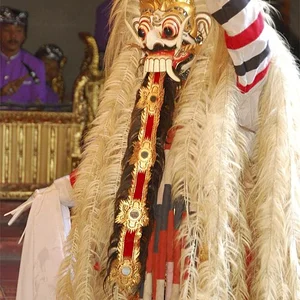
The mask of Rangda, with its wild hair, protruding tongue, and bulging eyes, represents death itself. Balinese priests assert that this mask must never be kept in an ordinary home, lest calamity befall those within.
The dance of the Barong and Rangda is the most complete ritual drama in the Balinese tradition, blending exorcism, theology, and collective catharsis. It cannot be reduced to mere performance.
Key Places
The temple of the dead in Peliatan, one of the sanctuaries that houses an ancient Rangda mask. It is in this type of temple, dedicated to Durga the goddess of death, that exorcism rituals involving Rangda are performed.
The grand mother temple on the slopes of Mount Gunung Agung, the spiritual heart of Bali. This is where the great cosmic ceremonies take place, in which the battle between Rangda and Barong symbolizes the balance of the world.
The legendary location mentioned in the Calon Arang as the village of the witch-widow, the original prototype of Rangda. Some Balinese scholars identify it with sites in the eastern part of the island, where practices of black magic (pengiwa) are still feared.
The ancient capital of the Balinese kingdom during the reign of King Udayana, where Queen Mahendradatta is said to have lived before her exile. This archaeological site holds the earliest inscriptions attesting to the syncretic religious practices that gave rise to the myth of Rangda.
The cultural heart of Bali, where the Barong-Rangda dance is regularly performed both as a living religious ritual and as an expression of Balinese cultural identity. The troupes of Ubud are regarded as the guardians of the most orthodox forms of this sacred drama.
Typical Objects

A sacred carved wooden mask with bulging eyes, a long red tongue, and protruding fangs, adorned with hair made from white hemp fiber. It is kept in the temple of the dead (pura dalem) and may only be handled by a consecrated priest during exorcism rituals.

A wavy-bladed dagger used by dancers in trance during the Barong ritual. Under Rangda's influence, the dancers attempt to stab themselves with the kris; the Barong's protection is believed to render their bodies invulnerable.

A traditional Balinese writing medium on which sacred texts such as the Calon Arang are transcribed. These manuscripts, preserved in temples, serve as liturgical guides for priests who recite invocation and exorcism formulas.

An assembly of flowers, incense, colored rice, and banana-leaf effigies placed at crossroads and in cemeteries to appease the leyaks. These offerings are prepared before sunset so that nocturnal spirits find them upon waking.

A small anthropomorphic effigy crafted by Balinese priests to embody and contain the power of leyak witches during rituals. It is burned or buried at the end of the ceremony to neutralize the invoked forces.

A double-headed membrane drum used to accompany the Barong-Rangda dance. Its syncopated rhythm is believed to open communication with the spirit world and induce a trance state in consecrated dancers.
School Curriculum
Vocabulary & Tags
Key Vocabulary
Daily Life
Morning
In mythology, Rangda reigns over the nocturnal and inverted world. While humans wake, she retreats into cemeteries and sacred forests (alas angker). Balinese priests, for their part, begin their day with ritual ablutions and the preparation of offerings (canang sari) to appease the forces she embodies.
Afternoon
The leyaks, Rangda's servants, are said to hide during daylight hours in ordinary human guises — as neighbors, merchants, or village elders. Ceremonies tied to her cult are prepared in the afternoon in the temples of the dead: crafting offerings, purifying sacred masks, and rehearsing the liturgical chants of the Calon Arang.
Evening
Night is Rangda's absolute domain. At dusk, the leyaks transform and roam the country paths as fireballs or flying heads. Exorcism rituals begin at nightfall, at crossroads or in cemeteries — places at the boundary between the world of the living and the dead.
Food
Rangda and her leyaks are described in ancient texts as feeding on the vital energy of newborns and the organs of corpses, symbolizing death consuming life. During rituals, offerings made to her include raw foods, animal blood, and dishes placed upside down — the inverse of the pure offerings dedicated to the gods of the sky.
Clothing
Rangda's iconography depicts her dressed in a stained white shroud — the color of mourning in Bali — and a skirt made of human skin. Her wild white hair reaches the ground, and her claw-like nails evoke her nature as a supernatural predator. Her ceremonial mask is adorned with feathers and white and blood-red fabrics.
Housing
Rangda dwells in the pura dalem, temples of the dead located at the northern entrance of traditional Balinese villages, facing Mount Agung. Her domain also encompasses the sacred-dangerous zone (sisi kaja-kelod) between the pure world of the mountain gods and the impure world of the sea. Cemeteries shaded by white frangipani trees are her favored places of manifestation.
Historical Timeline
Period Vocabulary
Visual Style
Style pictural du wayang Kamasan balinais — tracés noirs francs, aplats d'ocre, de vermillon et de blanc, rehauts d'or — pour une Rangda terrifiante inscrite dans l'esthétique tantrique hindou-balinaise.
Sound Ambience
Atmosphère nocturne d'un temple balinais des morts lors d'un exorcisme rituel, mêlant musique gamelan envoûtante, chants sacrés en vieux-javanais, sons de transe collective et ambiance tropical nocturne.
Liens externes & ressources
Références
Œuvres
Calon Arang (texte liturgique en vieux-javanais)
XIe-XIIe siècle
Danse rituelle Barong-Rangda (sanghyang)
XIIe-XVe siècle (forme actuelle)
Masques sacrés de Rangda (corpus régional)
XIVe-XVIIIe siècle
Inscriptions du roi Udayana (prasasti)
989-1011
Peintures Kamasan (style classique balinais)
XVe-XIXe siècle