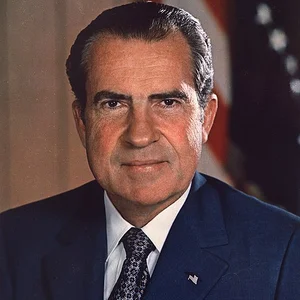

American statesman, 37th President of the United States from 1969 to 1974. He ended the Vietnam War and reopened relations with China, but resigned in the wake of the Watergate scandal.
Richard Nixon(1913 — 1994)
Richard Nixon
États-Unis
6 min read
Frequently asked questions
Famous Quotes
« I am not a crook.»
« When the president does it, that means that it is not illegal.»
Key Facts
- Vice President of the United States under Eisenhower from 1953 to 1961
- Elected 37th President of the United States in 1968, re-elected in 1972
- Historic visit to China in February 1972, rapprochement with Beijing
- Signing of the Paris Peace Accords in 1973, ending American involvement in Vietnam
- Resignation on August 9, 1974 in the wake of the Watergate scandal
Works & Achievements
Historic visit ending more than twenty years of estrangement, which lastingly rebalanced global geopolitics against the USSR.
First treaties limiting the nuclear arms race with the Soviet Union, marking a thaw in the Cold War.
Accords formalizing the withdrawal of American troops from Vietnam, ending the United States' direct military involvement.
Founding of the federal agency responsible for protecting the environment in the United States, still central today.
Suspension of the dollar's convertibility into gold, which transformed the international monetary system.
Memoir in which the former president looks back on his career and his downfall, the first in a series of works published after his resignation.
Series of interviews in which Nixon partially admits his wrongdoing in Watergate, watched by tens of millions of viewers.
Anecdotes
In July 1959, during the American National Exhibition in Moscow, Nixon, then vice president, launched into an impromptu debate with Soviet leader Nikita Khrushchev in front of a model American kitchen. This famous “Kitchen Debate” pitted the capitalist way of life against the communist way of life, household gadgets and all.
In February 1972, Nixon became the first sitting American president to travel to communist China, where he met Mao Zedong. This dramatic visit, after more than twenty years of total estrangement, has remained part of American political language as the example of a bold, unexpected gesture (“Only Nixon could go to China”).
The Watergate scandal began with a bungled break-in: in June 1972, men linked to Nixon's campaign were arrested while planting bugs at the Democratic Party headquarters. The investigation, driven by two Washington Post journalists and their secret source nicknamed “Deep Throat,” gradually traced its way up to the White House.
Nixon had a secret recording system installed in the Oval Office. These tapes, which proved that he had sought to cover up the investigation, became the evidence that brought him down: ordered by the Supreme Court to hand them over, he had to reveal his own involvement.
On August 9, 1974, facing an all but certain impeachment, Nixon became the only president in United States history to resign from office. A month later, his successor Gerald Ford pardoned him for any crimes he might have committed, a highly controversial decision.
Primary Sources
The greatest honor history can bestow is the title of peacemaker. This honor now beckons us.
I have never been a quitter. To leave office before my term is completed is abhorrent to every instinct in my body. But as President, I must put the interests of America first.
The two sides candidly examined the profound differences between them on social issues and foreign policy, and agreed to gradually normalize their relations.
A conversation on June 23, 1972 between Nixon and his chief of staff H. R. Haldeman, in which the president approves the idea of curbing the FBI investigation into the Watergate break-in.
Key Places
Nixon's birthplace, where he was born in 1913 into a modest Quaker family. His childhood home is preserved there today, near his presidential library.
The president's residence and workplace from 1969 to 1974. It was here that the secret Watergate tapes were recorded.
The building housing the Democratic Party headquarters, broken into in 1972. It gave its name to the scandal that brought about Nixon's downfall.
The Chinese capital where Nixon met Mao Zedong in February 1972, reopening relations between the United States and Communist China.
The institution where Nixon earned his law degree in 1937. His training as a lawyer shaped his entire political career.
The city where Nixon died in 1994, at the age of 81, following a stroke. There he had resumed work as a writer and foreign-policy adviser.
Typical Objects

Secret recording system that captured conversations at the White House. These tapes became the decisive proof of Nixon's involvement in the Watergate cover-up.

Direct communication link between the White House and the Kremlin, a symbol of the Cold War. It was used to prevent a misunderstanding from triggering a nuclear war.

American presidential aircraft aboard which Nixon made his historic trips to China and the USSR. It embodies the power and diplomatic mobility of the president.

Secret report on American involvement in Vietnam, whose publication in 1971 triggered a legal battle over freedom of the press. The affair prompted Nixon to create a unit of "plumbers" tasked with stopping leaks.

The central medium of the era, through which Nixon addressed the nation. His 1960 debates and his 1974 resignation speech were watched by millions of Americans.

Treaties signed with the USSR limiting strategic nuclear weapons. The first major step in the "Détente" between the two superpowers.
School Curriculum
Vocabulary & Tags
Key Vocabulary
Tags
Daily Life
Morning
An early riser and tireless worker, Nixon often began his day by reading briefing notes prepared by his advisers. He liked to fill yellow legal pads with pen, reflecting alone on his foreign policy decisions.
Afternoon
His afternoons were structured around meetings with his national security adviser Henry Kissinger, diplomatic talks, and cabinet meetings. Suspicious and solitary, he preferred working in small groups rather than in public.
Evening
In the evening, Nixon frequently retreated to a private office in the building next to the White House to work in peace. He enjoyed listening to classical music and talking on the phone late into the night.
Food
Nixon had simple, American tastes: he liked cottage cheese topped with ketchup at lunch, as well as meat and no-frills dishes. At official dinners, however, he discovered fine French and Chinese cuisine.
Clothing
He almost always wore the dark suit, white shirt, and tie of the American politician. He was mocked for his stiff appearance: he was known, it is said, to walk on the beach in dress shoes and a sport coat.
Housing
As president, he lived in the White House, but liked to retreat to his private properties in Key Biscayne (Florida) and San Clemente in California, nicknamed the “Western White House.” He found peace there, far from the pressure of Washington.
Historical Timeline
Period Vocabulary
Liens externes & ressources
Références
Œuvres
Ouverture diplomatique avec la Chine
1972
Politique de Détente et accords SALT I
1972
Accords de paix de Paris
1973
Création de l'Agence de protection de l'environnement (EPA)
1970
Fin de l'étalon-or (« choc Nixon »)
1971
RN: The Memoirs of Richard Nixon
1978
Entretiens télévisés avec David Frost
1977